


The best Workday Procurement alternatives are 1. Coupa 2. Zip 3. Zapro 4. SAP Ariba 5. Oracle Fusion Cloud Procurement 6. JAGGAER 7. GEP SMART 8. Unimarket 9. Order.co.
The best Workday Procurement alternative depends on what stays in Workday. Teams keeping Workday Financials add Zip for intake or Zapro for mid-market procurement, while large firms replacing Workday's spend suite compare Coupa, GEP SMART or JAGGAER. If your ERP is changing, look at SAP Ariba or Oracle. Universities should check Unimarket.
Workday procurement competitors: key takeaways
 Coupa: Best for large firms replacing Workday's spend suite with a full source-to-pay suite, with Workday named among the ERPs Coupa connects to.
 Zip: Best for teams that keep Workday Financials and add one intake front door for teams such as legal, IT and finance, with Workday in its integration list.
 Zapro: Best for mid-market teams on Workday that want intake, POs, sourcing and contracts from $699 a month, or a supplier portal with no network fees. Workday or your bank still pays suppliers.
 SAP Ariba: Best for firms moving finance onto SAP S/4HANA or SAP Cloud ERP, with SAP Ariba Snap packaged for midsize firms.
 Oracle Fusion Cloud Procurement: Best for firms moving to Oracle Fusion Cloud ERP, with a published list price of $625 per named user per month and a 10-user minimum.
 JAGGAER: Best for sourcing-heavy universities and large firms, with an Advanced Sourcing Optimizer and Workday and Banner among 40+ named ERPs.
 GEP SMART: Best for global firms that want procurement and supply chain planning from one vendor, now sold as GEP Quantum Intelligence (Qi).
 Unimarket: Best for universities and public bodies on Workday, with a fixed yearly pricing model on its E&I contract for higher education and K-12.
 Order.co: Best for multi-location teams buying operating supplies, with one cart across 40,000+ suppliers and a Workday procurement integration.
Workday Procurement alternatives compared
Workday Procurement alternatives fall into four groups. Coupa, GEP SMART and JAGGAER are enterprise suites, SAP Ariba and Oracle are ERP-native suites, Zip and Zapro sit beside Workday, and Unimarket and Order.co are specialist buying tools. The table compares who each is built for, key features, ERP integrations, starting price and G2 rating.
| Tool | Best for | Key features | ERP integrations | Starting price | Rating |
|---|---|---|---|---|---|
 Workday Procurement (for reference) | Procurement inside Workday Financials | Intelligent intake, guided buying, POs, 2-, 3- and 4-way matching; Strategic Sourcing with RFx and reverse auctions; Evisort-powered CLM | Workday Financials; Strategic Sourcing works with any finance or procurement system | Quote only, sold by module | G2 4.5 (35) |
| Coupa | Enterprise source-to-pay | Intake, sourcing, contracts, POs, 2-way and 3-way matching, supplier portal, payments through partners | SAP, Oracle, NetSuite, Workday, Dynamics | Quote; Vendr buyer data: median $94,519 a year | G2 4.2 (571) |
| Zip | Intake and approval orchestration | Intake front door, AI RFx with weighted scoring, contract orchestration, supplier onboarding, POs; payments add-on | Workday, SAP S/4HANA, Oracle Fusion, NetSuite, Sage Intacct, Business Central | Quote; Vendr buyer data: median $88,856 a year | G2 4.6 (153) |
| Zapro | Mid-market suite or the supplier side | Intake, approvals, POs, RFI/RFP sourcing, contracts, 2-way and 3-way matching, supplier portal with no network fees | Workday Financials and Workday HCM, NetSuite, SAP, Oracle, Sage Intacct, Dynamics | $699 per month, unlimited users | G2 4.7 (14) |
| SAP Ariba | Global firms on SAP ERP | Sourcing, contracts, supplier lifecycle, guided buying, intake, invoicing; Snap package for midsize firms | SAP S/4HANA and SAP Cloud ERP | Quote only, through SAP or partners | G2 4.1 (818) |
| Oracle Fusion Cloud Procurement | Oracle Fusion ERP firms | Self-service buying, sourcing, contracts, purchasing, supplier management | Built into Oracle Fusion Cloud ERP | $625 per user per month list, 10-user minimum | G2 4.1 (38) |
| JAGGAER | Complex sourcing, higher education | Advanced Sourcing Optimizer, contracts, punch-out catalogs, 3-way matching, supplier onboarding | Workday, SAP, Oracle, Infor, NetSuite, Banner; 40+ ERPs | Quote by module; full rollout 6 to 9 months | G2 4.1 (86) |
| GEP SMART | Procurement plus supply chain | Intake, POs, sourcing, contracts, supplier risk, N-way invoice matching; now sold as GEP Quantum Intelligence | Workday, SAP ECC and S/4HANA, Oracle, NetSuite, Dynamics, Infor | Quote; GEP says SMART terms are unchanged under Qi | G2 4.3 (27) |
| Unimarket | Universities and public bodies | Sourcing, catalog buying, requests, contracts, invoices, expenses, payments | Workday, Ellucian Banner and Colleague, Oracle, TechnologyOne, SAP | Quote; fixed yearly pricing on the E&I contract | G2 4.5 (64) |
| Order.co | Multi-location supply buying | One cart across 40,000+ suppliers, approvals, POs, vendor-locked virtual cards, one consolidated bill | Workday procurement integration; QuickBooks Online, NetSuite, Sage Intacct | Quote only; no pricing page | G2 4.4 (155) |
Find your Workday Procurement alternative
Choose a Workday Procurement alternative by deciding what stays in Workday. Teams that keep Workday Financials usually add one tool for intake, sourcing or suppliers, while teams changing ERP or replacing Workday's spend suite compare full suites. Pick the tab that fits your job, company size, ERP or budget, then check the reasons teams switch below.
What you use Workday Procurement for
ZipZaproJAGGAERCoupaZaproCoupaZipZaproOrder.coUnimarketCoupaZaproCompany size
ZaproOrder.coUnimarketJAGGAERCoupaSAP AribaGEP SMARTYour ERP
ZipCoupaZaproSAP AribaOracle Fusion Cloud ProcurementZipOrder.coZipGEP SMARTBudget
ZaproZipCoupaOracle Fusion Cloud ProcurementSAP AribaJAGGAERGEP SMARTUnimarketOrder.coWhy teams leave Workday Procurement, and what fixes it
Teams look past Workday Procurement mainly when they leave Workday Financials, need intake for legal and security reviews, want named punch-out suppliers or want a price before the sales call. G2 lists Workday Strategic Sourcing and Spend Management, not Procurement alone, so these reasons come from Workday's own pages, read on 11 and 12 November 2026.
What Workday does well, per its own pages: Supplier Management for onboarding and risk, spend dashboards, 2-way, 3-way and 4-way matching, Evisort-powered contract AI and VNDLY for contingent labor. Workday says most Strategic Sourcing customers launch their first event within 30 days, and G2 rates Strategic Sourcing 4.5 from 35 reviews.
What Workday Procurement doesn't cover, and who does
Workday Spend Management covers sourcing, contracts, suppliers, procure-to-pay, inventory and travel and expense, so its gaps are about price, catalogs, payments and supply chain, not core features. The table shows where Workday's pages stop and which alternatives fill each gap, so you only add a tool where Workday falls short.
| If you need | In Workday Procurement | Alternatives that include it |
|---|---|---|
| Published prices before the sales call | Quote only, sold by module | Oracle Fusion Cloud ProcurementZapro |
| Named punch-out suppliers such as Amazon Business | Catalog or marketplace results in guided buying | Coupa Amazon BusinessJAGGAERZapro |
| Supplier payments from the procurement tool | Payables run in Workday Financials | CoupaZipUnimarketOrder.co |
| Supply chain planning with procurement | Spend Management modules: sourcing, contracts, suppliers, P2P, inventory, travel and expense | GEP SMART |
The 9 best Workday Procurement alternatives, reviewed
Each review below shows what the tool is built for, its key features, pros, cons, pricing and the buyer it fits best. Coupa, GEP SMART and JAGGAER cover enterprise source-to-pay, and SAP Ariba and Oracle cover buying on their own ERPs. Zip and Zapro work beside Workday, while Unimarket and Order.co cover institution and supply buying.
Coupa: best for enterprise source-to-pay
Best for Enterprise source-to-pay
Coupa fits large firms that want to replace Workday's spend suite with a full source-to-pay suite and keep Workday Financials as the ledger. It covers intake, sourcing, contracts, AP, expenses and payments through partners, and names Workday among its ERPs. Coupa says most rollouts take a matter of months.
Key features 6 features
- Intake and Orchestration with AI-guided intake
- Sourcing and advanced sourcing optimization
- Contracts enforced at the time of purchase
- Any-format invoice capture with 2-way and 3-way matching
- Open Buy and Amazon Business punch-out
- Payments and virtual cards through payment partners
Pros and cons 3 pros, 3 cons
Pros
- Ease for requesters: 12 of 30 recent Coupa reviewers we read called it easy for everyday buyers, which matters when many staff only buy now and then
- Workday on the list: Coupa names Workday with SAP, Oracle, NetSuite and Dynamics, so it can run on Workday Financials or after an ERP change
- Wide suite: sourcing, contracts, buying, AP and expenses sit in one platform, so large teams can replace several Workday modules with one vendor
Cons
- No published prices: coupa.com shows no plans, so the Vendr median of $94,519 a year is the main public guide to cost
- Long rollouts: Coupa says implementations take a matter of months with partners, so plan for consulting fees and internal time
- Interface complaints: 11 of the 30 Coupa reviews we read called it complex or dated, so test the screens your buyers use
Pricing
Quote only, by module. Vendr buyer data shows a median of $94,519 a year across 128 purchases, from $20,804 to $331,084.
Best for
Large firms that want to replace Workday's spend suite with a full suite while Workday Financials stays the ledger, and can staff a multi-month rollout.
Verdict
Verdict: Coupa is a like-for-like swap for Workday's spend modules at enterprise scale. It costs more and takes longer than adding one tool beside Workday.
Zip: best for intake and approval orchestration
Best for Intake and approval orchestration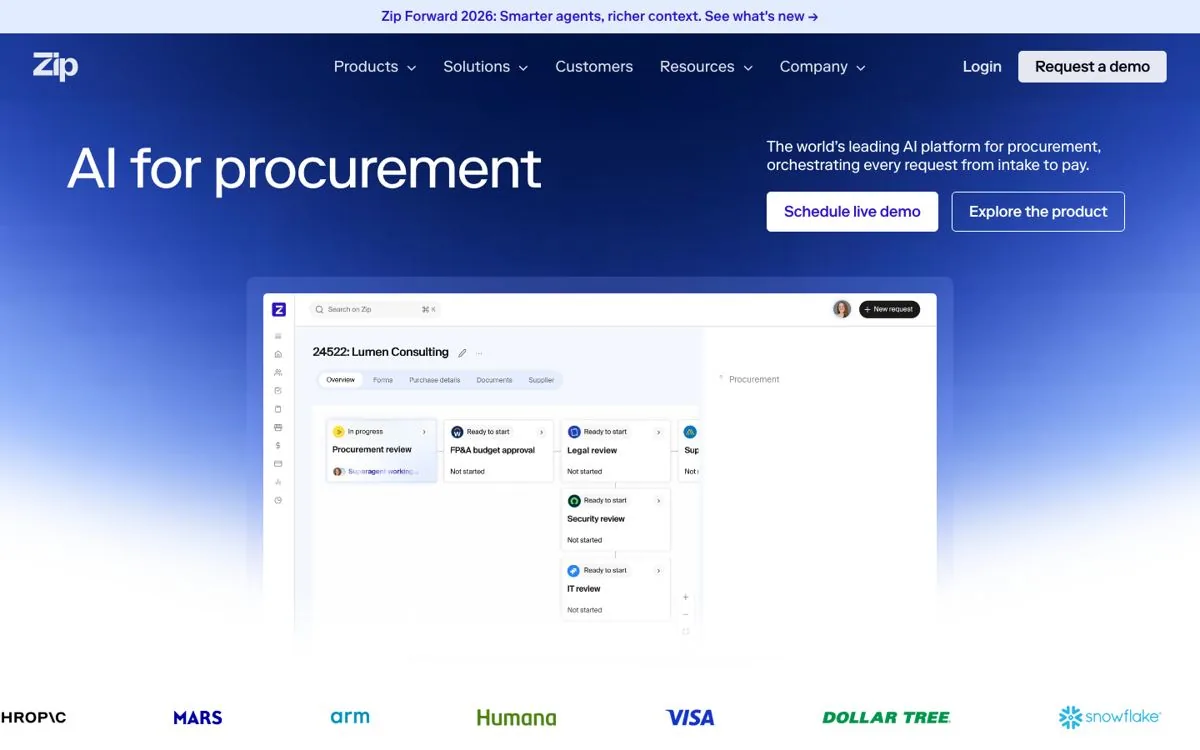
Zip fits teams that keep Workday Financials and need one intake front door for software and services buying. It routes each request through teams such as legal, IT and finance, and lists Workday, SAP S/4HANA and Oracle Fusion among its integrations. It is quote-only, and Vendr buyer data puts the median at $88,856 a year.
Key features 4 features
- Intake with AI-completed request forms and routing
- AI RFx generation with weighted supplier scoring
- Contract orchestration with AI redlines and DocuSign e-signature
- Global Payments add-on with 79+ international rails
Pros and cons 3 pros, 3 cons
Pros
- Intake front door: 11 of the 28 Zip reviews we read praised one intake point with full request visibility, which replaces requests by email and Slack
- Sits in front of Workday: Zip lists Workday in its integrations, so you can fix intake without replacing Workday Financials
- Approval changes: 11 of the 28 reviewers praised no-code approval workflows, so admins can change routing without a services project
Cons
- Reporting: 10 of the 28 Zip reviews we read called its reports limited or rigid, so check the spend views you need in the demo
- No published prices: zip.com has no pricing page, so the Vendr median of $88,856 a year is the main public guide
- Second tool next to Workday: you pay for Zip on top of Workday, so compare the combined cost with a single suite
Pricing
Quote only: Vendr says Zip quotes a platform fee plus per-seat pricing. Vendr buyer data shows a median of $88,856 a year across 78 purchases, from $27,776 to $220,210.
Best for
Teams on Workday Financials whose pain is the intake and review stage, especially software and services buying that crosses legal, IT and finance.
Verdict
Verdict: Zip fixes intake in front of Workday without a suite swap. Its Vendr median of $88,856 a year is suite-level spend, so compare it with the total of a single suite.
Zapro: best for mid-market suite or the supplier side
Best for Mid-market suite or the supplier side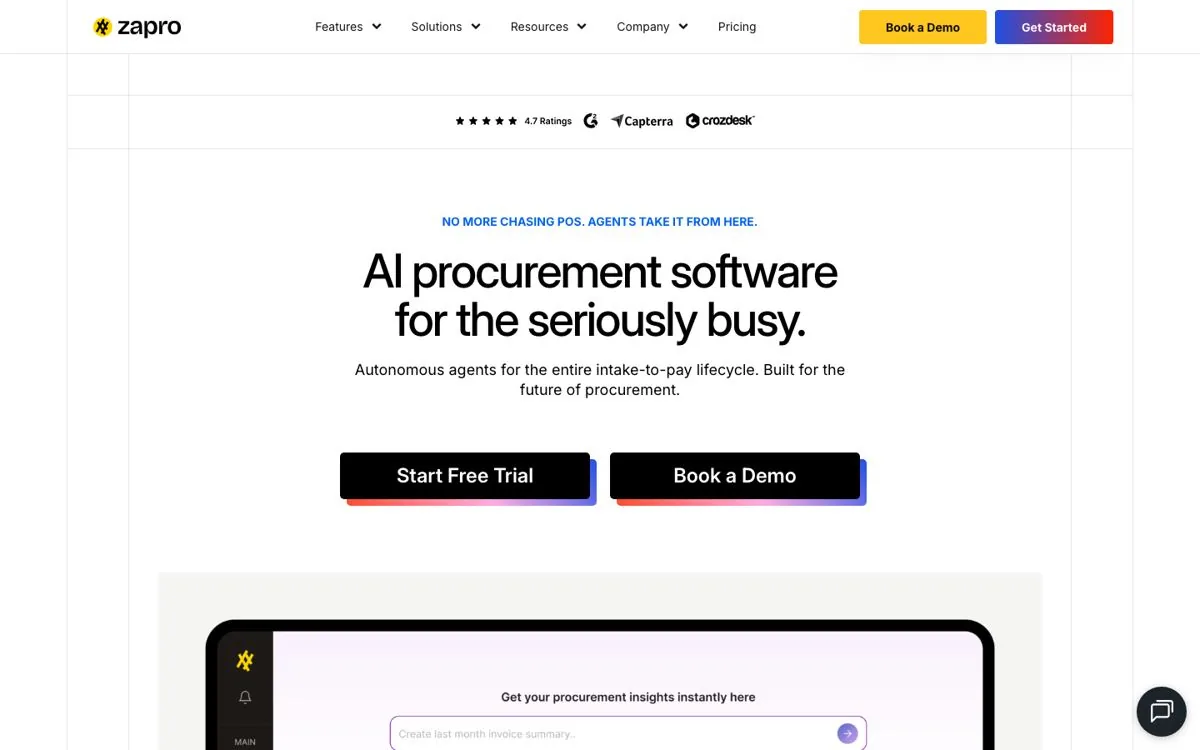
Zapro is a strong Workday Procurement alternative for mid-market teams whose gap is intake, POs, sourcing, contracts or suppliers. This AI-native procurement software integrates with Workday Financials and Workday HCM, with unlimited users from $699 a month. Workday or your bank pays suppliers.
Key features 5 features
- Keep AP in Workday, run full procure-to-pay in Zapro, or use it only as the supplier portal
- Approval limits that change on a promotion's effective date in Workday HCM
- RFI and RFP events on every plan; auctions on Scale
- Contracts with renewal alerts; contract authoring on Growth
- 2-way and 3-way matching with an exception queue (3-way on Growth and up)
Pros and cons 3 pros, 2 cons
Pros
- Unlimited users: every plan includes unlimited users, so occasional approvers never add to the monthly bill
- HR-aware approvals: approvals re-route on a manager change in Workday HCM, so chains stay right after a reorganization
- Supplier side: onboarding, one supplier record and a supplier portal with no network fees can run next to Workday
Cons
- No payments: Zapro prepares payment batches, but Workday or your bank sends the money to suppliers
- Vendor caps: Spark allows 50 active vendors and Growth 500, so supplier-heavy teams need Scale
Pricing
Spark $699 a month (up to 50 vendors), Growth $1,999 a month (up to 500 vendors), Scale on custom pricing, as published on zapro.ai in November 2026. The pricing page lists 3-way matching and contract authoring in the Growth plan's AI suite.
Best for
Mid-market teams of 50 to 200 people on Workday Financials that want intake, sourcing, contracts and matching at a published price, or a no-fee supplier portal.
Verdict
Verdict: Pick Zapro if you are a mid-market Workday customer that wants procurement without an enterprise suite. Large global rollouts fit Coupa or GEP SMART better.
SAP Ariba: best for global firms on SAP ERP
Best for Global firms on SAP ERP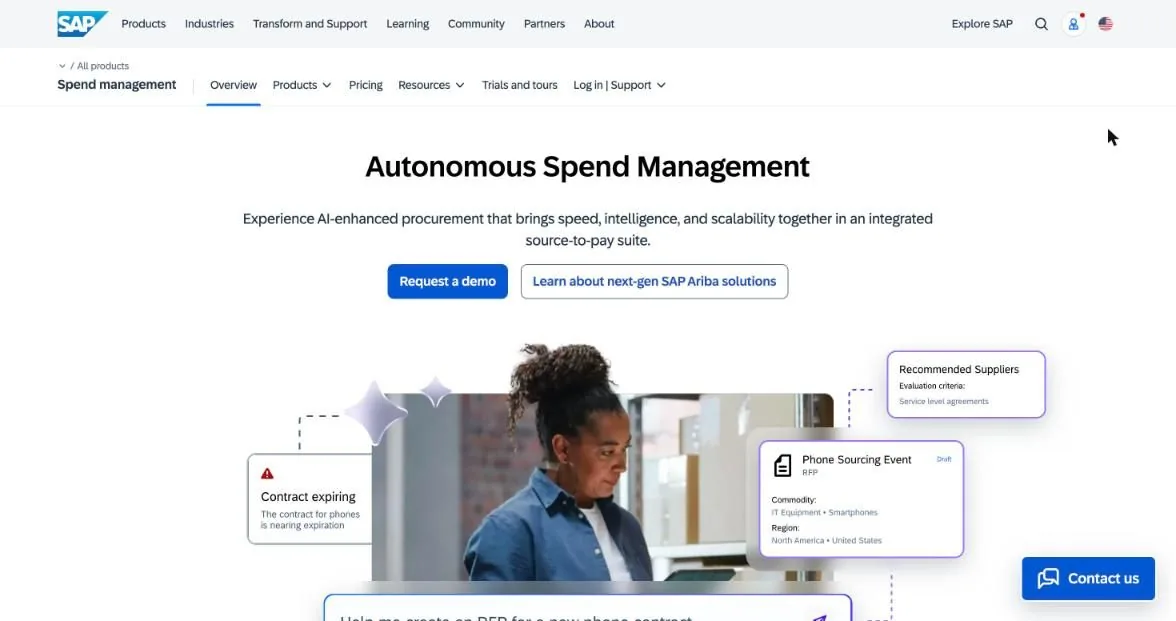
SAP Ariba fits firms that run, or are moving to, SAP S/4HANA or SAP Cloud ERP and want a full source-to-pay suite built around it. It covers sourcing, contracts, supplier lifecycle, guided buying, intake and invoicing, and Ariba Snap is packaged for midsize firms. SAP sells it by quote, directly or through partners.
Key features 5 features
- Intake Management and guided buying
- Ariba Sourcing and Ariba Contracts
- Supplier Lifecycle and Performance with 360-degree supplier profiles
- SAP Business Network for orders, invoices and supplier collaboration
- Joule AI assistants, announced in May 2026
Pros and cons 2 pros, 3 cons
Pros
- Whole process in one place: 6 of the 22 Ariba reviewers we read praised having all of procure-to-pay in one system, which suits large buying teams
- Midsize package: SAP says Ariba Snap can start controlling spend in as few as 12 weeks, delivered through partners
Cons
- Too many clicks: 8 of the 22 Ariba reviews we read said simple buys take too many steps, so count the clicks in the demo
- Supplier fees: enterprise suppliers pay SAP Business Network fees past 5 documents and $50,000 with one buyer, so ask what your suppliers will pay
- SAP-first fit: SAP's pages center on SAP S/4HANA and SAP Cloud ERP, so test the connection if you stay on Workday Financials
Pricing
Quote only, sold by SAP or partners. SAP says Ariba Snap is packaged and priced for midsize firms.
Best for
Firms that run or are moving to SAP S/4HANA or SAP Cloud ERP and want sourcing, contracts and buying in one SAP suite.
Verdict
Verdict: SAP Ariba makes sense when SAP becomes your ERP. If Workday Financials stays, a tool that names Workday fits better.
Oracle Fusion Cloud Procurement: best for Oracle Fusion ERP firms
Best for Oracle Fusion ERP firms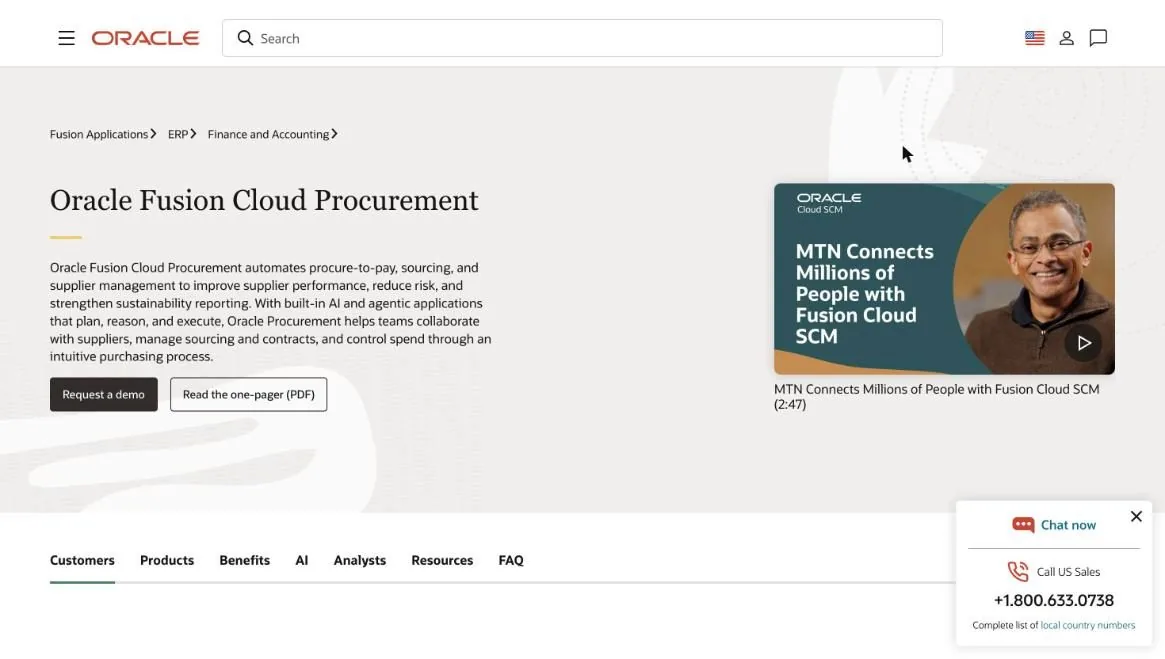
Oracle Fusion Cloud Procurement fits firms that run, or are moving to, Oracle Fusion Cloud ERP. It covers sourcing, contracts, self-service buying, purchasing and supplier management, while payables run in Oracle Fusion ERP. Oracle's price list shows $625 per named user per month, with a 10-user minimum.
Key features 4 features
- Guided self-service buying with smart forms
- Sourcing with bid ranking and supplier suggestions
- Oracle Enterprise Contracts: authoring, e-signature and renewals
- Supplier portal with onboarding, qualification and risk checks
Pros and cons 2 pros, 3 cons
Pros
- One Oracle system: suppliers, POs and payables share Oracle Fusion ERP, so there is no connector between procurement and finance to maintain
- Published list prices: Oracle's global price list shows per-user prices, so you can estimate cost before talking to sales
Cons
- Per-user cost: $625 per named user per month with a 10-user minimum is $75,000 a year at list, before other modules
- Oracle-only fit: it is built into Oracle Fusion Cloud ERP, so it does not suit teams staying on Workday Financials
- Long commitment: the standard term is three years and each module is licensed on its own, so model the full term
Pricing
Oracle's global price list (5 November 2026) shows $625 per named user per month, with a 10-user minimum. Self Service is $8 per user per month, with a 100-user minimum.
Best for
Firms leaving Workday Financials for Oracle Fusion Cloud ERP that want buying, suppliers and payables in one Oracle system.
Verdict
Verdict: Oracle is the right swap only if Oracle Fusion becomes your ERP. On Workday Financials, its value drops.
JAGGAER: best for complex sourcing, higher education
Best for Complex sourcing, higher education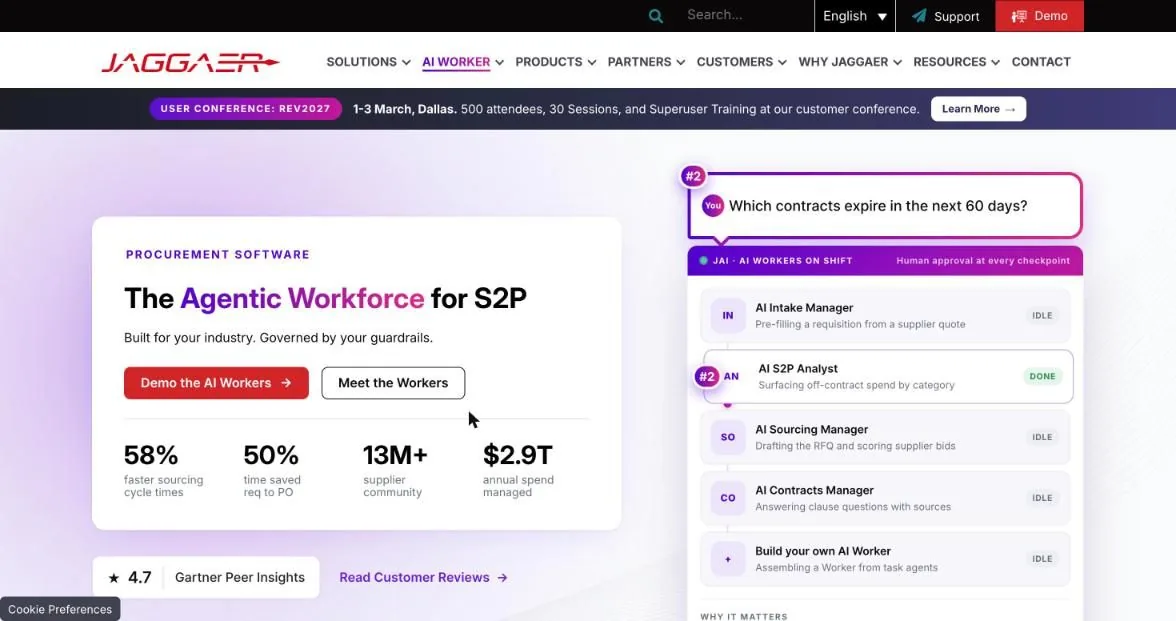
JAGGAER fits campuses and complex firms that run heavy sourcing next to Workday. JAGGAER One covers sourcing with an Advanced Sourcing Optimizer, contracts, catalogs, AP with 3-way matching and supplier onboarding, and names Workday and Banner among 40+ ERPs. A full rollout takes 6 to 9 months, per JAGGAER.
Key features 3 features
- Advanced Sourcing Optimizer and an AI Sourcing Manager
- Hosted and punch-out catalogs over cXML
- Encumbrance and fund checks for the public sector
Pros and cons 3 pros, 3 cons
Pros
- Sourcing depth: the Advanced Sourcing Optimizer handles complex multi-category bids, which matters if sourcing is your main Workday gap
- Campus fit: it names Banner and Workday among its ERPs and serves higher education, so campuses can keep their finance system
- Supplier enablement: JAGGAER says supplier enablement comes at no extra cost, which helps when you onboard many suppliers
Cons
- Long rollout: JAGGAER states 6 to 9 months for a full source-to-pay program, so plan for a long project
- Quote only: it is sold by module on a custom quote, so you only learn the cost in a sales call
- Review score: G2 shows 4.1 from 86 reviews, below Workday Strategic Sourcing's 4.5, so ask for references in your sector
Pricing
Quote only, sold by module. JAGGAER states 12 to 16 weeks for a single source-to-contract module and 6 to 9 months for full source-to-pay.
Best for
Campuses, research institutes and complex firms on Workday that run heavy sourcing events and can staff a long rollout.
Verdict
Verdict: JAGGAER suits sourcing-heavy teams that keep Workday Financials. For teams that mostly raise POs, it is more suite than they need.
GEP SMART: best for procurement plus supply chain
Best for Procurement plus supply chain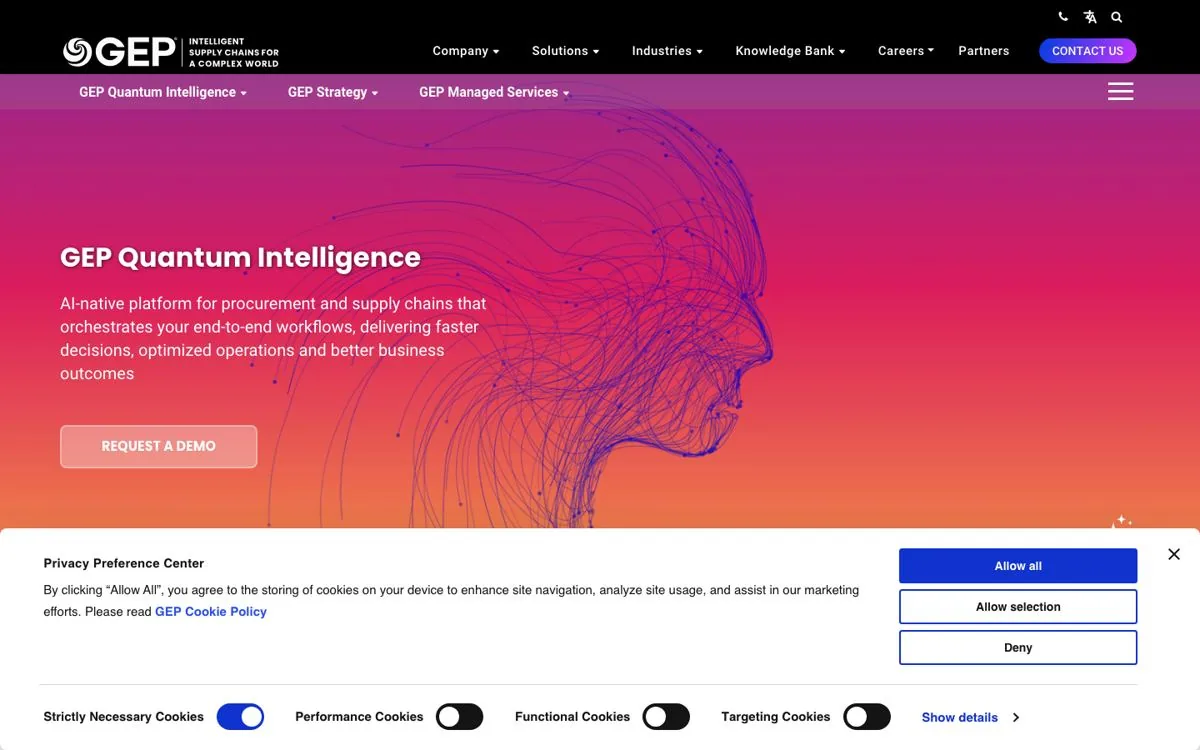
GEP SMART fits global firms that want source-to-pay and supply chain tools from one vendor. GEP is folding it into GEP Quantum Intelligence (Qi), says SMART stays fully supported with no forced move, and names Workday, SAP, Oracle and NetSuite among its ERPs. GEP shows no prices and sells through demos.
Key features 4 features
- Sourcing, contracts and third-party risk
- Intake with guided buying agents
- Invoice processing with N-way matching and tax validation
- Supply chain management on the same platform
Pros and cons 3 pros, 2 cons
Pros
- Analyst standing: GEP sits in the Leaders quadrant of Gartner's 2026 Magic Quadrant for source-to-pay suites, a useful check for an enterprise shortlist
- Broad ERP list: it names Workday, SAP, Oracle, NetSuite, Dynamics and Infor, which suits groups running several ERPs
- Supply chain too: procurement and supply chain sit on one platform, so you avoid a second vendor for planning
Cons
- Quote only: GEP shows no prices, so you need a sales call, though it says SMART terms stay the same under Qi
- Changing platform: the product name and platform are moving to Qi, so ask what your contract covers after the move
Pricing
Quote only. GEP says SMART pricing and terms stay the same during the move to Qi.
Best for
Global firms with several ERPs that want procurement and supply chain planning from one vendor and can staff a large rollout.
Verdict
Verdict: GEP fits global firms that want procurement and supply chain together. Teams that mainly raise POs will use a small part of it.
Unimarket: best for universities and public bodies
Best for Universities and public bodies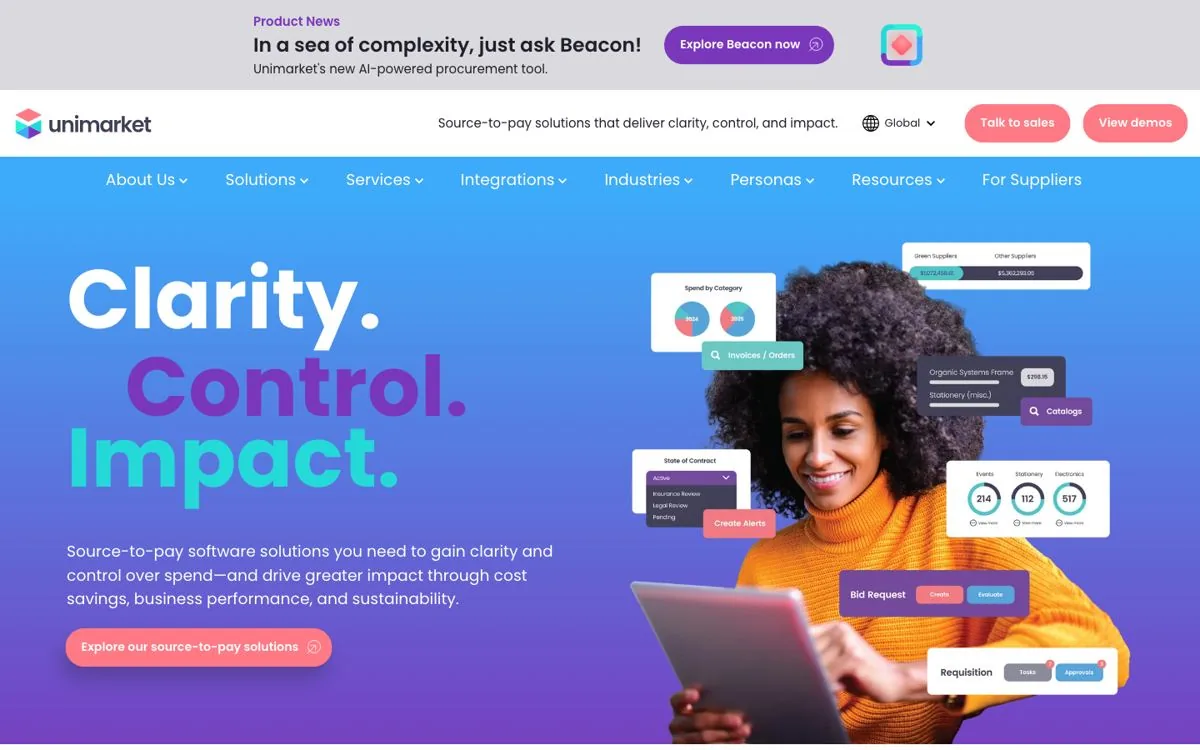
Unimarket fits colleges, schools and public bodies on Workday Financials that want catalog buying, contracts and supplier payments in one tool. It lists Workday next to Ellucian Banner, Colleague and Oracle among its ERP links. It is quote-only, with a fixed yearly pricing model on its E&I contract for higher education and K-12.
Key features 4 features
- Source module from planning and supplier discovery to award
- Marketplace with multi-catalog buying
- Contracts with AI term extraction and e-signature
- Supplier payments with fraud prevention
Pros and cons 2 pros, 2 cons
Pros
- Cooperative contract: it sells through an E&I contract for higher education and K-12, so campuses can buy through a cooperative agreement
- Fixed yearly price: the E&I contract says usage expands across users and suppliers at no additional cost, so adding requesters does not raise the bill
Cons
- Quote only: Unimarket shows no prices on its site, so buyers outside the E&I contract need a sales call to learn the cost
- Sector focus: its site leads with education, healthcare and government, so corporate teams should ask for references in their own sector
Pricing
Custom quote from sales. The E&I contract (CR001502, to October 2030) uses a fixed annual pricing model, and you license only the modules you need.
Best for
Colleges, K-12 districts and public bodies on Workday Financials that want catalog buying, contracts and supplier payments from a vendor built for them.
Verdict
Verdict: Unimarket suits Workday campuses that buy through E&I. Corporate teams will find tools built for them elsewhere on this list.
Order.co: best for multi-location supply buying
Best for Multi-location supply buying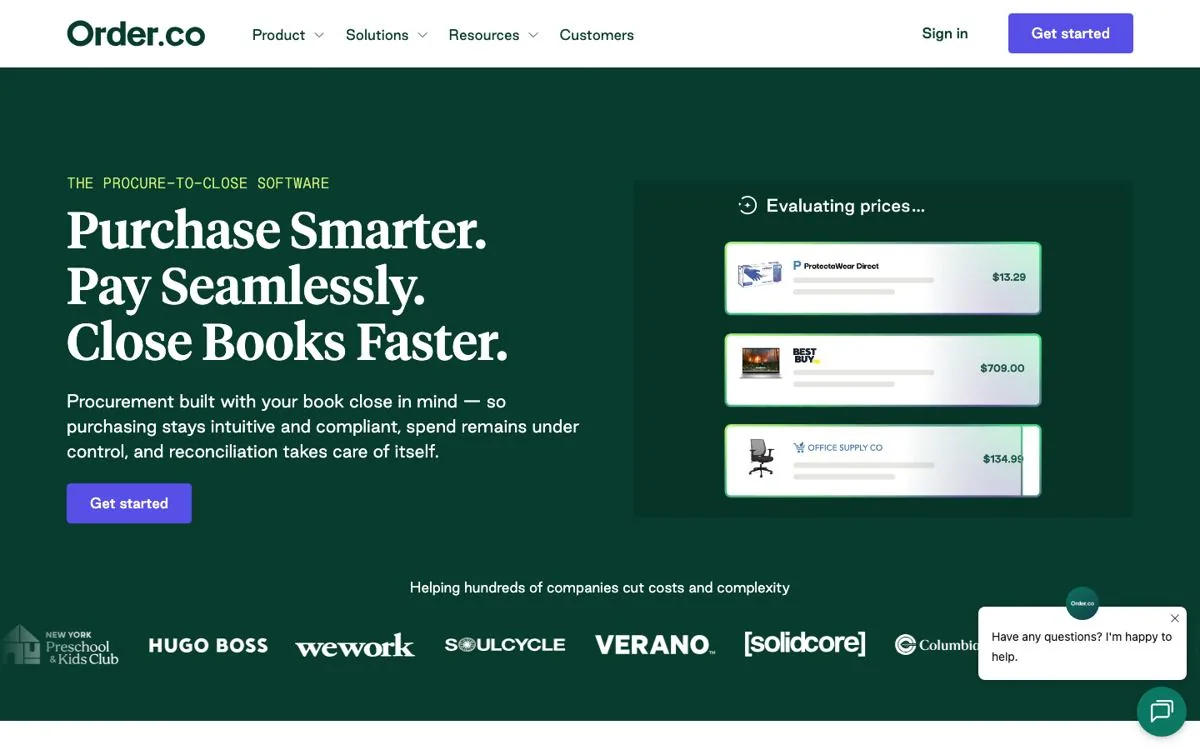
Order.co fits multi-location teams that buy the same operating supplies at many sites. Staff order from one cart across their own vendors and a network of 40,000+ suppliers, and Order.co pays the vendors and sends one consolidated bill. It lists a Workday procurement integration, but it runs no RFx events or auctions.
Key features 3 features
- Approval rules by location, cost center, role or spend
- Vendor-locked virtual cards with AI receipt matching
- AI Sourcing that suggests cheaper vendors for the same items
Pros and cons 2 pros, 3 cons
Pros
- One place to buy: 13 of the 30 Order.co reviewers we read praised buying from many vendors in one login, which suits store and office managers
- Fast start: Order.co says most mid-market multi-location firms go live in 4 to 6 weeks, including ERP connections and catalogs
Cons
- Catalog gaps: 8 of the 30 reviews we read cited out-of-stock items or poor substitutions, so test your most-ordered items first
- Light on sourcing and contracts: it has no RFx events and only basic contract tracking, so services buying needs another tool
- No pricing page: Order.co quotes each customer, so ask for its fee on top of supplier costs before you compare
Pricing
Custom quote; there is no pricing page. Ask for Order.co's fee on top of supplier costs, and its payment terms.
Best for
Operations leaders at multi-site businesses on Workday, such as clinics, schools or coworking spaces, that buy the same supplies across many locations.
Verdict
Verdict: Order.co fits when supply buying across sites is the whole job. Look elsewhere for services, sourcing or contracts.
Also worth a look: Procurify, a mid-market procure-to-pay tool that Google's AI Overview names for this search. It covers requests, POs, receiving, an AP add-on with 2-way and 3-way matching and payments to 190+ countries, and its integrations page lists NetSuite, QuickBooks, Sage Intacct and Business Central. It prices by quote.
Workday Procurement alternatives: feature-by-feature comparison
Compare Workday Procurement alternatives on the source-to-pay work you run every day: requests and POs, sourcing and contracts, invoice capture and matching, supplier onboarding and supplier payments. Order.co is a supply-buying tool rather than a source-to-pay suite, so it is compared in the main table above instead.
| Tool | Requests and POs | Sourcing and contracts | Invoice capture and matching | Supplier onboarding | Supplier payments |
|---|---|---|---|---|---|
| Workday Procurement | Intelligent intake, guided buying and supplier POs | Strategic Sourcing with RFx and reverse auctions; Evisort-powered CLM | 2-way, 3-way and 4-way matching | Supplier Management: onboarding, performance and risk | Payables in Workday Financials |
| Coupa | Guided intake, requisitions and POs with PO Collaboration | Sourcing, sourcing optimization and a central contract repository | Any-format capture; 2-way and 3-way matching | Supplier Portal self-registration; risk and performance module | Payments and virtual cards through payment partners |
| Zip | Intake front door; PO generation and change orders | AI RFx generation; contract orchestration with renewal alerts | AI extraction from email; flags duplicates and overages | Guided supplier portal with bank and TIN checks | Global Payments add-on with 79+ international rails |
| Zapro | Intake, catalog, Amazon Business punch-out, request to PO | RFI and RFP on every plan; contract authoring on Growth | OCR capture; 2-way matching, 3-way on Growth | Onboarding, one supplier record, portal with no network fees | Prepares the payment batch; Workday or your bank pays |
| SAP Ariba | Intake Management and guided buying | Ariba Sourcing and Ariba Contracts | Invoicing, plus an announced AI Invoicing Assistant | Supplier Lifecycle and Performance, 360-degree supplier profiles | SAP Business Network for orders, invoices and supplier collaboration |
| Oracle Fusion Cloud Procurement | Self-service buying with smart forms; Purchasing module | Sourcing with bid ranking; Oracle Enterprise Contracts | AP automation in Oracle Fusion ERP, outside Procurement | Supplier portal with onboarding, qualification and risk | Payables in Oracle Fusion Cloud ERP |
| JAGGAER | Guided buying, requisitions and POs | Advanced Sourcing Optimizer and contract management | Digital capture, autonomous AP and 3-way matching | Supplier Intelligence onboarding with an AI autofill agent | Scheduled payments, virtual card and premium ACH |
| GEP SMART | Intake and guided buying; automatic PO creation | Sourcing and contract management modules | Invoice processing with N-way matching | Supplier management and third-party risk | Payment runs and virtual cards through ERP integration |
| Unimarket | Requisitions, Policy Guide and POs; catalog marketplace | Source module to award; contracts with AI extraction | AI invoice extraction; rules-based matching | Supplier directory with onboarding, vetting and screening | Supplier payments with fraud prevention |
How Workday Procurement alternatives charge
Workday Procurement pricing is a custom quote by module, and most suites quote the same way. Oracle publishes per-user list prices, Vendr buyer data shows medians for Coupa and Zip, and Zapro publishes flat monthly plans. Compare at your real volume and over three years, for example against flat Zapro pricing.
| Tool | Pricing model | Starting price |
|---|---|---|
| Workday Procurement | Custom quote by module | Quote only |
| Coupa | Custom quote by module | Vendr median $94,519 a year |
| Zip | Platform fee plus seats; payments and vendor cards as add-ons | Vendr median $88,856 a year |
| Zapro | Flat monthly plan by active vendors; unlimited users | $699 per month |
| SAP Ariba | Custom quote, through SAP or partners | Quote only |
| Oracle Fusion Cloud Procurement | Per named user per month, three-year term | $625 per user per month list |
| JAGGAER | Custom quote by module | Quote only |
| GEP SMART | Custom quote, sold through demos | Quote only |
| Unimarket | Custom quote; fixed yearly pricing on the E&I contract | Quote only |
| Order.co | Custom quote | Quote only |
Questions to ask any Workday Procurement alternative
Before you choose a Workday Procurement alternative, ask every vendor five questions in writing. What syncs with Workday Financials, and how often? Does it read Workday HCM for approvers? Do we keep AP in Workday? How long until the first PO and sourcing event? What is the three-year cost? Strong answers are specific and dated.
| Question | Why it matters | What a strong answer includes |
|---|---|---|
| What exactly syncs with Workday Financials, and how often? | Suppliers, POs, receipts and invoices must match the ledger. | A list of objects, sync direction and timing. |
| Does it read Workday HCM for approvers? | Approval chains break when people change roles. | Approvers and limits updated from HCM automatically. |
| Do we keep AP in Workday or move it? | Moving AP changes your month-end close. | Both options shown, with who runs the payment. |
| How long until our first PO and first sourcing event? | Vendor timelines range from 30 days to 9 months. | A dated plan with your team's hours estimated. |
| What is the 3-year total cost? | Module and seat pricing grows with scope. | A 3-year quote with implementation on its own line. |
Which Workday Procurement alternative should you choose in 2027?
The best Workday Procurement alternative depends on what stays in Workday. If Workday Financials stays and intake is the gap, start with Zip, or Zapro on a mid-market budget. To replace Workday's spend suite, compare Coupa and GEP SMART, or SAP Ariba and Oracle if your ERP is changing. Universities should look at JAGGAER or Unimarket.
A practical shortlist: one intake layer (Zip or Zapro) if you keep Workday for the rest, or one full suite (Coupa or GEP SMART) if you replace Workday's spend suite. Size the savings with the procurement ROI calculator, then run the same request, PO and invoice through Workday in each demo.
Frequently asked questions
Does Workday have a procurement module?
Yes. Workday Procurement is one module of Workday Spend Management. Workday sells it next to Strategic Sourcing, contracts (CLM), Supplier Management, Inventory and Travel and Expense. Procurement covers intake, guided buying, POs and 2-way, 3-way and 4-way matching.
What is the best alternative to Workday Procurement?
Coupa suits large firms that want to replace Workday Spend Management with a full suite. Zip suits teams that keep Workday Financials and need better intake, and Zapro suits mid-market teams on Workday. SAP Ariba or Oracle fit if your ERP is moving to SAP or Oracle.
Who are Workday Procurement's main competitors?
Workday Procurement's main competitors are Coupa, SAP Ariba, Oracle Fusion Cloud Procurement, JAGGAER and GEP SMART in enterprise source-to-pay. Zip competes on intake, Procurify and Zapro compete in the mid-market, and Unimarket competes in higher education and the public sector.
What is Workday's biggest competitor?
In procurement, SAP Ariba, Oracle and Coupa are Workday's biggest rivals. Google's AI Overview lists all three as the major enterprise suites among Workday competitors in procurement. In HR and payroll, related searches point to Rippling, BambooHR, Paylocity and Dayforce instead.
What are the top 5 procurement software tools?
Coupa, SAP Ariba, Oracle Fusion Cloud Procurement, JAGGAER and GEP SMART are the five enterprise tools Google's AI Overview names for Workday buyers. Mid-market teams more often compare Procurify, Zip and Zapro, which cost less and go live faster than a full suite.
What are some good alternatives to Workday?
For procurement, Coupa, Zip and Zapro work next to or instead of Workday Spend Management. For Workday HR, related searches point to Rippling, BambooHR, Paylocity and Dayforce, and firms replacing Workday Financials often look at SAP or Oracle ERP with their own procurement suites.
Can Workday Strategic Sourcing work without Workday Financials?
Yes. Workday says Strategic Sourcing integrates with any finance or procurement system, and that most Strategic Sourcing customers launch their first sourcing event within 30 days. Its pages present Workday Procurement itself inside Workday Financials, so ask how P2P runs on another ERP.
Keep Workday Financials, upgrade procurement
See how Zapro runs intake, approvals, sourcing and 3-way matching next to Workday for a mid-market team, with unlimited users on every plan.
Sources: Workday Spend Management; Workday Strategic Sourcing; ERP Research: procurement software for Workday; Coupa pricing on Vendr; Zip pricing on Vendr; Oracle Fusion Cloud global price list.