As businesses expand, their purchasing activities tend to get more complicated. Processes that relied on emails, spreadsheets, or informal approvals simply can no longer handle the increasing volume of spending and the complexity of the supplier base. Purchase Order Management Best Practices become essential as purchase order lifecycle management grows in scale. Purchase order management is often the first area where this growing complexity is felt.
Neglected purchase orders cause a chain reaction of problems, such as delayed approvals, invoice mismatches, budget overruns, and a breakdown in supplier relationships. Conversely, diligent purchase order management, supported by PO management best practices, is the foundation of structure, visibility, and control within procurement operations.
In this article, you will learn about purchase order management best practices, their significance, the common problems faced by the teams, and the role of automation in scaling purchase order management in organizations through digital purchase order management.
Platforms like Zapro AI are designed to standardize this purchase order lifecycle automatically, from creation through approval and matching.
What Is Purchase Order Management?
Purchase order management encompasses all the activities involved in purchase orders from their initiation to closure, including creating, approving, issuing, tracking, and completing the purchases, forming the backbone of the PO management process.
The PO management cycle starts with the approval of the purchasing need and goes through the supplier’s acceptance, delivery of goods or services, invoice matching, and payment. Efficient PO management guarantees that all purchases are properly authorized, documented, and adhere to the budgets and agreements, which aligns with purchase order process best practices.
Simply put, it is the method an organization uses to dictate how, from whom, at what price, and under which terms it buys as part of structured purchase order lifecycle management.
Purchase order management is an integral element of the source-to-pay process and has a direct influence on the areas of financial control, compliance, and operational efficiency.

By 2026, virtual assistants and chatbots will gain traction, as 20% of organizations use them to handle internal and vendor interactions.
– Gartner, Predicts 2024: CPOs Adjust to Technology’s Impact on Procurement
Why Purchase Order Management Matters
Purchase orders are so much more than just administrative paperwork. They are legally binding agreements that spell out each party’s responsibilities and duties.
Strong purchase order management matters because it reflects proven purchase order best practices and it:
- Helps to prevent unauthorized and off-contract purchases
- Improves the ability to stick to the budget and make accurate financial forecasts
- Leads to fewer cases of discrepancies in invoicing and delays in payments
- Builds supplier confidence and trust, and, therefore, increases supplier accountability
- Facilitates audit readiness and compliance with regulatory standards
In the absence of a defined purchase order process, purchasing teams lose track of how much money has already been committed, finance teams find it hard to reconcile invoices, and suppliers get confused when it comes to approvals and payments. Dedicated AP Automation Software closes this gap by automatically matching invoices to their purchase orders and receipts, so finance no longer has to reconcile them by hand.
To the C-suite of Finance and Procurement, purchase order management is the safety net that supervises the connection between buying decisions and financial discipline through PO management best practices.
Common Purchase Order Management Challenges
Organizations face purchase order management challenges mainly due to the presence of manual processes or lack of standardization in practices. Some of the issues that trouble the organizations the most include:
Manual approvals and delays
POs that are sent and approved via emails or on the paper-based process usually remain unattended for a long time, thus slowing down the whole procurement cycle and, in turn, the internal teams get frustrated, highlighting gaps in purchase order process best practices.
Lack of spend visibility
When POs are kept on spreadsheets or are spread across disconnected systems, teams cannot know at a glance how much has been spent and how much is due, which weakens purchase order lifecycle management.
Maverick spending
Employees may decide not to use purchase orders at all if the process is slow or unclear, which inevitably leads to purchases that are off-policy and to budget overruns.
Invoice mismatches
The absence of purchase orders or the presence of incorrect ones results in discrepancies during invoice matching, thus increasing the number of exceptions and the delay in payments.
Poor supplier communication
When purchase orders are delayed, changed, or inconsistently formatted, suppliers do not get clear messages, which leads to a breakdown in the relationship.
Poor supplier communication around purchase orders often improves once both sides can see order status in real time, which is one reason some teams connect their PO process to an AI Vendor Management software.
Since these problems become more severe as the organization grows, it pays to implement structured purchase order management best practices right from the start.
Stop Drowning in Manual Purchase Orders

Purchase Order Management Best Practices
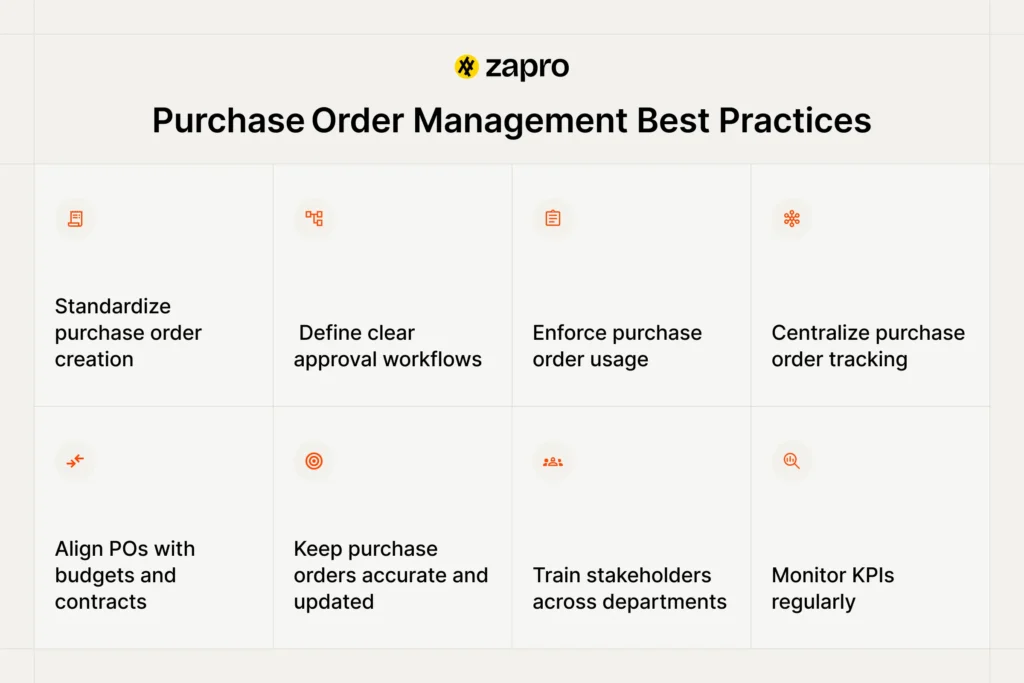
Top-notch procurement departments adhere to a steady set of best practices that help them stay in control, along with enabling velocity and flexibility, forming strong PO management best practices.
1. Standardize purchase order creation
Adopt generic formats for purchase orders that outline the key elements such as item description, quantity, price, delivery schedule, and payment terms. Having a single format would reduce the chances of errors and make the post-processing phase easier, reinforcing purchase order best practices.
Standardizing purchase order creation is one of the easier best practices to enforce when it’s built into an AI procurement platform rather than left to individual habit.
2. Define clear approval workflows
Specify the approval process criteria using the amount of money to be spent, department, or category as the basis, which strengthens the PO management process.
3. Enforce purchase order usage
Ensure that purchase orders become mandatory for certain classes of spending. Well-articulated policies pave the way for the elimination of the maverick buying practice.
4. Centralize purchase order tracking
A single repository for all purchase orders should be readily available to all concerned. With a centralized point of view, the different teams can keep track of the status, commitments, and supplier performance through digital purchase order management. If you are evaluating tools for this, compare the best procurement software on PO tracking and approvals.
5. Align POs with budgets and contracts
Make sure purchase orders are consistent with approved budgets and signed contracts as a way of assuring that pricing and other terms are adhered to.
6. Keep purchase orders accurate and updated
Any alteration in quantity, price, or scope should be officially reflected in the purchase order so as to avert possible disputes downstream.
7. Train stakeholders across departments
Requesters, approvers, and finance teams should be acquainted with how critical purchase orders are and be shown the right way of handling them.
8. Monitor KPIs regularly
Evaluate indicators such as the duration of the PO cycle, the success rate of the invoice match, and the extent of off-PO spend to discover opportunities for improvement in purchase order lifecycle management.
Purchase Order Management Best Practices: Process Flow
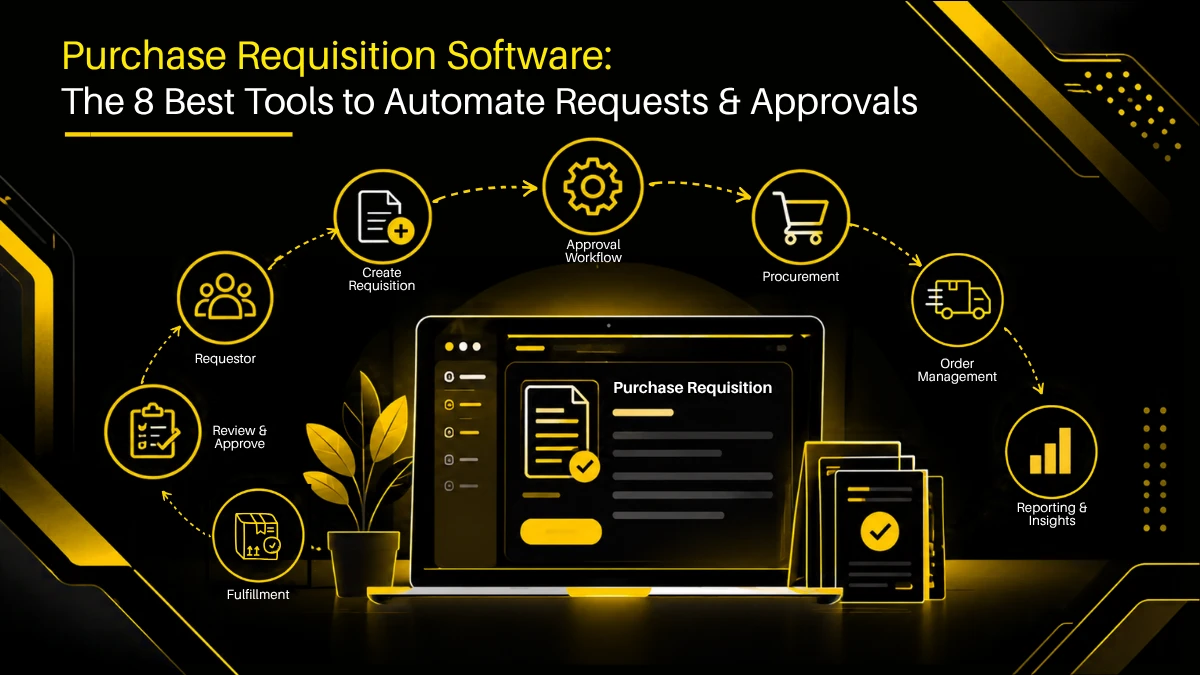
The purchase order process that is properly managed follows a definite and foreseeable flow, aligned with purchase order process best practices:
- Extending the purchase request and getting it approved
- Creating the purchase order by employing the standardized data
- Routing the purchase order for the required approvals
- Sending the authorized PO to the supplier
- The supplier acknowledging and delivering the order
- Receiving goods or services and recording the receipt
- Matching the invoice with the purchase order and receipt
- Completing the purchase order with a payment
This well-structured flow guarantees traceability throughout the whole chain and, thus, diminishes the number of frictions that might exist between procurement, finance, and suppliers.
Benefits of Following Purchase Order Management Best Practices
Businesses that adopt purchase order management best practices witness tangible improvements in procurement and finance areas.
More effective control over spend
Operational teams get to have a real-time perspective of the amount of money both committed and spent through a mature PO management process.
Procurement cycles are accelerated
Clearly defined workflows entail less waiting for approvals and fewer manual follow-ups.
Gentler supplier relations
Suppliers are given prompt and unambiguous purchase orders, along with speeding up their payments.
Compliance and audit readiness have been improved
Approvals that are documented and clean records are what make audits and regulatory reporting easier.
Virtually, purchase order management best practices facilitate the transformation of procurement, which in the past had been reactive, into an operation that is controlled, reliable, and strategic.
Learn more: Purchase Order Software for Small Business
Automating Purchase Order Management (Conclusion)
Working with manual purchase orders simply cannot keep pace with the rapidly increasing transaction volume, and automation here is inevitable, especially for digital purchase order management. These practices are far easier to enforce systematically than through policy alone. See AI-powered procurement software pricing and plans for a platform that enforces them.
Automation-based purchase order management software provides capabilities such as streamlined PO creation, approval enforcement, real-time visibility, and direct integration with invoicing and payment. By adopting automation, risks from human errors are mitigated, cycle times are shortened, and policy compliance is assured without hindering the business get going.
State-of-the-art procurement software gives enterprises the freedom to begin with basic PO automation and gradually mature into full procure-to-pay as their needs change.
When strong purchase order management best practices are combined with appropriate technology, businesses can reduce their risks and get their spend under control, ultimately resulting in a procurement process that allows for sustainable growth.
Learn More: Best 10 Purchase Order Management Tools
Best practices are easier to adopt when the software enforces them. See these practices built into a demo of the PO workflow.

Kickstart Your Smarter Procurement Journey
Experience how AI-powered platforms like Zapro bring clarity and automation to your entire procure-to-pay cycle.
FAQs
1. What are purchase order management best practices?
The best practices associated with purchase order management are the following: standardizing the production of purchase orders, requiring approvals, centralizing the tracking, coordinating POs with budgets, as well as, regularly measuring the efficiency by monitoring key performance indicators, all of which form PO management best practices.
2. Why is purchase order management important in procurement?
Purchase order management is the method through which the organization ensures that all purchases are authorized, documented, and cohere to the budget and agreements. The method safeguards against overruns, reduces mismatched invoices, and is a vehicle for compliance through purchase order process best practices.
3. What problems occur without proper purchase order management?
Lack of PO management exposes an organization to unnecessary spending, delayed approval cycles, invoice mismatching, poor spend visibility, and the breakdown of supplier relationships.
4. How does automation improve purchase order management?
Automation speeds up the approval process, guarantees the enforcement of regulations, minimizes manual mistakes, provides better visibility, and integrates purchase orders-to-invoicing and payments, thereby making procurement more efficient and scalable through digital purchase order management.
Don’t miss our weekly updates
We’ll email you 1-3 times per week—and never share your information.
Ready to Revolutionize Your Purchase Order Management?
Zapro’s automated workflows save time, cut costs, and boost efficiency across every department.

About the Author

Md. Kafil


About the Reviewer

Zapro is dedicated to helping businesses of all sizes make informed decisions. We adhere to strict editorial guidelines to ensure that our content meets and maintains our high standards.
Our editorial standards help keep every article accurate, useful, and trustworthy.