

1. Introduction
The procurement process in any enterprise does not begin when a supplier sends an invoice. It starts internally. Somebody in a department realizes that in order to perform their work efficiently, they need goods or services. Whether it is software for a new employee, raw materials for production, or marketing services for the campaign, the transaction from request to payment determines the level of control, compliance, and efficiency in procurement. This internal-to-external flow is central to understanding PR vs PO in procurement.
At the heart of the process lie two documents: the purchase requisition and the purchase order, often discussed as Purchase Requisition vs Purchase Order. These terms are regularly confused and used as synonyms but actually refer to two very different things. Ignorance of the distinction may cause budget overruns, unauthorized spending, delayed approvals, and supplier disputes.
The knowledge of the difference between purchase requisition and purchase order goes far beyond mere vocabulary. It represents clear allocation of duties, financial control, and being prepared for audit. For the finance team, procurement manager, and business leaders, it is the knowledge of these documents that leads to a robust purchasing process that can accommodate changes in the size of the organization.
This handbook delineates the terms purchase requisition and purchase order, explains what is a purchase requisition and what is a purchase order, describes their connection, and demonstrates their importance. You will discover the function of each document, their differences, the way they are interrelated, and the reasons why both are necessary. We will also take into consideration the role of automation in reducing the process cycle time and easing the cooperation among different teams.
Zapro AI is one example of a platform that manages this requisition-to-purchase-order flow end to end, keeping approvals and budget checks in a single workflow.
2. What Is a Purchase Requisition?
A purchase requisition, often referenced when explaining what is a purchase requisition, is merely a permission-to-incur request document for obtaining approval of the purchase. It is an internal request raised within the organization and submitted by an employee or department whenever they spot the need for a good or service. The major function of a purchase requisition is not the purchase itself but rather, it is a request for permission to purchase routed through an approval workflow.
In layman’s language, a purchase requisition is a document that seeks approval to spend money.
A purchase requisition normally contains the following:
- A short description of the goods or services requested
- Number required and estimated cost
- Date when the delivery is necessary
- The department or budget center
- The purpose of the purchase
- The name of the supplier, if known
When the requisition is sent, it is subjected to an approval process. According to the company rules, the approvers could be the immediate manager, head of the department, the finance team, or the purchasing department. Approvers examines whether (i) the request is within the budget limits, (ii) it corresponds to the business objectives, and (iii) it complies with the procurement policy.
Only upon approval of the purchase requisition should the procurement team be authorized to issue a purchase order, forming the PR to PO process.
The purchase requisition term can be linked to the explanatory page of the company’s internal wiki if the idea needs to be developed further.

Forrester expects global spending on order management system (OMS) software to reach $1.9 billion by 2026, up from $1.0 billion in 2021.
Why Purchase Requisitions Matter
Purchase requisitions are one of the tools that introduce order in procurement. They stop expenses incurred without approval and guarantee that purchases are reviewed before commitments are made. Strictly speaking, this is the case of a company in a state of growth where various teams make purchases on their own.
In the absence of purchase requisitions, companies mostly resort to the use of informal requests that take place in emails or chats. Being deprived of proper records, the requests get lost, approvals are missed, and it becomes very tricky to figure out who ordered what and why. Ultimately, the lack of discipline causes non-compliance and budget leakage.
Nowadays, teams are increasingly resorting to purchase requisition software to make their requests digitally, approve them automatically, and keep a record of all changes in the purchase requisition process. This way, staff members are freed from having to do manual follow-ups and procurement becomes transparent.
3. What Is a Purchase Order?
A purchase order, often explained when defining what is a purchase order, is a buyer’s external document that is legally binding and confirms the buyer’s offer to buy certain goods or services under agreed pricing and delivery terms.
For example, if a purchase requisition seeks to obtain permission to make a purchase, a purchase order serves as the actual placing of the order and vendor confirmation.
A purchase order contains the following information at least:
- PO identifier
- Information about the parties to the transaction
- Description of the ordered items and respective quantities
- Prices
- Delivery conditions and delivery date
- Payment terms and payment due date
- Applicable taxes and other conditions
After the seller has agreed to the purchase order, it turns into a contract. The seller has the commitment to supply the products or services specified therein, and the buyer has the obligation to pay according to the agreed terms, which answers the question is purchase order legally binding.
That is why the purchase order is an essential document for the procurement and finance departments. It is a protection for the contracting parties since it reflects their commitments.
Companies often employ purchase order software for small business at the point when the volume of their transactions demands a structured system that helps to avoid errors and misunderstanding with suppliers and formalizes the purchase order process.
Why Purchase Orders Matter
Purchase orders provide both parties with a clear understanding and control of the commercial transaction. By recording exactly the agreed price and the items, purchase orders go a long way in helping parties to avoid disputes. Besides, they make it possible for three-way matching to occur, which is the verification of the PO, the goods receipt, and the invoice before the payment is made.
In the absence of purchase orders, companies mainly rely on oral agreements or confirmation emails. These situations create risk when an invoice does not correspond to what one is expecting or goods are delivered late.
The whole approved request is converted into a controlled and traceable commitment by means of a well-structured purchase order process.
Simplify requests, speed up approvals, and gain full control of procurement.

Simplifying that request-to-approval flow is exactly what an AI procurement platform is designed to do, turning a manual requisition and purchase order process into one connected workflow.
4. Key Differences Between Purchase Requisition and Purchase Order
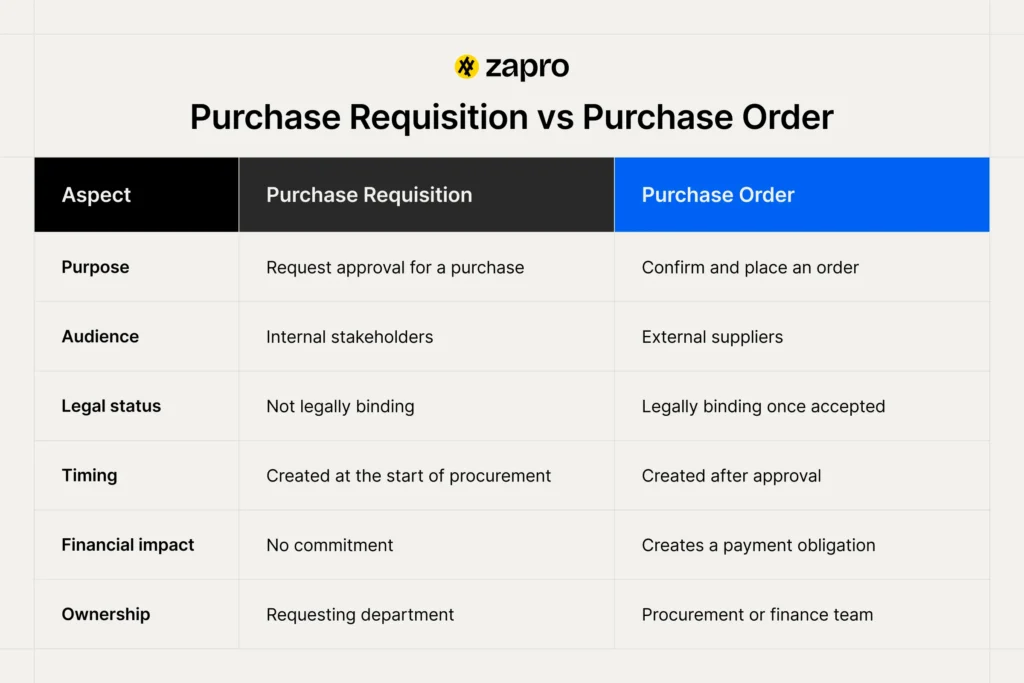
The major distinction between a purchase requisition and a purchase order, often summarized under Purchase Requisition vs Purchase Order, is that the former is an internal request for approval, while the latter is a document sent to a supplier to initiate a purchase.
As a matter of fact, the purchase requisition is the first document in the procurement cycle which triggers the process. The purchase order is issued after the approval of the requisition and it finalizes the transaction.
While a purchase requisition does not commit the company to a purchase, a purchase order does, making this distinction central to understanding PR vs PO in procurement.
In terms of control, purchase requisitions are used to monitor that budgets are kept and policies are complied with, whereas purchase orders serve to safeguard the legal and commercial facets.
These differences will enable the teams to utilize the documents correctly rather than skipping steps or overlapping functions.
5. Purchase Requisition vs Purchase Order: Comparison Table
6. How Purchase Requisitions and Purchase Orders Work Together
Purchase requisitions and purchase orders are not alternatives to each other. They are successive stages in one procurement process.
Usually, the process is:
- First, a staff member identifies a requirement and raises a purchase requisition
- The requisition is approved following the company’s policy
- After that, the procurement department looks at the supplier options
- One supplier is chosen, and a purchase order is drafted and sent to the vendor
- The supplier delivers the goods or services
- The invoice is checked against the PO and receipt
- The payment is made
The whole process is organized in such a manner that the spending is authorized before commitments are made and documentation precedes money leaving the company.
When purchase requisitions and purchase orders are not connected, various issues happen. For example, approved requests might not be turned into orders, orders can be made without approvals, and finance departments lose visibility of committed spends.
Automation links approved requisitions to POs, ensuring a seamless PR to PO process with a complete record of accountability.
Once a purchase order is issued, it becomes the reference point for everything the supplier delivers, which is why many teams keep POs visible inside an AI Vendor Management tool alongside the rest of that vendor’s history.
7. Benefits of Using Purchase Requisitions and Purchase Orders
Better Financial Control
Purchase requisitions help expenditure stay within budget limits, and purchase orders ensure payments do not go beyond agreed pricing and delivery terms.
Improved Compliance and Audit Readiness
Auditors look for approval trails and document flow. Requisitions and POs provide a clear path from request to payment.
Clear Accountability
Internal requestors, approvers, procurement teams, and finance each play a defined role, reducing confusion.
Stronger Supplier Relationships
Clear purchase orders improve vendor confirmation, delivery accuracy, and trust.
Operational Efficiency
Standardized requisition and purchase order processes reduce back-and-forth communication and manual corrections.
8. Automating Purchase Requisitions and Purchase Orders (Conclusion)
Manual procurement processes do not scale well. Email approvals, spreadsheets, and disconnected systems increase errors and delays.
Automating purchase requisitions and purchase orders introduces structure without complexity. Requests are raised digitally, approvals follow predefined workflows, and purchase orders are generated automatically from approved requisitions.
Automation also provides real-time visibility into commitments, suppliers, and payments, enabling procurement and finance teams to act proactively.
Modern systems combine requisitions, POs, invoices, reporting, and compliance into one platform, strengthening the foundation for scalable procurement.
Organizations that digitize early spend less time correcting errors and more time optimizing the purchase requisition process, purchase order process, and overall procurement performance.
Both documents are part of the core suite on every Zapro plan. See our procurement software pricing and plans to confirm what else is included.

Stop Chasing Approvals. Start Automating Success.
Automate procurement from requisition to payment with Zapro’s AI platform. Cut processing time by 90%, eliminate errors, and replace 15+ tools with one intelligent solution.
FAQ
Which comes first, PO or PR?
The purchase requisition comes first. It is created to request approval for a purchase. Once approved, it is converted into a purchase order.
How is PR converted to PO?
After approval, the procurement team reviews the requisition and creates a purchase order using the approved details. In automated systems, this conversion happens directly within the platform.
What is the difference between PR and PO in procurement?
A purchase requisition is an internal request for approval. A purchase order is an external, legally binding document sent to a supplier to place an order.
Don’t miss our weekly updates
We’ll email you 1-3 times per week—and never share your information.
Let’s Simplify Your Requisition Management
We’ll unify your requisition data and help your team move faster and smarter.

About the Author

Md. Kafil