

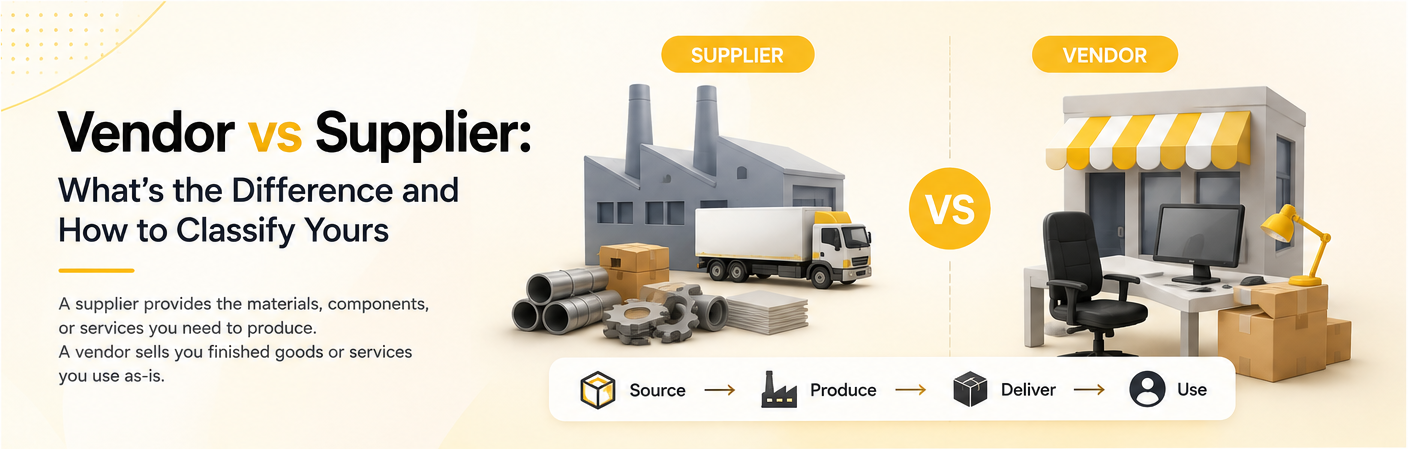
A supplier provides goods or materials as part of an ongoing, contracted relationship and usually sits earlier in the supply chain. A vendor sells finished goods or services directly to the buyer, often transactionally. In practice most organisations use the two terms interchangeably; the distinction matters most in contracting and supplier master data.
| Attribute | Supplier | Vendor |
|---|---|---|
| Position in the chain | Upstream – provides inputs | Downstream – sells to the end buyer |
| Typically sells | Raw materials, components, bulk goods | Finished goods and services |
| Relationship | Contracted and ongoing | Often transactional |
| Volume | Larger, scheduled | Smaller, as needed |
| Sold to | Manufacturers and distributors | Businesses and end users |
| Common usage | Manufacturing and supply chain | Procurement, IT and services |
Supplier vs Vendor: The Bottom Line
Supplier versus vendor comes down to position and relationship. A supplier feeds inputs into what you make, under an ongoing agreement. A vendor sells you a finished product or service, often per transaction. If you only need one rule: suppliers supply inputs, vendors sell outputs.
The short answer: A supplier provides the materials, components or services your business depends on to produce what it sells. A vendor sells you a finished good or service you use exactly as it arrives. Suppliers sit upstream and the relationship runs long. Vendors sit downstream and the relationship is usually transactional. In practice, dependency decides which is which, not the label in your system.
Key takeaways
- Suppliers feed production. Vendors feed consumption.
- The label matters less than the dependency. If their failure stops your delivery, manage them as a supplier whatever your system calls them.
- Almost every ERP stores both in one vendor master. That is an accounting decision, not a procurement one, and it is the main reason the two words got tangled.
- One company can be a supplier to you and a vendor to someone else, and occasionally both to you at the same time.
- The real difference shows up on the record: what you verify before you pay, what you monitor after, and what you do when they fail.
Ask five people on a procurement team to define the difference and you will get five answers, three of which are the same answer worded differently. Ask the finance team and they will tell you the question does not arise, because their system has exactly one field for it.
Both groups are being reasonable. The words genuinely do mean different things, and the system genuinely does treat them identically. That gap is where the confusion lives, and it is worth closing — because the cost of getting it wrong is not linguistic. It is the day a company you filed under office supplies turns out to be the only firm that can service the machine your line runs on.
What is a supplier?
A supplier is a business that provides the materials, components or services your operation consumes in order to produce what you sell.
The defining feature is not what they ship. It is that you cannot run without it. A steel mill feeding a fabricator. A contract manufacturer building sub-assemblies. A third-party logistics firm moving finished pallets. A cloud provider hosting the application your customers log into. All suppliers, in the sense that matters, because if they stop, so do you.
Everything bought from a supplier sits in direct procurement — the spend that goes straight into the finished product.
What suppliers typically provide
- Raw materials and commodities — steel coil, resin, reagents, flour, crude inputs
- Components and sub-assemblies — moulded housings, circuit boards, printed packaging
- Production services — contract manufacturing, sterilisation, machining, testing
- Infrastructure services — hosting, payment rails, logistics, the platform your operation runs on
What a supplier relationship asks of you
More than a purchase order. A supplier relationship expects a forecast they can plan against, a contract with remedies rather than aspirations and broadly aligned with a framework like ISO 31000 risk management, a named alternative that has actually been qualified, regular performance review, and someone on your side who picks up the phone when it goes wrong at 6pm on a Friday. Long-term, high-volume buying is exactly where strategic supplier relationships pay off.

Vendor management is no longer about cost-cutting. It’s about value creation and supply resilience.
What is a vendor?
A vendor is a business that sells you a finished good or a service you use exactly as it arrives.
Nothing gets transformed. You order, they deliver, you pay, and unless something goes wrong the interaction is over. The office furniture company. The catering firm. The design tool your marketing team keeps two seats on. Useful, occasionally expensive, rarely load-bearing.
What vendors typically provide
- Finished goods for internal use — furniture, IT hardware, stationery, workwear
- Discrete services — catering, events, cleaning, one-off translation or design
- Low-dependency software — single-purpose tools with no data of consequence in them
- Resale stock bought ready to sell, where alternatives are easy to source
Almost all vendor spend falls under indirect procurement — the goods and services that keep the business running rather than the product.
What a vendor relationship asks of you
Efficiency, and not much else. A preferred list so people are not sourcing from scratch every time. A threshold above which someone senior has to look. Clean payment terms. Spending management effort here past that point is overhead with no return, and the effort you spend on a stationery review is effort you did not spend on the supplier who could halt production. Most of that can be enforced in procurement software through approved supplier lists and approval thresholds on purchase requests.
Vendor vs supplier: the full comparison
Twelve dimensions, side by side. If you only take one thing from this page into a meeting, take this.
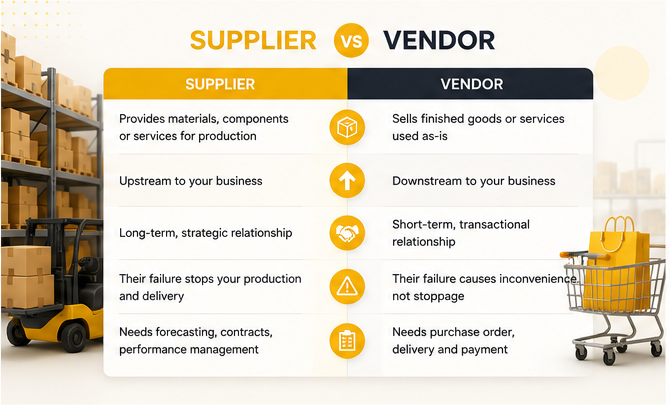
| Aspect | Supplier | Vendor |
|---|---|---|
| What they provide | Inputs: materials, components, production or infrastructure services | Outputs: finished goods and services used as delivered |
| Position in the chain | Upstream, before or alongside production | Downstream, closest to the point of use |
| Typical relationship | Ongoing, contracted, formally reviewed | Transactional, often order to order |
| Volume pattern | Bulk, few line items, forecast driven | Varied, low volume, demand driven |
| Who they sell to | Almost always other businesses | Businesses and consumers alike |
| If they fail | Production or service delivery stops | Inconvenience, absorbed internally |
| Replacement time | Weeks to months, often with requalification | Days, frequently same week |
| Contract depth | Service levels, quality specs, remedies, exit terms | Price, delivery window, standard terms |
| What you monitor | On-time-in-full, quality, capacity, financial health | Price consistency, delivery, service quality |
| Governance cadence | Scheduled business reviews | A renewal check, or nothing at all |
| Risk work | Tier-2 mapping, continuity plan, qualified alternate | Preferred list, occasional spot check |
| Typical examples | Raw material producers, contract manufacturers, 3PLs, core platforms | Office supplies, catering, furniture, events, single-seat software |
That gap in contract depth is exactly where structured vendor contract management earns its keep — the further left a relationship sits on this table, the more the paperwork needs to do.
Vendor agreements typically cover price, delivery windows and standard terms, while supplier contracts add service levels, quality specs and exit clauses. Because suppliers sit at the start of the chain, a single point of failure there creates supplier concentration risk that a vendor outage rarely matches. Running both contract types side by side is what a vendor contract management system is built for.
Vendor vs Supplier vs Contractor
Vendor and supplier both cover goods and inputs bought from a business. A contractor is a third category again — the work is the deliverable, and it is papered with an independent contractor agreement rather than a supply contract. Judge a contractor the same way you judge the other two: by what happens if they do not show up.
Negotiation Approach
The two also negotiate differently: supplier talks turn on volume and lead time, while vendor negotiation strategies turn on unit price and renewal timing. Walk into each conversation with the right lever and you get a better outcome than treating every third party the same.
Improve your supplier relationship in just a click!

The three-question test that settles it
Definitions settle arguments. Tests settle records. When a new company lands in your system you need a decision you can make in under a minute and still defend six months later.
Three questions. Answer each one yes or no.
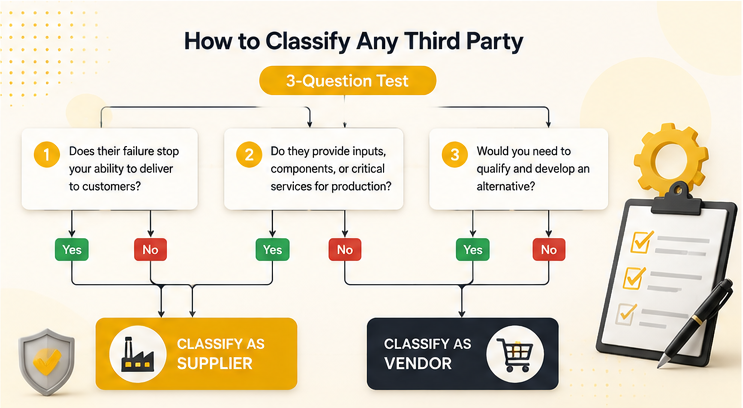
- If they stopped delivering tomorrow, would something your customer sees be late, worse, or missing?
- Would replacing them take longer than a month once you include qualification, contracting and onboarding?
- Does the spend repeat without anyone re-deciding — a subscription, a call-off, a blanket order?
Two yeses or more and you treat them as a supplier. Zero or one and you treat them as a vendor. A single yes attached to a very large number — a firm you spend more with than almost anyone else — is worth a second look regardless.
A worked example
A mid-sized diagnostics lab buys reagents, printer toner, and a scheduling platform.
Reagents. Yes, yes, yes. Supplier, obviously.
Toner. No, no, yes. Vendor. File it, buy it, forget it.
The scheduling platform. Yes — no schedule, no appointments. Yes — migration plus retraining is a quarter’s work. Yes — it renews automatically every January. Supplier, on all three counts, even though finance has it under software subscriptions and nobody has reviewed it since the day it was bought.
That third one is the point of the test. It is almost always the one that surprises people.
Where the line blurs, and why nobody agrees
Why your ERP calls everyone a vendor
Open almost any ERP and go looking for a supplier record. You will find a vendor master.
There is a sound reason for that. Accounts payable does not care what a company contributes to your product. It cares that there is one record, one tax identity, one set of remit-to details and one audit trail per legal entity you pay, because that master record is what feeds your procure-to-pay process end to end. Splitting that master in two would double the reconciliation work and halve the accuracy. This is exactly the master data that AP Automation Software relies on for invoice capture and three-way matching, so how clean that single vendor record is directly determines how much of the payables process can run without manual intervention.
So finance standardised on one word. Procurement kept the other, because procurement does care about the difference — it is the entire basis on which effort gets allocated. Two functions, two vocabularies, one database. That is the whole origin of the confusion, and it is not a problem you solve by renaming anything.
You solve it by adding a classification. More on that below.
The same company in two roles
A packaging converter prints cartons for a cereal brand — supplier, because the cereal cannot ship without them. The same converter sells short runs of plain cartons through a web shop to a local bakery — vendor, because the bakery could buy elsewhere on Tuesday. Same company, same machine, two completely different relationships. What decides it is what the buyer does with the output, not what the seller does for a living.
When a vendor quietly becomes a supplier
This is the one that catches people. A tool arrives as a nice-to-have with three users and a corporate card behind it. Two years later it holds your customer records, it is wired into four other systems, and the renewal is the third-largest line in the IT budget.
Nothing in the contract changed. Everything about the dependency did. Nobody reclassifies these, because reclassification is nobody’s job. Which is why one pass a year across your top spend — sorted by dependency, not by amount — earns back the afternoon it costs.
Vendor vs supplier examples across industries
The distinction gets much easier to see with real categories attached to it.
| Industry | Supplier example | Vendor example |
|---|---|---|
| Manufacturing | Steel coil, injection-moulded housings, contract assembly | Workwear, canteen services, office furniture |
| Healthcare and diagnostics | Reagents, sterile consumables, the LIS platform | Waiting-room furniture, uniform laundry, printer leases |
| Construction | Ready-mix concrete, structural steel, plant hire | Site signage, temporary fencing, site catering |
| Software and technology | Cloud hosting, payment processor, core data provider | Design tools, single-seat software, recruitment agencies |
| Retail and hospitality | Ingredient wholesalers, packaging converters, the 3PL | POS hardware, uniforms, window cleaning |
Notice the software row. Hosting and payments sit on the supplier side because an outage is visible to your customer within minutes. That surprises people who assume anything sold as a subscription is automatically a vendor.
How vendors and suppliers fit alongside manufacturers, distributors and contractors
Vendor and supplier are two roles in a longer chain. The rest of the vocabulary trips people up just as often, so here is the sequence and what each link actually does.
Supplier → Manufacturer → Distributor → Vendor → Customer
Manufacturer
Turns inputs into finished goods. A manufacturer is a supplier when it sells in bulk to another business that will process or resell the output, and a vendor when it sells the finished article directly to whoever will use it. The label changes with the transaction, not the factory.
Distributor
Buys in volume from manufacturers and moves goods to the businesses that sell or use them, usually adding warehousing and logistics on the way. Distributors rarely make anything. Their value is availability and speed.
Wholesaler
Similar to a distributor but generally without an exclusive relationship upstream. Buys large, sells large, to retailers and businesses rather than to consumers.
Contractor
Sells expertise and labour against a defined scope rather than a product. Contractors look transactional on paper and behave like suppliers in practice, because if the electrical contractor walks off site the building does not finish. Judge them by dependency like everyone else.
Subcontractor
Works for your contractor, not for you. You often have no contract with them and no visibility of them, which is precisely why they show up in incident reports. On anything critical, ask who else is on site.
Service provider
An umbrella term covering everything from a SaaS tool to a managed IT partner. It tells you the delivery format, not the importance. A service provider is a vendor or a supplier depending entirely on what breaks when they stop.
Vendor management vs supplier management
The two disciplines share a system and share almost nothing else.
Vendor management is about efficiency. Keep the catalogue current, keep purchases inside policy, keep the approval chain short, keep prices honest. Success looks like nobody having to think about it. Day-to-day vendor work follows the six stages of the vendor management lifecycle.
Supplier management is about continuity and value. It is a supplier management process as much as a mindset: track performance against a specification, understand capacity, know who your supplier depends on, agree what happens when a target is missed, and build enough of a relationship that you find out about a problem before it reaches you. Success looks like a disruption that never became your disruption. Innovation and continuity work is usually run in supplier relationship management software rather than a general vendor tool.
Both are legitimate. Applying the first to a company that needs the second is how organisations discover their exposure the hard way.
What actually changes on the record
Here is where the abstraction ends. If you open two records in your system — one classified as a vendor, one as a supplier — this is what should differ.
Both need the same foundation, the baseline every vendor onboarding compliance checklist should cover: legal entity name matched against a registry, tax identity (a W-9 in the United States, a GSTIN and PAN in India, a VAT number across the EU), remit-to bank details verified independently of the document they arrived on, a category and GL code, payment terms, and a named owner inside your business.
A supplier record needs all of that, plus:
- Capacity and standard lead time, so that a forecast means something to them
- Quality certifications with expiry dates, and the date of your last audit against them
- A named alternative source that has been qualified, not merely identified
- Tier-2 exposure, the kind NIST’s Cyber Supply Chain Risk Management guidance is built around — who they depend on, at least for the parts you cannot do without
- A service level with a remedy attached, rather than a target with a hope attached
- Exit and transition terms, agreed while everyone is still on good terms
- A continuity contact who is not the account manager
The gap between those two lists is the entire practical difference between the words. Everything above it is vocabulary.
How to manage both without running two systems
You do not need separate databases for supplier lifecycle management and vendor administration. You need one record and one honest label on it.
- Keep a single master record. One legal entity, one tax identity, one set of banking details, one audit trail. Splitting the master creates duplicate payees, and duplicate payees create the fraud you were trying to avoid.
- Add one vendor segmentation field with three values. Strategic supplier, important partner, transactional vendor. Three is enough. Five gets argued about and nobody maintains it.
- Drive the review cadence from the classification, not the spend. Quarterly reviews for strategic suppliers, annual for important partners, none for transactional vendors beyond a renewal reminder — a cadence that echoes the tiered governance principles in the OECD’s public procurement guidance. Sorting by spend alone will point you at the wrong companies, because dependency and invoice value are not the same thing. Set the metrics deliberately — supplier performance management uses a different scorecard from vendor performance.
- Match the verification depth to the tier. Everyone gets identity and bank verification before the first payment. Strategic suppliers additionally get financial health checks, certification expiry tracking and a documented continuity plan. Making every stationery supplier complete a forty-question risk assessment is how the process quietly stops being followed.
- Re-run the test annually. Classifications go stale in one direction only — things become more critical, never less. An afternoon a year keeps the tiering honest.
The mistake that actually costs money
If you take one operational thing away from this page, take this one.
The highest-risk event in the life of any third-party record is a change of bank details. It arrives by email, on convincing letterhead, from an address one character away from the real one, usually just before a large payment is due and often quoting a genuine invoice number because somebody’s mailbox has been read.
The reason this belongs on a page about vendors and suppliers is that the two categories fail differently. A fraudulent change on a vendor record costs you one payment. A fraudulent change on a supplier record costs you one payment and a relationship you cannot replace quickly, because the real supplier is now unpaid, unhappy and sitting on your next delivery. Getting ahead of this is a core part of vendor risk management, not a one-off fraud check.
The control is unglamorous and it works. Verify every change out of band, using a phone number already held on the record — never the number in the request. Require a second approver. Log who changed what and when. If you are running this in a spreadsheet you have no audit trail, which means you do not have a control. You have a habit.
Where software fits
None of the above requires a platform. It requires a classification, a cadence and a record you can trust. Plenty of organisations run it well on a shared drive and a calendar reminder, right up to the point where the number of third parties passes what one person can hold in their head. At that point, Zapro pricing is a useful benchmark, with plans from $699 per month and unlimited users included.
What a vendor management software platform changes is enforcement. A vendor management system holds both record types in one place, with different fields and approval paths for each. The classification becomes a field that drives workflow rather than a column somebody forgets to update. Certification expiry raises a task instead of surfacing in an audit. A bank-detail change routes to a second approver automatically and writes itself into an immutable log. In most ERPs both are stored in a single vendor master record, which is why the commercial distinction has to live in your procurement layer — ERP integrations keep the two in sync without duplicating records. Zapro handles supplier onboarding, verification and the transactional record on the same platform, so the classification you set at onboarding is the one still governing the relationship three years later. If you are still comparing options, start with our shortlist of vendor management tools.

Say Goodbye to Spreadsheet Vendor Management
Centralize, automate, and optimize your entire vendor lifecycle with Zapro’s all-in-one platform
Frequently Asked Questions
Is a vendor and supplier the same thing?
No, though they are used interchangeably in everyday conversation. A supplier provides inputs your operation depends on to produce what you sell. A vendor sells you a finished good or service you use as delivered. The distinction matters when you decide how much oversight each one gets.
What is the main difference between a vendor and a supplier?
Dependency. A supplier’s failure stops something your customer sees; a vendor’s failure is an inconvenience you absorb internally. Position in the supply chain, contract depth and relationship length all follow from that one difference.
Can a company be both a vendor and a supplier?
Yes, and it is common. The same manufacturer can supply bulk components to one buyer and sell finished units to another. It can even be both to the same buyer across different product lines. Classify the relationship, not the company.
Is a supplier always upstream and a vendor always downstream?
It is a useful rule of thumb and it holds well in manufacturing. It breaks down in software and services, where a downstream-looking subscription can carry more operational dependency than an upstream materials contract.
What is the difference between a vendor and a distributor?
A distributor buys in volume from manufacturers and moves goods onward to businesses that will sell or use them, adding warehousing and logistics. A vendor sits at the end of that chain and sells the finished item to whoever will use it. Because vendors sit closest to the end user, vendor discovery tends to be a shortlisting exercise rather than a sourcing project.
Why do ERP and accounting systems call everyone a vendor?
Accounts payable needs one record, one tax identity and one payment trail per legal entity. Splitting the master into suppliers and vendors would duplicate reconciliation work. It is an accounting convention, not a statement about the relationship.
What is the difference between vendor management and supplier management?
Vendor management optimises cost and process efficiency on purchases you could replace next week. Supplier management protects continuity and value on relationships you could not. Same system, different cadence, different depth of contract.
Should a contractor be treated as a vendor or a supplier?
Judge it by dependency rather than by the fact that the engagement has an end date. An electrical contractor on a critical path behaves like a supplier, because the building does not finish without them. A freelance designer on a one-off campaign does not.
Does the vendor versus supplier distinction matter for a small business?
It matters more, not less. A small business usually has fewer alternatives and less cash buffer, so a single critical dependency carries proportionally greater risk. You need fewer tiers, not fewer checks.
Is it ‘vender’ or ‘vendor’?
‘Vendor’ is the correct spelling. ‘Vender’ is a common misspelling and is not used in procurement, accounting or contract language. A vendor is a party that sells goods or services to a buyer. In supplier master data and purchase orders, always record the term as ‘vendor’.
Getting it right from here
Go and open your third-party list. Run the three questions down it. You will find companies sitting in the transactional tier that could shut you down inside a fortnight, and you will find a handful in the strategic tier that are there because someone was nervous in 2023.
Fixing that costs an afternoon and changes where your attention goes for the rest of the year. Getting the classification right is foundational to any modern procurement strategy — you cannot manage a relationship you have not correctly labeled.
See how vendor classification works in practice. Zapro handles onboarding, verification, tiering and the full transactional record on one platform, so the classification you set on day one still governs the relationship three years later. Book a 30-minute demo and we will run it against your own third-party list. If you want to see both record types handled in one system, walk through the vendor management software demo.
Don’t miss our weekly updates
We’ll email you 1-3 times per week—and never share your information.
Let’s Strengthen Your Vendor Relationships
We’ll unify vendor data and help your team build smarter partnerships.

About the Author

Md. Kafil


About the Reviewer

Zapro is dedicated to helping businesses of all sizes make informed decisions. We adhere to strict editorial guidelines to ensure that our content meets and maintains our high standards.
Our editorial standards help keep every article accurate, useful, and trustworthy.
Related Blogs
Best Vendor Performance Management Software to Maximize ROI
The Role of Communication in Effective Vendor Relationship Management
Wait! Don't Leave Without This Free Guide
How AI Is Replacing Manual Procurement And What Your Team Should Do Next