Vendor Management
 End-to-End Procurement
 Strategic Sourcing
 Spend Analytics
 AP Automation
 Inventory Management
 ERP Integrations
 Blogs
Blogs Procurement Guide
 Ebooks
 Healthcare
 Financial Services
 Technology
 Venture Capitalist
 Chief Procurement Officer
 Chief Financial Officer
 About Us
 Vendor Management Guide
The procurement process is the end-to-end strategic workflow for acquiring goods and services, that includes steps like identifying business needs and finding right suppliers to fulfill those needs, approving the invoices by doing 3 way or 2 way matches to verify the liability and finally making payments.
Streamlining these operations can reduce processing times by up to 75%. This level of time savings is done by eliminating manual bottlenecks like slow, repetitive or sometimes un-necessary approvals and by automatically resolving invoice mismatches.
An optimized process ultimately improves spend control, prevents off-contract purchases, and strengthens supplier relationships.
In this quick guide, we’ll break down the 7 key steps of the procurement process so you can streamline operations, reduce risk, and strengthen supplier relationships in 2026 and beyond.
What is Procurement?
Businesses use procurement processes to acquire necessary goods and services which enable their operational success.
The procurement process extends beyond simple buying, because unlike simple impulse driven purchases, procurement requires detailed steps starting from identifying the type of requests that comes to procurement, finding the best match for the requirement among the existing supplier base, if right supplier was not found, then perform a industrial grade supplier discovery process to find the right suppliers, assess them for vendor onboarding, work with legal, risk management and business teams to get the sign off on the supplier selection and finally negotiate a mutually beneficial contract that allows for sustained cost reduction, all the while ensuring business productivity or cost advantages are not lost.
Businesses in the present day prioritize sustainability alongside risk management and long-term supplier partnership development as part of their procurement operations. International CSRD standards such as Scope3 or SBTi, GHG and others incentivize the businesses to adhere to these comprehensive processes and policy directives
Organizations today implement procurement process management software and e procurement process platforms to not just enhance their workflows and achieve better visibility but also to maintain regulatory compliance in a complex and evolving global commerce landscape
Types of Procurement
All procurement activity within the company does not share equal value, criticality and impact, more importantly they do not share the same processes.
Different types of procurement processes exist for different industries or for different departments within the same company,
Whilst there could be thousands of process variations and industry specific requirements, all of them could largely be abstracted into 3 major work groups listed below.
| Type of Procurement | Description | Example |
| Direct Procurement | Involves buying goods and materials that directly impact the company’s core products or services. It affects production and revenue directly. | A car manufacturer buying steel, tires, and engines. |
| Indirect Procurement | Refers to goods and services that support daily operations but don’t go into the final product. These purchases impact efficiency rather than production. | Office supplies, marketing services, or IT software. |
| Services Procurement | Focuses on acquiring people-based or professional services needed for business operations or projects. | Hiring consultants, maintenance contractors, or logistics providers. |
These high level classification helps procurement teams manage different spending categories more effectively and apply the right strategies for cost control and efficiency.
For example, a typical direct procurement strategy involves consolidating supply base, because of the high value purchases, most of the times the supplier is treated as a strategic partner who has a direct impact on the profitability and business continuity.
Whereas indirect procurement suppliers could be in the 1000’s,
spread across multiple small categories with low value and high volume of orders- They are also known as Tail Spend suppliers or Long Tail suppliers.
A typical strategy recommended here is to automate as much as possible to save time and money. (You do not want a director making 600 USD/hour to approve a 10 USD product)
What is a Procurement Process?
The procurement process is a series of steps that an organization follows to obtain the goods and services that are necessary for it to function. If the process is handled well, it will lead to cost savings and fewer delays and also to a better understanding between the parties, creating long-term partnerships (Finding a new supplier takes 3x more time than fixing the existing supplier issues)
Procurement includes multiple, sequential and pre-defined workflow based activities, such as recognizing a need, issuing purchase orders, receiving goods and services, approving invoices, and keeping detailed records.
When a company implements a consistent procurement protocol, it enables the company to move its focus from uncontrolled and unplanned spending to a strategic spending behavior that protects the profit and keeps the operational efficiency at a steady level.
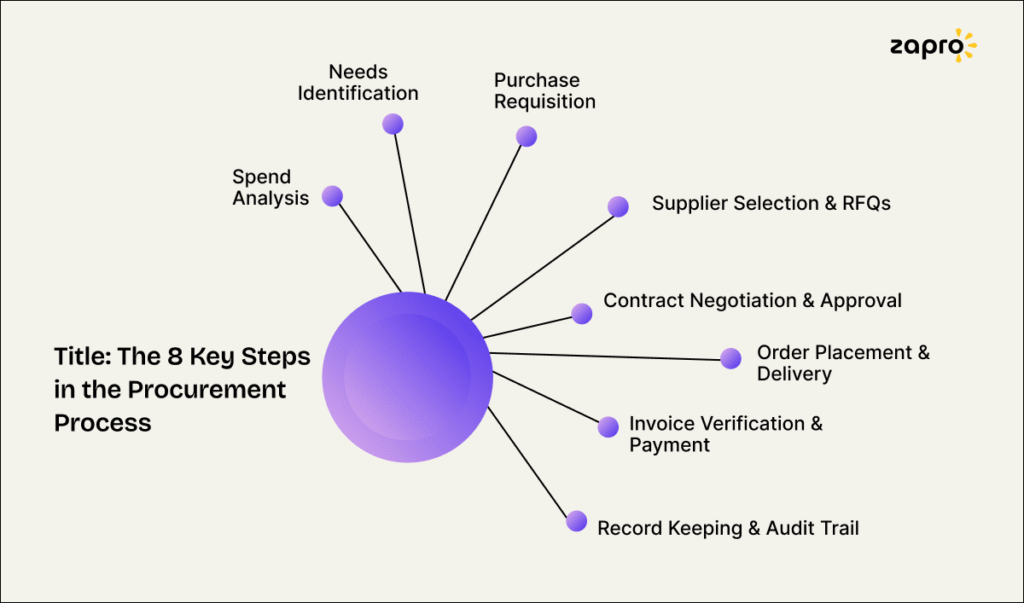
Steps involved in a Procurement Process
Procurement is a multi-step process that involves careful planning, evaluation, and execution. Key actions include determining requirements, researching suppliers, analyzing value, submitting purchase requests, reviewing approvals, converting requisitions to purchase orders, managing contracts, monitoring deliveries, and finally, handling payments and record-keeping.
Here’s a step-by-step breakdown of a modern procurement process:
Step 0: Needs Recognition
Everything starts with identifying a clear need or receiving a need, we can proactively identify a need (such as drinking water or printer) or we can procure based on what the business demands (pro-active procurement and re-active procurement) Whether the need is pro-active or re-active, the procurement team’s primary job is to classify it accurately.
You may need the supplies for the office to be restocked or the raw materials for the new product to be sourced, the point is that identification and classification of the need is the very basis of procurement.
Step 1: Purchase Requisition
The purchase requisition form is a document that is completed by the person requesting the purchase and gives a detailed explanation of the why needs to be purchased, what exactly needs to be purchased and from which budget the purchase will be made. This will give procurement and finance teams the necessary information.
Many a times – these purchases can also be made on behalf of others, such as requesting for other departments or other users based on their email, also known as centralised procurement or requesting for self use which is known as de-centralised procurement
Note: Zapro.ai provides unlimited user license that automatically enables you to adopt de-centralised procurement (that is every user will have access to a procurement system)
Step 2: Requisition Review
The procurement department tries to understand the request, checks its necessity, alignment with the budget, and if it is in the spirit of the company’s policies.
The requisition is sent back for clarification if there is an issue or ambiguity, it is also sent back for the purposes of merging a couple of same requests from different users – into one common purchase to get volume discounts.
Step 3: Solicitation Process (Optional)
Once the request is confirmed, the procurement team (The Buyer) tries to identify the right supplier within the onboarded suppliers list, if the matching supplier is found then the purchase order is issued to the internal supplier, Only if the right supplier is not found- then the team initiates the supplier search.
Normally, this entails releasing a Request For Information first – asking the supplier for the product or services availability, once the availability is confirmed then the Request for Quote (RFQ) or Request for Proposal (RFP) is sent to several suppliers (both existing and new) so that pricing, terms, and quality can be compared next to each other.
Note: if its a product need then RFQ is more appropriate, if its a services need then RFP is more fitting for the purpose.
Step 4: Evaluation and Contract
The new supplier will be onboarded first (if the existing supplier is not shortlisted based on the RFQ/RFP) and contract terms negotiated.
Before the contract signing, the team will verify that supplier’s delivery time, quality (or social proof) and products, and payment terms are well understood and incorporated to a mutually agreeable agreement.
Note: Post contract completion, catalog can be created in storefront for future direct purchases (this act will save 30-40% of processing time – from the second purchase)
Step 5: Purchase Order Management
The purchase requisition which has been approved will be converted to a purchase order (PO) which is the formal order document to the supplier.
Quote “The purchase request will have multiple items, belonging to multiple suppliers, the Purchase Order is always against one supplier – One fully approved PR will automatically split into multiple, supplier specific PO’s”
The procurement team tracks the purchase order ensuring that the supplier delivers the goods on time and that the items meet the required specifications.
Procurement team will use KPI’s like OTIF – On Time In Full – Delivery, to assess supplier performance, which would be considered against the suppliers over all performance score card during the annual relationship review
Step 6: Invoice Approvals and Disputes
The invoice is checked against the PO and packing slip in a three-way match upon receipt of the goods or services. For simple services it is checked against the PO and Invoice (2 way matching) and for complex services it is checked against PO, SOW, Time Sheet and Invoice – this level of matching is called Multi-way matching.
If a previously received goods or services is returned or rejected because of unsatisfactory performance or because of damages, a credit note is issued (to adjust) against the invoice – sometimes there will be disputes and subsequent resolutions during this phase
These control measures ensure that the company only pays for what has been delivered and agreed by both the parties, thus preventing errors and overpayments, liabilities and taxations.
Step 7: Record Keeping
Proper audit trail serves as a record of the PROCUREMENT activities for future reference or during annual book closing, auditing activities
The stored dataset is called as SPEND DATA and is analysed for forecasting the budget for next year’s purchasing needs, and also to analyse the need for changing suppliers, proactively finding new suppliers and so on.
Learn more about procurement software for small business.Proper documentation serves as a record of the PROCUREMENT activities for future reference.
Common Challenges in the Procurement Process
Organizations who have solid procurement plans can still face procurement challenges due to:
Unapproved purchases:
Employees skipping formal channels can lead to lost discounts and the mismanagement of associated risks.
Slow Approval Cycles:
Manual workflows contribute to requests waiting in inboxes for days, delaying the projects as a result. Without a procurement software it takes on average 56 hours to approve a PO (As per Survey in 2025).
Poor Data Visibility:
A dependence on spreadsheets makes it very difficult to get a real-time and accurate picture of spend thus requiring ongoing budget adjustment at the last moment.
Vendor Communication Gaps:
In the absence of a central system, purchase order and related communications can be lost leading to errors or late deliveries.
Manual Matching Errors:
Human errors in matching invoices and purchase orders can lead to overpayments or duplicates. On an average 2% of total invoices are either duplicate payments or overpayments
According to a recent Deloitte survey:
- 76% of procurement leaders rank digital transformation as a top priority, yet only 32% have fully implemented their digital strategy.
- 70% of Chief Procurement Officers (CPOs) reported increased procurement risks over the past year.
Learn about procurement automation tools.
How Zapro Optimizes Your Procurement Process?
Zapro is a cloud based platform that manages the entire procurement process from purchase request to purchase order and invoice including supplier communication and contract management.
1. Automate Repetitive Tasks
Manual work slows teams down and leads to costly errors. Automating order processing, invoice approvals, and workflows speeds up cycle times and improves accuracy. Studies show automation can onboard suppliers 10x faster, reduce requisition-to-order costs by 48%, and cut transaction cycles in half. Using e-procurement software gives your team real-time data to make smarter pricing and sourcing decisions.
Especially in the areas of Intake and PR Approvals – Zapro provides AI Intake Agents that automatically classify the type of requirements and routes it for approvals autonomously. As per configuration it can provide you with Approval recommendations, Auto approvals for low value requests – saving time and money in every transactions
2. Centralize Procurement Operations
Centralizing procurement unlocks your organization’s buying power. It helps negotiate better deals, enforce consistent standards on quality and pricing, and reduce costs. Centralized systems create rich datasets for strategic decisions, while a “center-led” model balances flexibility with governance and risk control.
Spend analysis is the backbone of optimization. By collecting, cleansing, and categorizing expense data, procurement managers gain a clear view of where money goes.
This helps uncover savings opportunities companies often save 3-5% of spend through structured, recurring analysis. Regular spend reviews support smarter sourcing and budget planning.
Zapro automatically feeds the daily, weekly spend data in to the analytics engine, giving you the opportunity to get live spend analytics and recommendations
3. Conduct Regular Spend Analysis
Spend analysis is the backbone of optimization. By collecting, cleansing, and categorizing expense data, procurement managers gain a clear view of where money goes. This helps uncover savings opportunities companies often save 3-5% of spend through structured, recurring analysis. Regular spend reviews support smarter sourcing and budget planning.
4. Implement Strategic Sourcing Practices
Strategic sourcing moves procurement beyond simple buying into a value-driving function. It involves continuously evaluating suppliers, scoring bids systematically, and aligning sourcing with business goals.
This reduces risks, boosts supplier performance, and improves cost-efficiency over time.
5. Monitor Supplier Performance
Supplier management is key to maintaining quality and controlling costs. Track delivery accuracy, product quality, warranty claims, and service responsiveness.
Use both quantitative and custom KPIs and stakeholder feedback for a complete view. Regular supplier reviews help reduce supplier count while raising quality, often unlocking cost savings and stronger partnerships.
6. Foster Cross-Department Collaboration
Successful procurement depends on close collaboration between procurement, finance, legal, and operations teams.
Aligning goals and streamlining approvals helps avoid delays and improves decision-making.
7. Prioritize Risk Management
Identify and mitigate risks related to supplier stability, geopolitical changes, and supply chain disruptions. Proactive risk management safeguards your procurement continuity and protects costs.
Integrating automation and transparency features allows Zapro to deliver a procurement process that is efficient, compliant, and aligned with the goals of an organization. Thus, it helps keep your company alive and thriving even in difficult times.
Procurement Process: FAQs
1. What are some common issues in the procurement process?
Procurement often gets bogged down by manual approvals, duplicate vendor data, poor communication, and lack of visibility into spend. These issues don’t just slow things down they create compliance risks and waste money. The good news? Tools like Zapro are changing that. By automating routine tasks, centralizing vendor data, and offering real-time dashboards, Zapro helps procurement teams skip the chaos and focus on strategy.
2. How long should the procurement process ideally take?
There’s no one-size-fits-all answer, but ideally, a well-structured procurement process from identifying needs to payment—should take a few days to a few weeks, depending on complexity.
However the best process times are 12-24 hours for PR approvals and <7 day shipment from the vendor side.
Legacy systems and email chains slow everything down. Zapro’s AI-driven workflows accelerate the process dramatically by eliminating bottlenecks, automating approvals, and keeping everyone aligned on one platform.
3. Why is the procurement process important for businesses in 2026?
Businesses operating in 2026 must handle worldwide supply chain breakdowns and environmental sustainability requirements while managing decreased financial resources.
A properly defined procurement process enables organizations to make fast adjustments while obtaining dependable suppliers and achieving cost optimization.
The process maintains environmental and regulatory compliance while building sustainable business operations for long-term success. Ongoing procurement process improvement will be essential for staying resilient and competitive.
4. What are the best practices for effective procurement management?
Organizations should implement best practices through supplier relationship development and data-based decision systems and approval process clarity and contract adherence.
Organizations should promote procurement-department collaboration while making sustainability and ethical sourcing their main priorities. Process evaluation at scheduled intervals leads to ongoing enhancement of operational systems.
Here, procurement process improvement supported by analytics and automation ensures better outcomes.
5. How does technology improve the procurement process?
The procurement process benefits from technological advancements which automate routine operations while providing instant data access and complete visibility.
Cloud-based platforms together with AI tools help organizations manage their suppliers and contracts and analyze their spending data in real time. The implementation of procurement process management software enables businesses to achieve better strategic decision-making while reducing errors and saving time.
With e procurement process solutions, companies gain agility and improved market competitiveness.
Why Teams Are Switching to Zapro?
- Procurement++ → Goes beyond POs and invoices to manage the full vendor relationship
- One platform = 15+ tools replaced → No more hopping across spreadsheets, emails, and portals
- Built-in collaboration → Chat, notes, feedback, and calls tracked in one place
- Faster onboarding → Cut vendor onboarding time in half.
- Smarter decisions → Real-time vendor risk, spend visibility & interaction history
- Audit-ready, always → Every action tracked. Every doc in place.
- AI Native → Every process area is automated and assisted by 21 different procurement agents.
No more scrambling for contract details, chasing approvals, or missing cost-saving opportunities. Zapro brings everything sourcing, compliance, collaboration, and intelligence into one seamless flow.
Zapro brings everything from sourcing, compliance, collaboration, and intelligence into one seamless flow.
Don’t miss our weekly updates
We’ll email you 1-3 times per week—and never share your information.
Your Next Big Step Starts Here
Find the right plan, pricing, and strategy for your business growth.

About the Author

Mohammed Kafil