

Contract compliance AI uses artificial intelligence, machine learning, and NLP to automatically track, audit, and enforce obligations and regulatory mandates within signed agreements, converting static text into real-time operational data.
Contract compliance AI is the use of artificial intelligence, machine learning, and natural language processing to automatically track, audit, and enforce the obligations, terms, and regulatory mandates within signed business agreements, replacing manual spreadsheet-based tracking with continuous, real-time analysis.
Signing a corporate contract sets a business partnership in motion, but verifying that both parties actually follow through is a massive operational burden. When a company manages hundreds or thousands of active agreements, human oversight quickly falls short. Minor oversights eventually compound into severe financial leakage and unexpected regulatory penalties.
Contract compliance AI changes this dynamic. By shifting compliance tracking from slow, manual spreadsheets to automated, continuous analysis, businesses can turn legal text into real-time operational execution.
What Is Contract Compliance AI?
Contract Compliance AI Definition
Contract compliance AI refers to the use of artificial intelligence, machine learning, and natural language processing (NLP) to automatically track, audit, and enforce the obligations, terms, and regulatory mandates contained within signed business agreements.
How AI Is Used in Contract Compliance
Instead of forcing human teams to read agreements line by line, AI engines scan entire contract portfolios simultaneously. They extract key performance indicators, establish interactive milestone trackers, monitor live operational workflows against agreed parameters, and flag language inconsistencies automatically.
Contract Compliance AI vs. Traditional Compliance Management
Traditional compliance management relies heavily on human memory, manual calendar entries, and fragmented shared drives. Contract compliance AI introduces centralized, machine-driven visibility. It converts static contract text into dynamic, real-time data points that proactively alert the right stakeholders before operational failures happen.
Why Businesses Are Adopting AI for Contract Compliance
Enterprise contract volumes are growing too fast for manual tracking. Businesses are adopting AI to eliminate the human error inherent in manual review, protect their profit margins from hidden fees, and ensure total alignment across their legal, finance, and procurement operations.
Learn about Contract Compliance Management
Watch Contract Compliance Run Itself

Why AI Matters in Contract Compliance
Reduce Manual Contract Review
Manual contract review forces highly paid legal and procurement experts to spend days searching for specific indemnity, termination, or pricing clauses. AI handles this primary data sorting in seconds, allowing human professionals to focus purely on strategic resolution.
Detect Risks Earlier
Waiting for a supplier to fail or for a regulatory audit to uncover a missing clause leaves a business vulnerable. AI scans active contract portfolios continuously, instantly highlighting unusual liability limits, outdated regulatory language, or missing compliance terms.
Improve Compliance Visibility
Contracts often remain trapped inside localized team folders or regional office systems. AI-driven centralization creates a unified index, offering finance managers, legal counsel, and operations heads identical, crystal-clear visibility into corporate obligations.
Prevent Revenue Leakage
Untracked volume discounts, automated price hikes, and unbilled SLA penalties drain corporate budgets quietly. AI continuously maps incoming vendor invoices against contracted rate sheets to spot financial mismatches the moment they occur. This works best paired with AP Automation Software on the capture side, since a system that already reads and codes each invoice gives the compliance engine cleaner line-item data to check against the contract.
Automate Compliance Monitoring
Operational compliance cannot be achieved via annual or biannual spot-checks. AI connects directly with corporate systems to keep a continuous eye on delivery timelines, service uptimes, and certification renewals.
Improve Audit Readiness
Preparing for an internal or regulatory audit traditionally involves weeks of stressful document gathering. AI maintains flawless, single-click digital audit trails, logging every draft change, user access, and approval stamp automatically.
Accelerate Contract Operations
By handling the time-consuming tasks of data entry, obligation mapping, and milestone setup, AI shortens the path from contract execution to everyday operational management.
The Impact of AI Adoption
- Before AI: A global manufacturing company required an average of 14 business days to manually review and map obligations for a new multi-tier supplier contract across three separate departments.
- After AI: The same company utilizes an AI-driven system to upload, extract, and assign ownership for all contract obligations within 15 minutes, cutting administrative overhead drastically.
Learn about Contract Compliance Services
How Contract Compliance AI Works
The shift from static document text to automated tracking follows a highly sophisticated technological workflow:
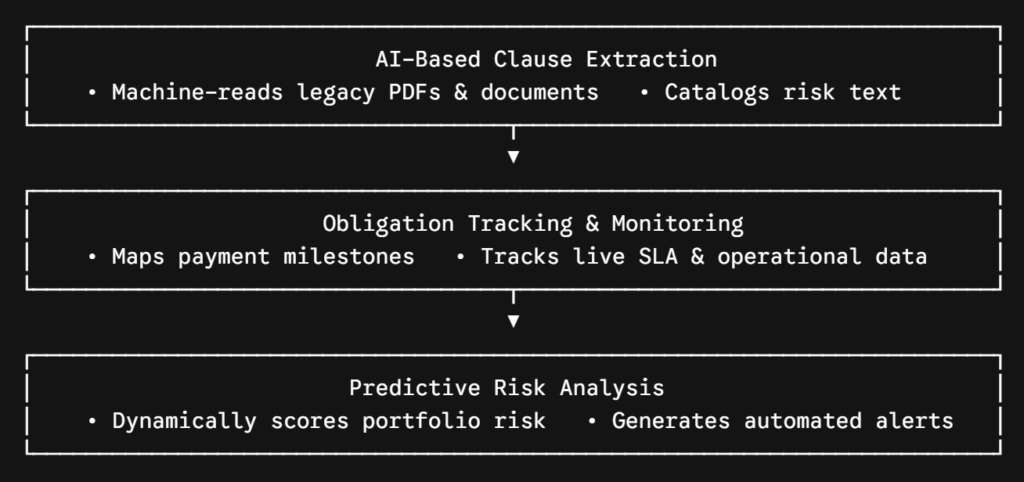
AI-Based Clause Extraction
Advanced natural language processing models treat a contract not just as a static document, but as structured data. The AI reads through unstructured text across thousands of legacy PDFs, identifying specific clauses, governing laws, and limitation of liability rules in seconds.
Obligation Identification and Tracking
The system automatically isolates actionable tasks embedded within legal language—such as a mandatory data security update or a recurring payment deadline. It extracts these milestones and maps them into an interactive operational timeline.
Real-Time Compliance Monitoring
The software hooks directly into your primary enterprise resource planning (ERP) systems, service desks, and supply chain applications. It constantly checks actual field performance data against written contract parameters.
Intelligent Alerts and Notifications
When an obligation deadline approaches or an operational deviation occurs, the AI triggers a multi-tier notification ladder, ensuring the assigned internal owner is alerted well ahead of a breach.
AI Risk Detection and Scoring
AI engines evaluate both draft text and active contract portfolios against corporate playbooks. The system dynamically assigns a risk score based on how far a contract’s clauses diverge from standard corporate safety limits.
Learn about contract management software.

By 2027, 50% of organizations will support supplier contract negotiations through AI-enabled contract risk analysis and editing tools
Automated Audit Preparation
The platform acts as an always-on compliance monitor, logging every system event and contract modification. When auditors ask for proof of compliance, the system outputs structured records with a single click.
Predictive Compliance Analytics
By analyzing historical vendor performance patterns, sophisticated machine learning models can spot early warning signs of supply chain distress, alerting procurement teams to potential delivery failures weeks before they actually happen.
Key Capabilities of Contract Compliance AI
- Automated Contract Review: Rapidly identifies non-standard language and missing legal protections during negotiation phases.
- Contract Risk Analysis: Performs real-time risk scoring across the entire portfolio to uncover hidden financial and operational liabilities.
- Compliance Tracking and Monitoring: Converts narrative contractual commitments into clear, live milestones.
- AI-Powered Reporting Dashboards: Provides visual summaries of contract health, upcoming renewals, and verified cost savings for leadership teams.
- Regulatory Change Monitoring: Automatically flags active contracts requiring updates whenever international data privacy, environmental, or financial laws change.
- Vendor Compliance Management: Monitors supplier background credentials, automated insurance certificate renewals, and safety filings through integrated portals.
- SLA and Obligation Tracking: Digitally tallies performance metrics, like software uptime or product delivery speed, against original contract promises.
- AI Agents for Compliance Audits: Deploys dedicated software agents capable of searching systems and gathering compliance evidence autonomously.
AI-Powered Contract Compliance Process
Step 1: Upload and Centralize Contracts
All signed business agreements, legacy paper scans, and digital additions are uploaded into a central, secure cloud repository. The AI instantly processes the documents, utilizing optical character recognition (OCR) to make every word searchable.
Step 2: Extract Clauses and Obligations Using AI
The AI parses the document text to isolate hidden financial terms, renewal parameters, service agreements, and operational duties, eliminating manual data entry.
Step 3: Identify Compliance Risks
The system evaluates the extracted terms against your corporate compliance playbook, immediately flagging any unusual indemnification rules, high liability caps, or missing security clauses.
Step 4: Configure Monitoring Rules
Teams set up automated enforcement workflows. For example, the software can be configured to track a supplier agreement’s auto-renewal deadline and send alerts 90, 60, and 30 days before the cancellation window closes.
Step 5: Track Performance and SLAs
The AI draws live data from internal operational systems to verify vendor metrics.
Procurement Contract Scenario: An enterprise vendor management system monitors an incoming raw material shipment. The contract mandates delivery within 5 business days of an order. The AI system tracks the transit data, logs a 3-day delay, and calculates the appropriate contractual penalty automatically.
Step 6: Trigger Smart Alerts and Escalations
If a partner fails to meet an SLA or allows their mandatory liability insurance to lapse, the system sends automated warnings. If the issue remains unresolved, it can automatically put a freeze on pending payouts.
Step 7: Generate Compliance Reports
The platform compiles comprehensive data into clean dashboards, giving executives an instant look at contract health, cost avoidance figures, and risk concentrations.
Step 8: Continuously Improve With AI Insights
By analyzing recurring compliance bottlenecks and vendor disputes, the AI recommends clear updates for your master contract templates to eliminate future operational friction.
Benefits of Using AI for Contract Compliance
- Faster Compliance Monitoring: Cuts down verification times from weeks of manual spot-checks to instantaneous, real-time data analysis.
- Improved Accuracy: Eliminates human reading oversights, ensuring complex clauses are tracked perfectly every time.
- Reduced Human Errors: Automates date calculations and data transfers, preventing missed renewals or invoice typing errors.
- Better Risk Mitigation: Uncovers hidden liabilities across legacy contract databases before they turn into expensive legal disputes.
- Increased Operational Efficiency: Allows legal, finance, and procurement professionals to ditch administrative chores and focus on high-value business deals.
- Lower Compliance Costs: Reduces the immense labor costs and consultant fees traditionally associated with preparing for corporate audits.
- Better Vendor Oversight: Provides objective, data-driven supplier performance profiles to give your teams maximum leverage during contract renegotiations.
- Stronger Regulatory Compliance: Keeps your active portfolio perfectly aligned with evolving global standards, avoiding severe regulatory fines.
Contract Compliance AI Use Cases
Vendor and Supplier Compliance
Ensures complex global supply chains run smoothly by verifying that third-party vendors hit their quality, shipping, and packaging targets exactly as written.
Procurement Contract Monitoring
Keeps corporate spend under control by cross-checking everyday procurement orders against original negotiated wholesale rates, catching unauthorized price adjustments instantly. This check works best when contracts and purchase orders live in the same procurement platform, so negotiated rates are available when an order is raised.
Regulatory Compliance Tracking
Protects sensitive industries like healthcare or financial services by ensuring every active contract contains up-to-date data handling, privacy, and compliance clauses.
Financial and Revenue Compliance
Prevents revenue leakage by tracking complex billing structures, tier-based pricing triggers, and volume discounts across thousands of active clients.
Contract Renewal Management
Eliminates costly accidental software or service extensions by tracking cancellation windows for enterprise SaaS agreements and giving IT leaders plenty of time to renegotiate.
Government Contract Compliance
Helps public sector contractors meet strict compliance criteria, automatically verifying labor standards, sourcing limitations, and documentation rules.
SaaS and IT Vendor Compliance
Monitors critical technology infrastructure agreements, confirming that software providers meet their system uptime guarantees and tracking service credits whenever outages occur.
Third-Party Risk Monitoring
Tracks the long-term operational health of business partners, checking external data feeds for financial issues, security breaches, or ethical compliance lapses.
AI Agents for Contract Compliance Audits
What Are AI Compliance Agents?
AI compliance agents are autonomous software programs designed to execute specific, multi-step monitoring and audit tasks without constant human intervention.
How AI Agents Automate Audits
Unlike basic automation software that simply sends calendar reminders, an AI compliance agent can log into internal corporate systems, retrieve operational data, compare it directly to a contract’s text, and determine whether a policy violation has occurred.
AI-Based Evidence Collection
During an audit process, an AI agent can scan through emails, shipping records, and financial ledger items to assemble a complete, cross-verified portfolio of evidence proving compliance or documenting a breach.
Real-Time Audit Monitoring
Instead of conducting stressful annual reviews, AI agents provide continuous audit readiness, constantly testing internal data against external regulations and contract promises.
Predictive Compliance Risk Detection
AI agents trace performance trends across multiple related agreements, flagging subtle operational slowdowns that indicate a vendor may default on a future milestone.
Benefits of Agentic AI for Compliance
- Hands-free verification: Operates continuously in the background, minimizing the need for manual data requests.
- Unbiased analysis: Delivers clear, objective compliance scores based entirely on live system evidence.
- Scalable workflows: Easily handles complex audit workflows across global business units simultaneously.
Learn about Contract Compliance Audit
Challenges in Traditional Contract Compliance
- Manual Contract Reviews: Highly slow, exhausting work that scales poorly as a company grows.
- Decentralized Contract Data: Agreements get lost across individual email chains, local computers, and different business divisions.
- Missed Obligations and Renewals: Forgetting a deadline can lock a company into expensive multi-year contracts for tools they no longer need.
- Limited Compliance Visibility: Executive leaders lack an easy way to assess total contract risk or identify systemic supplier underperformance.
- Slow Audit Processes: Gathering proof manually wastes weeks of valuable team time and creates significant regulatory friction.
- High Operational Costs: Spending massive sums on administrative labor just to keep track of basic business commitments.
Challenges and Risks of Contract Compliance AI
Data Privacy and Security
Feeding proprietary, high-value corporate contracts into an AI platform requires strict data security. Businesses must ensure their AI compliance tools use isolated, secure cloud networks and follow strict data protection standards like SOC 2.
AI Hallucinations and Accuracy Risks
Generative AI models can occasionally misinterpret complex legal language or hallucinate facts. Because of this, companies must use highly specialized legal-LLM engines and maintain human oversight for critical verifications.
Integration Challenges
An AI compliance system is only as good as the data it accesses. Connecting an AI tool to older legacy ERPs, internal databases, and varied team systems can require substantial technical setup.
Change Management and Adoption
Getting team members to trust automated alerts over traditional manual spreadsheets takes time. Companies need clear onboarding plans to build internal confidence in AI-driven insights.
Regulatory Concerns Around AI
As global frameworks around AI usage grow stricter, companies must verify that their automated compliance tools meet regional algorithmic transparency and data privacy laws.
Human Oversight Requirements
AI is a powerful accelerator, but it is not a replacement for professional human judgment. Final legal decisions, major vendor escalations, and complex settlement negotiations must always remain in human hands.
How to Implement Contract Compliance AI Successfully
1. Assess Current Compliance Processes
Map out your team’s current tracking workflows. Identify where bottlenecks occur, locate where documents are stored, and note which types of contracts cause the most administrative headache.
For a broader walkthrough of what this stage should cover, see our guide to the Contract Compliance Process, which breaks down risk and performance tracking step by step.
2. Define Compliance Objectives
Establish clear, practical targets for your AI adoption. Focus on specific goals, such as eliminating missed SaaS renewals, cutting invoice review times by 50%, or automating vendor SLA scorecards. Setting these targets early also makes it easier to weigh procurement software pricing against the time and leakage you expect to recover.
3. Centralize Contract Data
Gather your signed contracts, active addendums, and supplier documentation from scattered hard drives and move them into a single, structured digital space.
4. Select the Right AI Platform
Pick an enterprise-grade software system that features advanced OCR text searching, custom automated workflow tools, secure internal data protection, and seamless integrations with your existing ERP or CRM applications. Zapro AI links contract management with purchase orders, invoice matching, and ERP integrations, so contract terms can be checked against actual transactions.
5. Train Teams and Stakeholders
Run thorough training sessions for your legal, finance, and procurement units. Ensure your managers understand how to read AI dashboards, handle automated alerts, and manage task ownership.
6. Define Governance Policies
Set clear rules for your AI operations. Establish who has access to sensitive contract data, define when an AI alert requires immediate human escalation, and set regular intervals for auditing the AI’s accuracy.
7. Monitor and Optimize AI Performance
Regularly review your AI system’s performance. Refine its data extraction rules, update your risk scoring models, and adjust notification chains to ensure your compliance operations run smoothly.
Features to Look for in AI Compliance Software
- AI Clause Extraction: An advanced engine capable of accurately identifying core legal terms and obligations from unstructured text.
- Compliance Dashboards: A clean, intuitive interface showing active risk trends, upcoming deadlines, and vendor health at a glance.
- Smart Alerts and Notifications: A flexible, multi-stage alert system that reliably routes tasks to internal owners before deadlines hit.
- AI Risk Scoring: An automated scoring tool that immediately flags deviations from standard corporate language guidelines.
- Audit Trail Management: A permanent digital log that records every user action and contract revision for regulatory reviews.
- ERP and CLM Integrations: Ready-built connections to sync data smoothly with core tools like SAP, NetSuite, Salesforce, or e-signature software.
- Workflow Automation: Simple, no-code builders to create custom internal approval steps and document routing paths easily.
- Role-Based Access Controls: Precise permission settings to ensure employees only view the sensitive contract data required for their job.
Learn about Contract Compliance Tools
Traditional vs. AI-Powered Contract Compliance
Manual Monitoring vs. Automated Monitoring
Manual tracking forces teams to constantly check static spreadsheets, a method that is slow and leaves room for human error. Automated tracking turns contract clauses into active, digital milestones that monitor real-world operations 24/7.
Reactive Audits vs. Continuous Compliance
Traditional audits are reactive, time-consuming scrambles triggered by regulatory check-ins or major supplier failures. AI-driven systems provide continuous compliance, catching minor errors and billing mismatches long before they turn into crises.
Static Reporting vs. Real-Time Insights
Spreadsheet reports become outdated the moment they are compiled. AI dashboards provide live, real-time data on contract health, risk exposures, and financial savings.
Human Review vs. AI-Assisted Analysis
Relying entirely on human review burns valuable team hours on repetitive data entry. AI-assisted analysis handles the heavy lifting of data sorting, freeing human experts to focus on strategic decisions.
Learn about Contract Compliance Tracking
Comparison at a Glance
| Feature | Traditional Compliance | AI-Powered Compliance |
| Contract Tracking | Manual data entry into spreadsheets | Automated AI clause extraction |
| Deadline Warnings | Indivual calendar alerts (easily missed) | Automated multi-tier escalation ladders |
| Search Speed | Scrolling manually through folder systems | Instant, smart keyword and clause filtering |
| Audit Preparation | Days of manual document gathering | Instant, single-click digital audit trails |
| Risk Detection | Reactive (noticed after an operational failure) | Proactive (flagged automatically during review) |
| Resource Strain | High administrative and labor overhead | Fast, highly efficient automated execution |
The Future of AI in Contract Compliance
Agentic AI and Autonomous Monitoring
The next generation of compliance will rely heavily on fully autonomous AI agents. These intelligent tools will not only flag deviations but will also independently collect system evidence, draft dispute notifications, and manage routine compliance inquiries.
Predictive Compliance Analytics
Compliance systems will move from tracking what happened to forecasting what will happen. Machine learning models will trace market trends, shipping data, and historical vendor habits to predict and prevent compliance risks before they surface.
Real-Time Regulatory Intelligence
As international laws shift, AI compliance systems will automatically cross-reference global legal databases. They will flag active contracts requiring updates and provide compliant fallback phrasing automatically.
AI-Powered Negotiation Insights
By connecting post-signature performance records directly back to pre-signature negotiation tools, AI will guide teams to use clauses that historically result in the fewest disputes and the highest financial returns.
Continuous Contract Governance
Contracts will completely evolve from static, signed text into living digital architectures, seamlessly connecting corporate strategy, daily operations, and legal governance into a single, automated loop.

Turn Your Contracts Into a Compliance Engine
Automate clause extraction, risk scoring, and audit trails — and catch compliance gaps before they cost you.
Frequently Asked Questions
1. What is contract compliance AI?
It is the use of artificial intelligence, machine learning, and natural language processing to automatically track, monitor, and enforce the obligations, terms, and regulatory mandates inside signed business contracts.
2. How does AI improve contract compliance?
AI eliminates manual tracking errors, uncovers hidden financial and legal risks, automates milestone alerts, tracks vendor performance against SLAs, and prevents costly revenue leakage.
3. Can AI automate contract audits?
Yes. AI provides continuous audit readiness by maintaining flawless digital audit trails and instantly compiling required compliance evidence, eliminating weeks of manual document gathering.
4. What are AI agents in contract compliance?
AI agents are autonomous software tools designed to log into internal systems, retrieve operational evidence, check performance data against contract terms, and flag compliance errors without needing human direction.
5. What are the benefits of AI contract monitoring?
It delivers real-time portfolio visibility, cuts down administrative labor costs, increases tracking accuracy, improves vendor accountability, and protects company budgets from hidden fees.
6. What risks exist with AI contract compliance tools?
Main risks include data privacy exposure if secure networks are not used, integration challenges with older corporate software, and occasional AI hallucinations that require consistent human oversight.
7. How does AI detect compliance risks?
AI compares the text of your active contracts against your corporate playbook rules to instantly flag non-standard liabilities, missing clauses, or outdated regulatory terms.
8. What industries benefit most from contract compliance AI?
Highly regulated, data-sensitive, and contract-heavy industries benefit most, including procurement, supply chain logistics, healthcare, financial services, government contracting, and enterprise technology.
9. What features should AI compliance software include?
Look for advanced AI clause extraction, live compliance dashboards, automated notification ladders, built-in risk scoring, full digital audit trails, and seamless ERP integrations.
10. Can AI replace manual contract reviews completely?
No. AI is a powerful tool that automates data extraction, sorting, and monitoring, but high-stakes legal strategy, final contract approvals, and complex dispute resolutions will always require human judgment.
Don’t miss our weekly updates
We’ll email you 1-3 times per week—and never share your information.
Drowning in Contract Reviews?
Get expert guidance on automating compliance monitoring and risk detection with Zapro.
About the Author

Md. Kafil


About the Reviewer

Zapro is dedicated to helping businesses of all sizes make informed decisions. We adhere to strict editorial guidelines to ensure that our content meets and maintains our high standards.
Our editorial standards help keep every article accurate, useful, and trustworthy.
Related Blogs
Contract Repository System: Centralize Business Contracts
Top 10 Contract Management Challenges & How to Solve Them