Meet Zap 2: the AI agent that can handle your entire frontline support Learn more

Source-to-Pay Platform Guide: Everything You Need to Know in 2026

Source to Pay Platform

Procurement has evolved from being a mere cost-cutting function to a source of strategic advantage, risk management, and speed. However, a majority of organizations are still plagued by fragmented processes: sourcing is done through spreadsheets, contracts are kept in shared drives, and invoices are manually processed by the Accounts Payable department.

Such fragmentation is not only slow and error-prone but also very costly. The answer is to implement a unified source-to-pay platform which is a fully digital ecosystem engineered to bring order, intelligence, and automation to every phase of the procurement lifecycle. If you are 2026 planning for growth and enhanced efficiency, this manual is a perfect fit for your S2P technology inquiries.

What is a Source-to-Pay Platform?

A source-to-pay platform (or S2P) is an end-to-end integrated software solution that supports all procurement-related activities. The path of the solution records the first strategic move of recognizing a business need and searching for a supplier, then ends with the payment that is done and settled.

The aim of S2P technology is to link all procurement-related tasks in one single workflow without losing the operational foundation of Procure-to-Pay (P2P) process.

The S2P Lifecycle:

  1. Source-to-Contract (S2C): Strategic decisions requiring spend analysis, sourcing, supplier evaluation, and contract negotiation.
  2. Procure-to-Pay (P2P): Transactional decisions like requisitioning, ordering, receiving, invoicing, and payment.

A source-to-pay system is essentially a combination of both the strategic S2C and the operational P2P stages.

Key Features of Modern S2P Software

The power of a modern source-to-pay platform is in its all-in-one, integrated, and comprehensive features. A perfect suite for you is one that covers seamlessly these essential modules:

  • Supplier Management: A system gathers, maintains, and manages all vendor data, from onboarding and certifications to performance tracking and risk management, which is continuous.
  • Strategic Sourcing: The system takes charge of the RFX process (RFIs, RFPs, RFQs), enables the e-auctioning of bidding, and facilitates structured supplier negotiations.
  • Contract Lifecycle Management (CLM): The system automates the processes of drafting, negotiating, and storing contracts. Most importantly, it features automated renewal alerts and tracks supplier compliance with agreed terms.
  • Purchase Order Automation: The system converts the requisition process into a digital format, enforces multi-level approval workflows, and automatically generates compliant purchase orders (POs).
  • Invoice Processing: The system is equipped with advanced technologies like OCR (Optical Character Recognition) for automatic data capture from invoices, validates the invoice using the crucial three-way match (PO, Receipt, Invoice), and deals with exceptions.
  • Payment Automation: The system facilitates multi-currency payments, times payments to be cash flow-friendly, and works with worldwide payment methods.
  • Spend Analytics: The system gives access to real-time dashboards and predictive insights into past spending patterns, contract leakage, and gaining of net savings opportunities.

Quote icon

Organisations utilising Source-to-Contract automation witness an average of 25–30% reduction in procurement cycle times.

Gartner

Benefits of Source-to-Pay Technology

The installation of a unified source-to-pay technology system is a big step towards achieving tangible and measurable benefits that far outstrip the mere efficiency gains.

Quantifiable AdvantageDescription
Cost ReductionAchieves an average of 15% to 25% savings on procurement spend through better negotiation, contract enforcement, and reduced maverick spending.
Time EfficiencyReduces manual invoice and PO processing time by up to 70%, freeing up procurement staff for strategic activities.
Improved Compliance & Audit ReadinessProvides an automatic, tamper-proof digital audit trail for every transaction, making compliance checks and audits faster and less stressful.
Enhanced Supplier RelationshipsEnsures timely, accurate payments and clear communication channels, building trust and fostering long-term strategic partnerships.
Data-Driven Decision MakingCentralized spend analytics give leaders real-time insights into budgets, commitments, and supplier performance for smarter forecasting.
Scalability for Growing BusinessesThe cloud-based architecture allows the platform to easily handle growing transaction volumes, new entities, and global expansion without needing an IT overhaul.

How to Choose S2P Software Vendors

Choosing the most appropriate source-to-pay software vendors is a major strategic move. Don’t select a vendor just on their features; rather, assess how well they fit in with your existing ecosystem and future plans.

  • User Experience: Is the product offering modern, simple, and user-friendly? The mobile friendliness of the product and facer/user-friendliness of the product for all staff and not just for procurement experts will greatly determine the product usage rates.
  • Integration Capabilities: The offering/platform must be able to integrate and have connector points with your core systems especially your ERP (e.g., SAP, Oracle, NetSuite), accounting software, and CRM, directly out of the box without extensive customization.
  • Customization: Is it possible for you to set up approval workflows, matching rules, and reporting tailored to your company’s unique needs and wide policies without the help of an expensive custom coding?
  • Security & Compliance: Be sure that the vendor is following industry necessities such as SOC 2 and GDPR and are implementing strong data encryption.
  • Pricing Transparency: Seek out clearly defined tier structures that are user- or transaction volume-based and stay away from vendors that are known for hidden fees for necessary integrations or support.
  • Support & Implementation: You can assess the vendor support for guided setup, continuous user assistance, and personalized training programs by looking at their historical performance.
  • Scalability: Apart from being able to cater to the current requirements, the platform should also be capable of smoothly scaling up to meet the expected increase in expenditure, suppliers, and geographical scope.

Implementation Best Practices

Implementing an S2P successfully is not about the mere software installation but rather, it necessitates a well-planned and executed strategy.

  • Phased Rollout Strategy: The idea is not to do the “big bang” rollout of all modules at once but rather, to start with one or two key modules (such as invoice processing or PO automation) and gradually increase the scope to handle change and risk.
  • Stakeholder Buy-in and Change Management: Get Finance, AP, Legal, and end-users on board early. Communicate the benefit clearly (e.g., “faster payments,” “easier approvals”) to stimulate the uptake.
  • Data Migration Planning: Allocate enough time and resources to clean and standardize your master data, especially supplier information and commodity codes. Without clean data, there is no S2P intelligence.
  • Training and Adoption Programs: Conduct role-specific training. For example, a warehouse manager will require a totally different training than a contract attorney.
  • Performance Metrics: Agree on the most important metrics (e.g., compliance rate, invoice processing cycle time, savings achieved) prior to go-live that will be used for objectively measuring success.

The source-to-pay technology sector is basically changing its nature due to the two main factors: intelligence and connectivity.

  • AI-Powered Procurement Intelligence: Ada will no longer be relegated to pure automation; it will be in charge of sourcing decisions optimization, supplier performance prediction, and negotiation strategies recommendation on the basis of market changes.
  • Blockchain for Supplier Verification: New blockchain tech will allow for the creation of more secure and unchangeable records for supplier certifications and transaction histories, thus, lowering fraud risk and speeding up compliance checks.
  • Sustainability and Ethical Sourcing Integration: The platforms will provide suppliers’ tracking tools for Environmental, Social, and Governance (ESG) in addition to ensuring that corporate sustainability policies are being enforced through the sourcing workflow automatically.
  • Mobile-First Procurement Experiences: The whole procurement process will be made more straightforward which in turn will let staff handle purchase requests, approvals, and expense reporting right from their mobile gadgets.
  • Predictive Analytics for Demand Forecasting: Such systems will use spend and inventory data to automatically forecast future demand thus, allowing procurement to strategically engage with suppliers months ahead.

Conclusion & CTA

The era of handling procurement through unlinked systems is almost over. A centralized source-to-pay platform is not a luxury reserved for the Fortune 500 anymore; it is the core technology that makes it possible for medium-sized and growing companies to stay in control, accomplish huge efficiency, and use their spending as a source of strategic value.

The elimination of silos, ensuring compliance, and equipping your teams with real-time data for success in 2026 are all the results of you bringing together everything from supplier risk to final payment under one roof.

Transform your procurement strategy with Zapro.

Optimize Your P2P Cycle

FAQ

1. What differentiates s2p from p2p?

The main difference is in scope: Procure-to-Pay (P2P) is specifically about the transactional process from purchase requisition to payment. Source-to-Pay (S2P) is a much wider, strategic concept that covers P2P process plus the strategic phases such as spend analysis, sourcing, supplier management, and contract negotiation. P2P is operational; S2P is strategic and end-to-end.

2. How long does it take to put in place a source-to-pay platform on average?

The time for putting in place a S2P solution depends greatly on complexity and the need for integration. The time needed for a standard P2P module rollout may vary between 3 and 6 months, whereas the implementation of full, highly customized S2P platform integrating multiple ERPs and global subsidiaries may take between 9 and 18 months.

3. Is it possible for source-to-pay software to work together with ERP systems that are already there like SAP or Oracle?

Absolutely, integration with already present ERP systems (like SAP, Oracle, NetSuite) on a deep level is the non-negotiable prerequisite for all leading source-to-pay software vendors. These integrations make it possible for procurement data to be transferred smoothly to the financial ledgers and inventory systems.

4. What return on investment can businesses expect in their first year of S2P tech adoption?

Most of the time businesses will have a very significant return on investment in the 1st year which will be mainly due to cost savings and efficiency improvements. Examples of quantifiable returns are the cost reductions related to manual processing, the decrease in maverick spend, and the cost savings attributable to strategic sourcing (usually 5 to 15% reduction in addressable spend).

5. Is source-to-pay software designed for middle-market companies or just for big corporations?

Cloud-based, modern, source-to-pay solutions are gradually becoming more and more appropriate for middle-market businesses even though traditionally they were used by big enterprises. These platforms come with modularity and flexible pricing options which allow growing companies to gain access to S2P functionalities without being burdened by the high overhead cost of old and complex ​‍​‌‍​‍‌​‍​‌‍​‍‌systems.

Read More

Best eSourcing Tools: Top 10 eSourcing Software in 2026

Best eSourcing Tools

The strategic sourcing process that has been going for decades in a way in which procurement professionals had to manually write Request for Quotes (RFQs), send them to a long list of vendors, wait for responses, and then try to compare the prices across different spreadsheets has been changed radically. This manual and opaque process slows decision making, limits price comparison, and leads to huge audit gaps.

This old traditional method of 2026 is not acceptable anymore. The answer is to adopt e sourcing tools – a set of digital solutions aimed at turning sourcing from a disintegrated manual task into a smooth, data-driven process.

This tutorial will explain the worth of e sourcing platforms and also will review the top contenders to help you choose the ideal system for your procurement needs.

What Are E Sourcing Tools in Procurement?

E sourcing tools in procurement imply digital platforms that shift the whole vendor selection process to the Internet.

Such devices are meant to improve the production, centralization, and automation of the communication between companies and suppliers, solicitation of bids, and evaluation of the proposals. They build a single place where:

  • Digital Platforms Manage RFQs, RFPs, and Vendor Bidding: The platform handles all requests for proposals (RFPs), requests for information (RFIs), and quotes (RFQs), thus it is free from the email overload.
  • Centralized Vendor Communication: All communication and Q&A sessions with vendors take place in the one safe spot thus ensuring everyone is given the same information.
  • Data Driven Sourcing Decisions: The platform looks at the bids automatically comparing them side by side based on already set criteria such as price, quality, delivery time, and compliance thus making evaluation objective.

Key Challenges E Sourcing Platforms Solve

By converting and centralizing the process, e sourcing platforms conquer the most significant procurement obstacles:

  • Vendor Discovery and Comparison: Tools provide easy and quick access to a reliable supplier database and use automated comparison matrices for sourcing managers to evaluate bids holistically.
  • Pricing Transparency: Online bidding processes (usually through reverse auctions) make it possible for all vendors to follow the same rules thus ensuring fairness and transparency and producing unambiguous documentation of the best price offered.
  • Sourcing Cycle Delays: The time saved by using automation in the stages of drafting, distributing, collecting, and comparing bids is very significant which in turn leads to both contract award and time to market getting accelerated.
  • Compliance and Documentation: The digitized records of each step-from the first invitation through the last bid selection-are stored automatically, thus leaving behind an audit trail without any gaps.

Quote icon

Successful companies have realized that defining such a strategy and its business benefits not only supports effective operations but also minimizes downstream vendor management risks.

Forrester report: Create An Effective Sourcing Strategy

Types of E Sourcing Tools Used by Procurement Teams

The phrase e sourcing tools stands for several different features which might be present in a single integrated suite or as separate modules.

RFQ Tools

Basic apps for requesting standard price and quantity quotes, which are perfect for simple, transactional purchases of low complexity.

RFP & Tender Management Tools

Comprehensive systems intended for intricate, expensive purchases where qualitative factors (e.g., technical features, implementation plan) matter more than just the price.

Reverse Auction Platforms

Extremely competitive settings where vendors “fight” with each other by lowering their price in real-time during a set period. Good for achieving cost savings on commodity goods.

Supplier Evaluation Instruments

After the completion of the bidding process, these tools help in assessing vendor risk, compliance, financial health, and overall performance before signing a contract.

Top 10 eSourcing Tools in Procurement

The market of top strategic sourcing software is quite vibrant and filled with products that appeal to companies of different sizes and levels of complexity.

1. Zapro

A contemporary and combined platform that targets medium-market and growing businesses which require close integration between sourcing, vendor onboarding, and procure-to-pay (P2P). It features extremely configurable RFX and vendor management.

2. SAP Ariba

One of the market leaders widely known for its immense supplier network and full-cycle S2P (Source-to-Pay) suite, which is a perfect fit for big, global enterprises.

3. Coupa

A solution designed for the cloud and very much focused on user-friendliness and customer engagement, it offers a full Business Spend Management suite such as sourcing and expense management.

4. Ivalua

A flexible, modular platform very strong in spend analysis and customized sourcing workflows for business with complicated procurement requirements.

5. Jaggaer

Concentrates mainly on handling difficult spend categories, mostly in direct procurement and the higher education sector.

6. Oracle Procurement Cloud

The sourcing integration within Oracle Cloud ERP is perfect for current Oracle users who want a combined finance and procurement solution.

7. GEP SMART

A combined sourcing and procurement suite that is famous for its extensive analytics capabilities and managed services offering.

8. Zycus

Along with its eSourcing module, it offers robust AI-driven tools for spend analysis and contract lifecycle management.

9. Basware

Although it is primarily an AP automation and e-invoicing product, it provides purchasing and sourcing tools that are integrated for managing spend across the P2P cycle.

10. Proactis

Provides solutions that can be scaled for middle-market organizations and that concentrate on spend control and contract compliance, which is also integrated with their eSourcing feature.

Master the strategic sourcing process with ease.

Get Started Today!
Optimize Your P2P Cycle

Why Businesses Are Moving Toward Integrated Sourcing Software

The previous method made procurement staff move from one tool to another to perform a single task, which led to inefficiencies caused by changes at every transition point.

Disconnected sourcing and procurement work inefficiently because the data from the sourcing event (e.g., the final price from the bid) has to be manually entered into the ERP system to produce the contract and purchase orders.

The advantages of complete sourcing software are pretty obvious:

  • Manual Tasks Are Reduced: The contract and vendor master record are automatically created from the approved bid, which removes data transfer errors and accelerates time to contract.
  • Single Data Source: All spend data, from sourcing decisions to final payment, is kept in one place, thus offering unparalleled visibility into Total Cost of Ownership (TCO).

Learn more about procurement software.

How Modern Sourcing Software Is Evolving

Contemporary sourcing software solution vendors are not only providing simple bidding platforms but are creating integrated, smart systems that link the entire procurement lifecycle.

Modern solutions such as Zapro put a great emphasis on the integration of sourcing, procurement, and inventory processes thus enabling the teams to go from vendor selection to purchase execution without interruption. This connection is very important in the case of direct materials purchasing because the result of sourcing is the production planning and inventory management that depend on it. The program offers features not only for getting the best price but also for handling the most trustworthy and compliant supply chain partner.

What to Look for in Top Strategic Sourcing Software

Picking the proper sourcing software tools is only possible if you have a clear checklist that is mainly focused on worth and usability:

  • Easy Vendor Comparison: The system should provide flexible and easy-to-configure scenario analysis tools that allow comparing bids on Total Cost of Ownership (including shipping, payment terms, and risk) and not just on unit price.
  • Pricing Transparency: The software should keep track of all communication and bid changes thus giving a full, auditable history of the vendor chosen and the reasons behind it.
  • Collaboration Across Teams: The platform ought to give access to and allow evaluation of the pieces by the stakeholders (e.g., Legal, Engineering, Finance) right within the system, thus getting rid of external email chains.
  • Scalability: Is the system capable of dealing not only with your current RFQ volume but also with your future worldwide expansion and more complex categories?

Conclusion: E Sourcing Is Now a Procurement Standard

The period of manual, spreadsheet-based sourcing is a thing of the past. The implementation of e sourcing tools should not be considered as an optional step anymore, rather it is a fundamental prerequisite in order to achieve financial control, risk mitigation, and competitive advantage. By making a modern strategic sourcing tools investment, you empower your procurement team to negotiate better deals, ensure compliance, and secure supply chains that are reliable for the future.

Optimize Your P2P Cycle

Ready to Transform Your Procurement Process?

Request demos and transform your procurement

Start Improving Today!

FAQ

1. How do eSourcing tools improve supplier comparison and selection?

They set up structured templates (RFI/RFP) for collecting standard data and then use automated scoring matrices. This makes the procurement teams to objectively compare qualitative factors (like compliance and technical fit) and quantitative factors (price, delivery) side by side.

2. Are eSourcing tools suitable for indirect and service procurement?

Surely. Though e sourcing platforms are mainly thought of as direct materials, they are also the right choice for indirect spending (IT, marketing) and services (consulting, maintenance) as they help to formalize scoping and evaluation through detailed RFP templates.

3. Can eSourcing platforms support multi-vendor bidding and reverse auctions?

Yes, they can. Most advanced platforms are capable of managing both. Reverse auctions – the situation when suppliers competitively lower their price – is one of the most important features of many e sourcing tools in procurement to be used for achieving maximum cost savings on commodity goods.

4. How do eSourcing tools help ensure compliance and audit readiness?

They build a non-modifiable, centrally-located digital record for each and every action — every bid, every communication, and every approval — demonstrating the rationale behind the decision. This frees from the need for manual bookkeeping and meets strict regulatory audit requirements.

5. Which industries get the most benefits from strategic sourcing software?

Industries that are characterized by high spending, complex supply chains, or strict regulatory requirements are the ones that benefit the most from it such as manufacturing, retail, financial services, healthcare, and public sector ​‍​‌‍​‍‌​‍​‌‍​‍‌organizations.

Read More

The Comprehensive Guide to the Strategic Sourcing Process: A Step-By-Step

The Complete Strategic Sourcing Process

The world today is fast-paced witnessing a lot of changes!

The supply chain and procurement processes are under the spell of digital transformation which heavily impacts the strategic sourcing as well . Therefore, organizations need to learn about what is being purchased, from where it is sourced, and at what price. Strategic sourcing optimizes the sourcing process through ongoing market study and connections with suppliers, in the process, prioritizing the total costs of ownership and the original purchase price.

Procurement managers can ensure they purchase specific services or goods from high-quality and reliable suppliers by applying a strategic sourcing strategy. The role of strategic sourcing services is to streamline the process, even though it may seem a little complex at first.

What Is Strategic Sourcing?

In simple terms, strategic sourcing is part of a broader, comprehensive procurement process that comprises data collection, spend analysis, market research, supplier negotiation, and contract management. It concludes before the payment is made for purchasing the goods or services. One of the main advantages of implementing strategic sourcing is to boost the profitability. Based on the business needs, it can be customized and set up to accelerate growth, process, and profitability.

Businesses employ strategic sourcing platform to optimize the purchase and supply chain management. This approach helps reduce costs, improve quality, and increase overall efficiency. Therefore, the businesses can devote more time to staying focused on their revenue-generating part. Strategic sourcing and traditional sourcing are not the same; the former is used for the complete life cycle of a product, while the latter is used for the initial purchase price.

What Is the Sourcing Process?

Sourcing process is related to identifying and evaluating potential suppliers that empower a business to operate conveniently. Strategic sourcing focuses on the mutual benefits of cooperation shared by both parties. Suppliers play a crucial role in providing a competitive advantage through their innovative product offerings, and in return, they expect your commitment to long-term strategic collaboration.

Therefore, this process involves identifying the required goods or services. Furthermore, it involves shortlisting potential suppliers, assessing the suitability of each supplier, and establishing a long-term working relationship with the supplier.

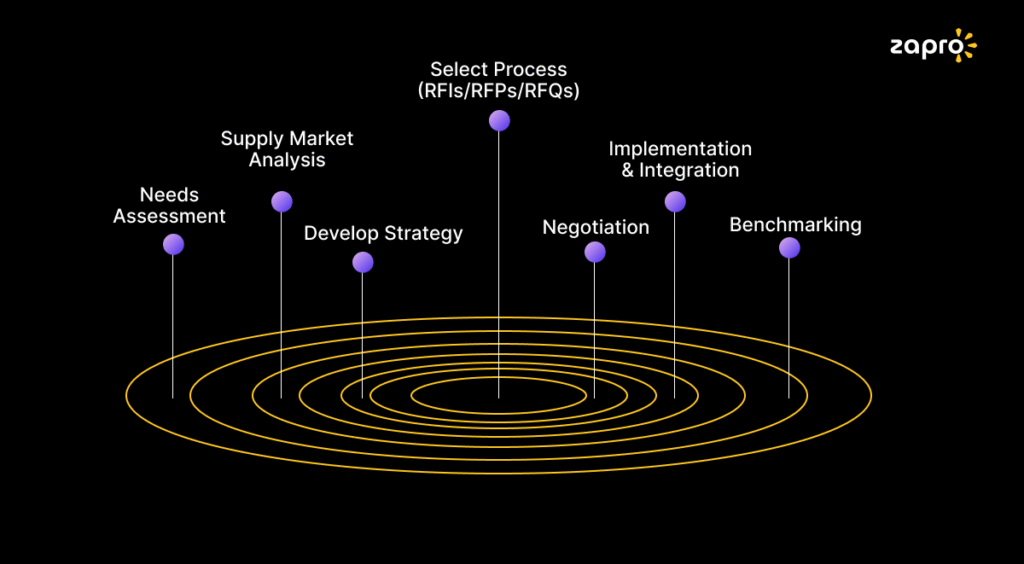
7 Steps in the Strategic Sourcing Process

7 Steps in the Strategic Sourcing Process

Let us discuss in detail the 7 steps that play a prominent role in the Strategic sourcing process:

Step 1: Needs Assessment

The needs assessment stage of the strategic sourcing process involves evaluating the present condition and understanding the company’s requirements for the goods or services to be sourced. This includes identifying the specific needs of the company in terms of quantity, quality, delivery times, and other factors, as well as considering the budget and other constraints that may impact the sourcing process.

The needs assessment stage is crucial in the strategic sourcing process as it helps identify the most suitable suppliers and negotiate the most suitable feasible terms for the goods or services it requires. This stage may include collecting and analyzing data on the supplier base. This would help decipher all gaps or weaknesses in the present sourcing strategy, therefore paving the way for greater understanding of the business’s requirements and goals.

The needs assessment stage might also include consulting with relevant stakeholders, such as department heads or key decision-makers. This would help in understanding the business’s needs and requirements.

Step 2: Supply Market Analysis

At this stage, the business aims to compile an ideal list of potential suppliers that can meet its needs. During this phase, the business team is likely to conduct market research, find new suppliers through online databases, and also keep the existing supplier relationships.

The stage is going to look into all the details, ranging from the quality, cost of the goods or services, the reputation and reliability of the supplier, and the delivery timeline. Also, it is important to keep an eye on the supplier location as it can impact delivery time and transit costs.

This stage of the strategic sourcing process demands the compilation of a diverse list of potential suppliers. This would open up opportunities and provide an extra hand in choosing from a wide range of options. Bottom line, it ensures that the business selects the ideal supplier to meet its requirements.  

Step 3: Develop a Strategic Sourcing Strategy

This step will help businesses ward off risks and extra expense by helping make the right decision on how and where to buy. It is good to go with the existing and potential supplier list to get good mileage from the supplier pool.

It is ideal to go with the selection based on your goals, capabilities, and resources. This can be achieved once the company’s purpose and the minimal requirements for suppliers are determined.

Quote icon

Successful companies have realized that defining such a strategy and its business benefits not only supports effective operations but also minimizes downstream vendor management risks.

Forrester report: Create An Effective Sourcing Strategy

Step 4: Select the Strategic Sourcing Process

After the supplier market research is done, requesting  RFIs, RFPs, and RFQs from suppliers is the 4th step of the strategic sourcing process. This helps in choosing the supplier and drafting the perfect negotiation plan. In order for the suppliers to understand the organizational demands, it is vital to share the requirements of the business.

Come up with appropriate plans for your company to meet its goals and submit a comprehensive proposal. The provided information should include important details, such as pricing structure, delivery options, warranty terms, product or service specifications, and more. After gathering this data, you can establish criteria for selecting suppliers based on your sourcing capabilities.

Step 5: Negotiation

Talking to the most preferred supplier numerous times is part of the plan. Always go with the pre-established standards in picking the favaroble provider. Ensure the contract is drafted and signed by both parties; for many, skip this important step and think about it later. Automating all the steps in the process allows software solutions to make contract management more efficient and easier to handle.

Step 6: Implementation and Integration

It is essential in strategic sourcing to keep in touch with suppliers. Send out messages to successful vendor management participating in the implementation stage. Maintain a good relationship with the vendors to increase cooperation. During the implementation stage, inform your vendors of all the developments and let them know about the meetings and conversations you had.

Step 7: Benchmarking

The supplier selection and onboarding process marks the initial step in your strategic sourcing efforts. The final and most critical phase involves accurately assessing how suppliers perform about the organization’s needs and goals. Assess their performance according to the terms and conditions mentioned in the contract.

It is important to keep a tab on supplier performance at regular intervals and determine options for improvement. This practice helps businesses identify supplier risks and create strategies to avoid supply chain disruptions in the future.

The evolving corporate environment, the changing trends, new tools, and techniques demand the best approaches to stay in the market. As a result, Strategic sourcing is not a one-time step up and move on; it is an ongoing process. If the contract is about to expire, it is important to run a deep study on its importance in all the related processes, spend data, and market research. Also, keep it open for negotiations if needed.

Streamline Your Strategic Sourcing Process With Zapro.ai

The Zapro.ai platform lets organizations customize according to their business needs, thereby, providing a strategic advantage. Therefore, it is easy for the organization to manage strategic sourcing and run the procurement processes hassle-free.

The strategic sourcing process comprises numerous steps from identifying a potential supplier to evaluating their suitability for the business, negotiating terms and contracts, and then establishing long-term working relationships. Zapro.ai offers a comprehensive platform to ensure the smooth running of the process. It provides a 360-degree view in each step, which helps identify the milestones and potential bottlenecks.

Zapro.ai effortlessly eliminates many manual tasks that work with strategic sourcing. By doing so, it helps save a lot of time and increases efficiency. Do you want to know how it will work for your business? Talk to our experts for a free demo.

Businesses depend on Process Managers and Owners to enhance operations and boost efficiency. A low-code strategy simplifies workflow automation like never before. Discover how Zapro.ai revolutionizes process management.

Start using the Zapro.ai Platform and discover how to utilize its features for improved results.

Master the strategic sourcing process with ease.

Get Started Today!
Optimize Your P2P Cycle
Read More

Best Strategic Sourcing Software Tools in 2026

What is Strategic Sourcing Software?

Strategic sourcing software is a centralized platform that streamlines, automates, and optimizes the key processes involved in sourcing goods and services. It goes beyond basic procurement tools by focusing on long-term value creation, risk mitigation, and strategic supplier relationship management.

It primarily serves as a comprehensive workflow and analytics tool to help:

  • Supplier Discovery and Management: Identify, qualify, and onboard suppliers efficiently through supplier databases, RFx management, and online auctions.
  • Spend Analysis: Gain deep visibility into spending patterns across categories, departments, and suppliers to identify savings opportunities and improve budgeting.
  • Contract Lifecycle Management: Automate contract creation, negotiation, execution, and monitoring, ensuring compliance and reducing risk.
  • eSourcing and Auctions: Conduct online auctions and reverse auctions to drive competitive pricing and achieve significant cost savings.
  • Supplier Performance Management: Track supplier performance against key metrics, identify areas for improvement, and foster collaborative relationships.
  • Risk Management: Assess and mitigate supplier-related risks, including financial instability, supply chain disruptions, and compliance issues.
  • Collaboration: Improve communication and collaboration with the suppliers.

Throughout the sourcing lifecycle, the data generated by this software is vital for organizations to:

  • Enhance Operational Efficiency: Automate manual tasks and streamline workflows.
  • Improve Spend Visibility and Control: Gain a clear, real-time view of all procurement spending.
  • Strengthen Supplier Relationships: Foster collaboration and improve communication with suppliers.
  • Mitigate Risks: Proactively identify and manage supplier-related risks.
  • Drive Cost Savings: Identify and realize significant savings opportunities.

Why Strategic Sourcing Software is Important?

Here’s why strategic sourcing software is crucial, and how a connected platform like Zapro delivers value:

1. Comprehensive Spend Analysis and Visibility

Strategic sourcing software provides a single, unified view of all procurement spend data. This eliminates the reliance on disparate spreadsheets and emails, offering a clear, real-time picture of your organization’s spending across all categories, departments, and suppliers.

A common challenge is the lack of visibility into “maverick spending” – purchases made outside of established procurement processes. This hidden spending can undermine cost-saving efforts and increase risk. Imagine, you’ve negotiated a favorable contract with a preferred supplier, but departments continue to purchase from other vendors at higher prices.

Without centralized visibility, you’re unable to track this leakage and enforce compliance. Modern strategic sourcing software, like Zapro, automates data collection, cleansing, and analysis, providing accurate and timely insights into spending patterns. This allows you to identify maverick spending, consolidate suppliers, negotiate better contracts, and ensure compliance with procurement policies.

image 3
Zapro’s dashboard which gives a bird’s eye view view of all processes


2. Automated and Streamlined Sourcing Processes

Strategic sourcing software automates many of the manual, time-consuming tasks involved in the sourcing process, such as creating RFx documents, collecting and comparing bids, and managing supplier communications. A

ccording to Aberdeen Group research shows that automating the sourcing process can reduce cycle times by up to 50%. This automation frees up your procurement team to focus on higher-value strategic activities, such as building relationships with key suppliers, negotiating complex contracts, and driving innovation.

Zapro offers features like customizable workflows, automated bid analysis, e-signature capabilities, and integrated communication tools.

3. Enhanced Supplier Collaboration and Relationship Management

Strategic sourcing software facilitates better communication, collaboration, and relationship management with suppliers. It provides a secure platform for sharing information, exchanging documents, managing contracts, and tracking performance.

A study by The Hackett Group found that Companies with strong supplier collaboration programs achieve 10-15% higher levels of supplier performance.

For instance, Zapro can help you manage supplier onboarding, track performance against key metrics (KPIs), conduct regular performance reviews, and resolve issues quickly and efficiently. This fosters stronger, more collaborative relationships with your suppliers, resulting in better pricing, improved service levels, increased innovation, and reduced risk.

Quote icon

By leveraging strategic sourcing, businesses can achieve an average 10–20% cost reduction and improve supplier performance by up to 30%.

– Gartner, Magic Quadrant for Strategic Sourcing (2024)

4. Proactive Risk Management and Compliance

Strategic sourcing software helps you mitigate risks by providing tools for supplier risk assessment, contract management, and compliance tracking.

Consider a scenario where a key supplier faces financial difficulties or a major supply chain disruption. Without a robust sourcing system, identifying alternative suppliers and mitigating the impact can be a reactive, time-consuming, and costly process.

Modern strategic sourcing software, like Zapro, helps you proactively manage supplier risk by providing tools for:

  • Supplier Risk Assessment: Evaluating suppliers based on financial stability, operational capacity, and other risk factors.
  • Contract Compliance: Ensuring that all contracts comply with legal and regulatory requirements.
  • Performance Monitoring: Tracking supplier performance against agreed-upon metrics and identifying potential issues early.
  • Business Continuity Planning: Developing contingency plans to address potential disruptions.

Who Needs Strategic Sourcing Software?

The following industries and roles benefit significantly from strategic sourcing software:

  • Procurement Leaders Driving Digital Transformation: Organizations embracing digital procurement need a platform to leverage technologies like AI, machine learning, and data analytics to optimize sourcing. Strategic sourcing software provides the foundation for this transformation.
  • Companies with Complex Supply Chains: Managing a global network of suppliers across diverse categories requires a robust sourcing platform. Strategic sourcing software provides the visibility, control, and collaboration tools needed to manage this complexity.
  • Organizations with High Procurement Spend: For companies with significant procurement spending, even small improvements in efficiency and cost savings can have a substantial impact on the bottom line.
  • Government Agencies and Public Sector: Public sector procurement is subject to strict regulations and scrutiny. Strategic sourcing software helps ensure transparency, accountability, and compliance.
  • Businesses Across Industries: Manufacturing, retail, healthcare, technology, financial services, and other industries can all benefit from the streamlined processes, cost savings, and improved supplier relationships that strategic sourcing software enables.

Top 3 Strategic Sourcing Software Comparison

Feature/AspectZaproCoupaJaggaer
DeploymentCloud (SaaS)Cloud (SaaS)Cloud (SaaS), On-Premise (optional)
Target MarketMid-size to Large EnterprisesMid-size to Large EnterprisesMid-size to Large Enterprises, Public Sector
Key StrengthsComprehensive Platform, User-Friendly, AI-powered, Value focus, Strong AnalyticsUsability, Network Effects, Comprehensive P2P, Rapid DeploymentDirect Materials Focus, Industry-Specific Solutions, Configurable
Potential WeaknessesNewer to market compared to established players (may have fewer integrations)Can be expensive, Some complexity in configurationUser Interface can be less intuitive, Reporting can be complex
Core ModulesSpend Analysis, eSourcing (RFx), eAuctions, Contract Management, Supplier Management, Workflow Automation, ReportingSpend Analysis, Sourcing, Contract Management, Supplier Management, Procure-to-Pay (P2P), Inventory Management, Travel & ExpenseSpend Analysis, Sourcing, Contract Management, Supplier Management, Supply Chain Collaboration, Quality Management, Direct Materials Sourcing
Spend AnalysisRobust, AI-powered, User-FriendlyStrong, Integrated with P2PDetailed, Customizable
eSourcing (RFx)Streamlined, AutomatedUser-Friendly, CollaborativeRobust, Configurable
eAuctionsSupported, IntegratedSupported, IntegratedSupported, Integrated
Contract ManagementCentralized, Automated, Version ControlCentralized, Integrated with Sourcing & P2PComprehensive, Configurable Workflow
Supplier ManagementComprehensive, Performance Tracking, Risk AssessmentNetwork-Based, Risk ManagementDetailed, Performance Management
Workflow AutomationConfigurable, User-FriendlyExtensive, CustomizableConfigurable, Powerful
Reporting & AnalyticsReal-time Dashboards, CustomizableComprehensive, Pre-built ReportsCustomizable, Drill-Down Capabilities
AI CapabilitiesYes (Integrated)Yes (Coupa Community Intelligence)Limited
IntegrationsGrowing, API AvailableExtensive, Pre-built IntegrationsGood, API Available
Mobile AppYesYesYes


Final Thoughts

Strategic sourcing software is no longer a luxury; it’s a necessity for organizations that want to optimize their procurement processes, reduce costs, mitigate risks, and build stronger supplier relationships. The best time to adopt this is now!

The best time to adopt this strategy is now. The sooner you implement a strategic sourcing solution, the faster you can realize the benefits and gain a competitive advantage.

For enterprise businesses, SaaS-based strategic sourcing platforms like Zapro, GEP SMART, Ivalua and Zycus offer a compelling solution – service-oriented, flexible, scalable, and easy to integrate.

It’s time to move beyond spreadsheets and emails and embrace the power of strategic sourcing. Zapro, along with the other solutions highlighted, provides the tools and insights you need to transform your procurement function from a cost center to a strategic value driver.

Zapro empowers your team to:

  • Gain complete visibility into your spend.
  • Automate manual sourcing tasks.
  • Negotiate better contracts with suppliers.
  • Proactively manage supplier risk.
  • Drive significant cost savings.
  • Collaborate more with stakeholders.

Optimize your sourcing processes, reduce costs, and build a more resilient and agile supply chain.

Sign up for a personalized demo of Zapro and see how effortless strategic sourcing can be!

Unlock Smarter Sourcing — Start Driving Savings and Supplier Success Today!

Get Started Today!
Optimize Your P2P Cycle

Read More

Sourcing vs Procurement: What’s the Difference?

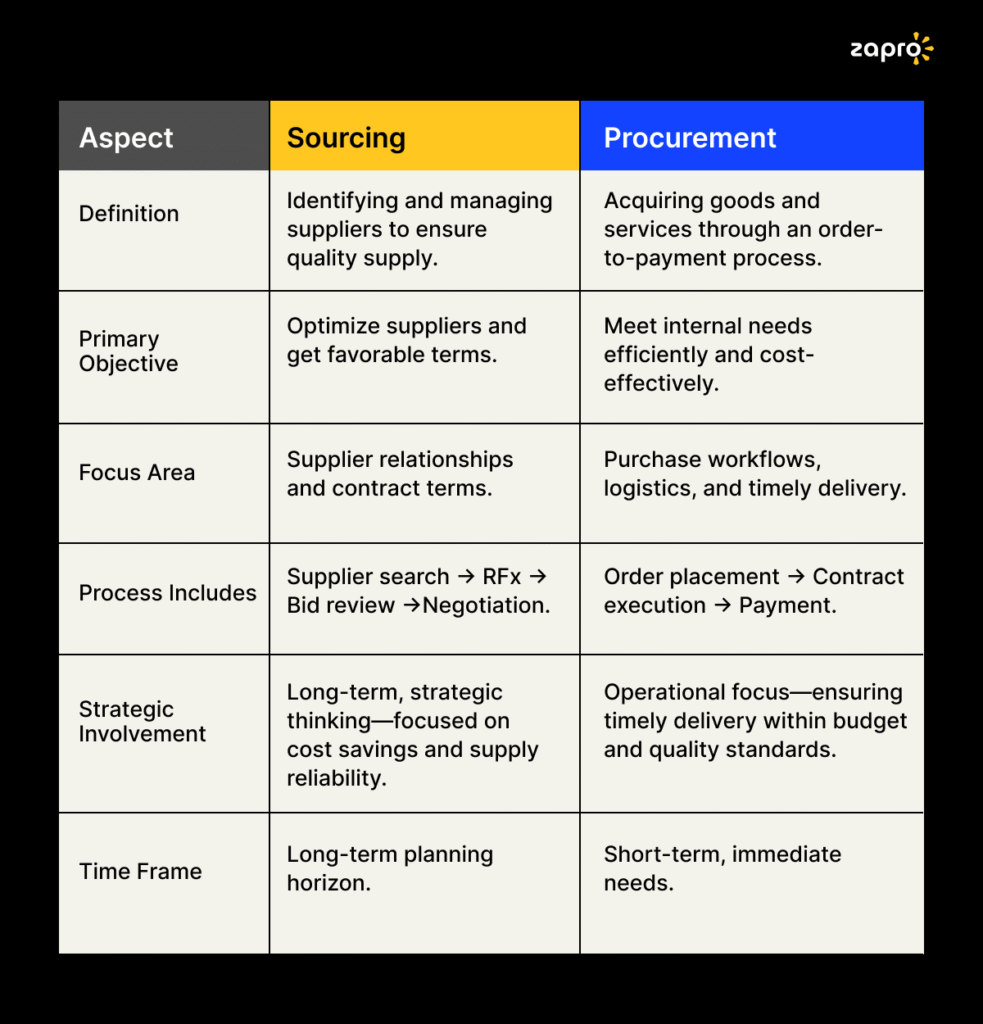
Sourcing is just another way that people talk about the process of strategically finding, assessing, and choosing suppliers. Procurement, on the other hand, is more about putting those choices into work through things like buying, making agreements, arranging for delivery, and handling payments.

Sourcing vs Procurement

For CFOs, the ability to discern these differences can significantly enhance strategic decision-making, allowing for a proactive approach in mitigating risks such as supply chain disruptions and cybersecurity threats. By harnessing an understanding of sourcing vs procurement, CFOs can implement sophisticated tools to streamline both processes, facilitating technology adoption and innovation. 

  • Sourcing: Encompasses the evaluation of suppliers and the establishment of strategic alliances that align with tech-specific objectives such as innovation and cost efficiency.
  • Procurement: Involves the practical aspects of requisition, purchase orders, and ensuring timely delivery and payment of technological assets.

By leveraging these key differences, CFOs can address challenges like talent shortages and slow procurement processes, ultimately transforming potential obstacles into opportunities to enhance procurement efficiency and create value through strategic partnerships and technology insights.

What is Sourcing?

Sourcing is far more than discovering suppliers. It is a strategic discipline focused on selecting vendors who align with rapidly evolving technological requirements.

In the technology sector, sourcing is foundational to managing supply chain volatility, vendor risk, and cybersecurity exposure. While procurement executes decisions, sourcing determines which decisions are worth executing in the first place.

Through structured RFP and RFx processes, suppliers are evaluated not only on cost, but also on:

  • Technical capability
  • Innovation readiness
  • Risk management posture
  • Compliance and security standards

By integrating analytics and market intelligence into sourcing, CFOs gain insight-driven clarity that enables better supplier selection. Ultimately, effective sourcing optimizes procurement by balancing cost efficiency with the agility required to keep pace with technological change.

The use of technology and analytics in sourcing equips CFOs with the insights needed to make strategic decisions, ensuring that procurement efforts deliver maximal value. Ultimately, effective sourcing optimizes procurement processes, balancing cost efficiency with the agility needed to stay abreast of technological advancements.  

What is Procurement?

Procurement is often mistakenly equated with purchasing, but it is, in reality, a strategic asset. Procurement is known as the orchestration layer that transforms sourcing decisions into measurable business outcomes.

For CFOs, procurement extends across:

  • Planning and budgeting
  • Contract negotiation and compliance
  • Supplier relationship management
  • Risk mitigation and governance

Whereas sourcing focuses on supplier selection, procurement ensures those relationships deliver value over time.

Modern procurement must be agile. It supports fast decision-making, rapid technology adoption, and operational continuity. By leveraging e-procurement platforms and automation, CFOs reduce friction, control costs, and align procurement with broader corporate responsibility and compliance goals.

In essence, procurement empowers organizations to acquire technology responsibly, efficiently, and strategically, positioning leaders to turn complexity into competitive advantage.

Quote icon

Sourcing scouts talent; procurement manages the team. It’s strategy first, execution second.

– Pierre Mitchell

Differences Between Sourcing vs Procurement

Here, we provide a comprehensive breakdown of their key differences between sourcing vs procurement to help you navigate these essential functions with greater clarity and efficiency. 

Learn more about Procurement vs. Strategic Sourcing.

The Critical Role of Procurement Software in Modern Business

For CFOs navigating technology procurement, procurement software is the linchpin that converts uncertainty into control. While the tech landscape shifts rapidly, procurement platforms provide the stability required to respond intelligently.

However, by integrating advanced procurement software, CFOs can mitigate risks associated with rapid technological shifts by leveraging AI-driven insights for smarter, data-backed decision-making. 

Adapting to Global Supply Chain Disruptions

Global supply chain disruptions, whether due to natural disasters or geopolitical developments, remain formidable concerns. A robust procurement platform offers real-time data visibility that empowers CFOs to swiftly adapt to changes, maintaining a steady flow of technology resources. It helps prepare for unforeseen events and ensures continuity in tech supply. 

Whereas traditional systems react late, modern procurement platforms anticipate and adapt.

Strengthening Cybersecurity in Procurement

An ideal procure-to-pay system not only safeguards data but also offers collaborative tools to work closely with IT security teams to incorporate risk mitigation strategies seamlessly into the procurement process. This alignment is vital for introducing new technology without opening security loopholes. 

Addressing Talent Shortages

Procurement software also addresses talent shortages in the procurement domain by allowing CFOs to streamline operations, thus making the process less reliant on large teams. It optimizes workflows and approval processes, reducing friction between employees and enhancing collaboration, which helps make technology adoption faster and smoother. 

Enhancing Innovation and Cost Efficiency

Through automation, spend analytics, and e-procurement systems, CFOs can cut costs while improving agility. While challenges persist, procurement technology unlocks innovation and operational excellence simultaneously.

Building Strategic Partnerships

Furthermore, CFOs can build strategic partnerships with suppliers using these tools. The procurement software facilitates stronger connections, unlocking benefits like preferential pricing and early access to emerging innovations. By fostering these relationships and investing in a skilled procurement team, CFOs are better positioned to navigate complexities in tech procurement. 

Diversifying and Risk Management

Diversifying supplier bases is critical to resilience. Procurement technology helps CFOs identify alternative suppliers, assess risk exposure, and build layered defenses against disruption.

Features of a Top-Tier Procurement System

A modern procurement system simplifies complexity while delivering insight. Platforms like Zapro combine automation, analytics, and collaboration to elevate both sourcing and procurement outcomes.

Let’s explore how these features can transform your sourcing vs procurement landscape, ensuring you remain competitive in an ever-evolving marketplace. 

  1. Effortless Sourcing and Onboarding: Simplify the technology procurement process with intuitive features that adapt to rapid technological changes and ensure your team stays current.
  2. Complex Requirements Made Easy: Seamlessly integrate intricate approval flows to guarantee robust procurement processes, addressing the slow purchasing challenges and streamlining the adoption of emerging technologies.
  3. AI-Driven Insights for Smart Decisions: Utilize advanced AI to keep abreast of market trends and identify optimal sourcing strategies, effectively managing cybersecurity risks and ensuring informed technology procurement decisions.
  4. Flexible Bidding at Your Fingertips: Customize and adapt your bidding strategies to swiftly navigate supply chain disruptions and enhance agility in procurement operations.
  5. Nudge Supplier Twice a Day: Enhance supplier engagement with timely reminders, fostering strategic partnerships that secure favorable pricing and early access to innovation.
  6. Choose Suppliers or Initiate Bidding: Easily select from existing suppliers or initiate competitive bidding processes to combat talent shortages, maintaining procurement efficiency and service levels.
  7. Make Risk and Compliance Integral: Incorporate crucial risk management and compliance measures into your awards, effectively mitigating supply chain and cybersecurity risks.

Learn about Procurement vs contract management.

Why Choose Zapro: A Game Changer in Procurement

Zapro is built to simplify, streamline, and scale procurement. It enables organizations to identify the right suppliers, manage RFx processes, execute contracts, and control procurement end to end from a single platform.

While sourcing identifies opportunity, Zapro ensures procurement converts opportunity into results.

From RFI to RFP, live auctions to contract catalogs, Zapro supports both strategic and tactical buying with precision and speed.

Simplify, Streamline, and Succeed

Zapro empowers your procurement team to identify needs and overcome the challenges of supplier selection accurately. Whether you’re sourcing something as straightforward as a water bottle or navigating more intricate procurement scenarios, Zapro ensures you efficiently discern procurement costs and essential details, thus simplifying what can often be a daunting journey. 

Streamlined Approval Workflow

Procurement requests with Zapro travel through a streamlined managerial workflow, typically moving from managerial approvals to the procurement team seamlessly. Meanwhile, senior roles have the flexibility to expedite the process by directing requests straight to procurement, resulting in an efficient and accelerated approval process. 

Engaging the Procurement Process

The procurement process at Zapro empowers teams to engage deeply in the quotation phase. This stage involves exploring diverse manufacturing options, gaining clarity on specifications such as size and functionality, and effectively communicating these requirements to suppliers. The meticulous quotation process ensures alignment with all essential criteria. 

The Sequential Steps: RFI to RFP

Beginning with the RFI (Request for Information) process, Zapro helps identify suppliers who meet specific requirements, leading into the RFQ (Request for Quotation) phase. This progresses to the RFP (Request for Proposal), where proposals are customized and new contracts initiated, culminating in a new catalog of signed agreements. 

Master Strategic and Tactical Buying

Master both strategic and tactical buying processes with Zapro’s ability to host live auctions, enabling suppliers to present their best offers. Whether managing vast networks or tailored purchasing needs, Zapro supports live bidding events that encourage competitive proposals, ensuring you remain agile and responsive in both strategic and tactical scenarios. 

The Future of Sourcing and Procurement

As a CFO navigating the complexities of technology procurement, you’re tasked with overcoming unique challenges in this ever-evolving industry. Rapid technological shifts make it difficult to keep pace with trends, requiring informed and agile procurement decisions. 

Additionally, global supply chain disruptions pose significant risks, necessitating proactive strategies to ensure your company maintains access to essential technologies. Cybersecurity is another concern, demanding collaboration with IT security teams to safeguard against potential threats. 

The scarcity of skilled procurement professionals adds another layer of complexity, while inefficient purchasing processes can stymie your organization’s innovation and agility. Also, friction between employees and the procurement team can impede progress due to misaligned priorities and misunderstandings. 

However, these challenges also present strategic opportunities. However, you cannot tap into these opportunities without a tactical procurement system like Zapro.Say goodbye to manual paperwork and embrace the efficiency of Zapro’s sourcing solutions

From managing all supplier interactions to streamlining strategic sourcing, procurement, contract management, inventory management, and more, Zapro integrates essential capabilities such as AP automation and spend analytics to offer a holistic procurement experience. 

Schedule a demo of Zapro today to level up your procurement capabilities, driving efficiency and value creation in your organization.

Streamline both sourcing and procurement with Zapro – all in one place.

Get Started Today!
Optimize Your P2P Cycle

FAQs

What is the difference between sourcing and procurement?

Sourcing and procurement hold distinct roles within the technology supply chain. While sourcing is centered around identifying the right suppliers and negotiating strategic partnerships, procurement is called as the function that manages the execution, logistics, and integration of those decisions into day-to-day operations.

How does sourcing support procurement?

Sourcing is the first step that picks out the best suppliers. Procurement is the stage that handles the work, and sourcing is the one that makes sure the activities done are in line with the overall strategy, innovation, and risk management.

Is sourcing a part of procurement?

Of course! The sourcing process is often referred to as an essential upstream component of procurement. It provides the necessary information for procurement decisions; meanwhile, procurement takes care of the supplier’s lifecycle and the delivery of operational outcomes.

When should you use sourcing vs procurement?

Use sourcing if you are deciding in a strategic way, who you want to partner with and how you want to set these partnerships ​‍​‌‍​‍‌​‍​‌‍​‍‌up.

Read More