

Buying things cheap is no longer the main focus of procurement. Organizations, in today’s economy, have to deal with rising procurement complexity that is largely a result of global supply chains, economic volatility, and the requirement for speed. If you do not have a clear view of the money that is being spent and in what manner, it will be very difficult to make the supply chain efficient and at the same time keep the costs under control. This is exactly the point where spend analysis in procurement comes to the rescue, which is a tool that helps to convert the raw transaction data into the strategic decisions that have a positive effect on the business growth.
What Is Spend Analysis in Procurement?
Spend analysis in procurement refers to a carefully planned series of activities that involve gathering, cleansing, categorizing, and analyzing an organization’s past purchasing data, with the objective of achieving a clear understanding of what the company buys, from which supplier, and at what price.
In fact, it is the moment in which the company uses a supply chain financial check-up to figure out its overall health. By reviewing the records of Accounts Payable, Purchase Orders, expense reports, and ERP data, procurement departments discover consumption patterns, cost-saving-focused initiatives, and the areas where regulations are not followed. Hence, the output of the exercise is the one and only correct data set giving the full picture of all external spending. Since Accounts Payable records are one of the primary data sources for spend analysis, capturing invoices at the point of entry through AP Automation Software gives procurement cleaner, more consistent transaction data to work with from the start.

By 2029, 80% of human decisions will be augmented by generative AI, transforming procurement operations.
– Gartner
Why Spend Analysis Matters
An accurate procurement spend analysis fundamentally changes the role of procurement from being a transactional department to a strategic one, thus enabling the business to realize benefits that are measurable.
- Cost Reduction: Through the process of maverick spending identification, elimination of duplicate payments, and detection of situations where multiple vendors are used for the same item, enterprises can effectively cut down on the unnecessary costs that are resulted by these activities.
- Supplier Consolidation: Spending on analysis uncovers that a company spends its money on different suppliers too much while not getting the most out of any single supplier. The main result of consolidating volumes to fewer, preferred suppliers is that companies get better contract terms and discounts.
- Contract Optimization: With spending data in hand, a procurement department can easily verify if the prices paid correspond to the contract terms. Besides, it offers the leverage that is needed for getting better terms at the time of renewal by showing the actual volume committed to a supplier.
- Risk Mitigation: Knowing who you are spending money with and how dependent you are on them, the process helps in the identification of risks of single-source supply as well as compliance issues (for example, expired insurance certificates or tax forms) that may result from these sources.
- Better Forecasting and Budgeting: By analyzing the past spend, finance teams get historical data that they can use to come up with realistic budgets and cash flow forecasts thus leading to overall financial stability.
Learn about saas procurement software
Transform Your Procurement Process with Ease

Key Components of Spend Analysis
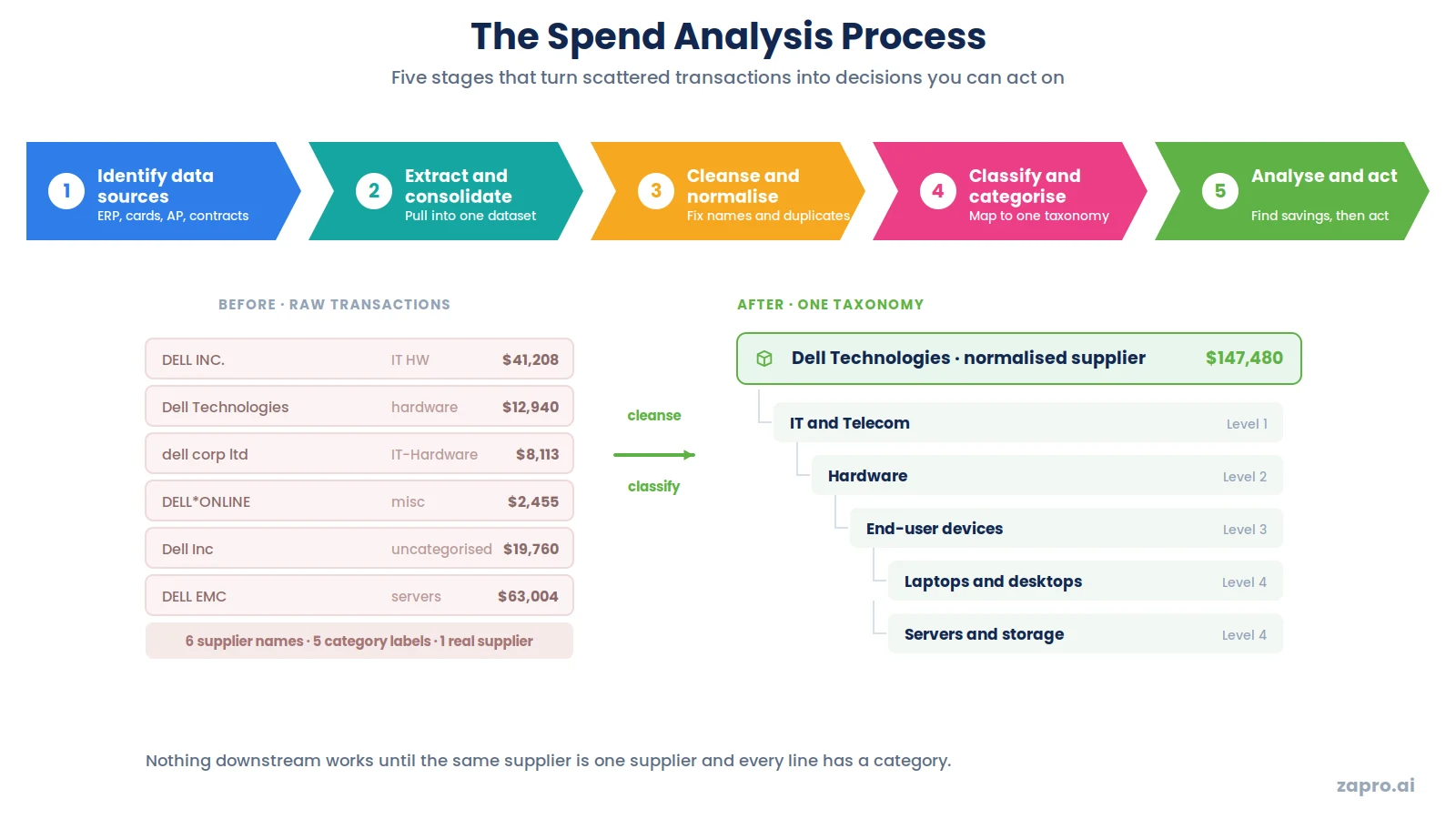
Spend analysis solution providers establish multiple essential steps to transform raw data into usable and reliable information.
Spend Data Collection
The process of collecting purchasing data requires access to all systems that contain this information including ERPs and Accounts Payable and credit card programs and expense management tools.
Spend analysis is only as clean as the transaction data feeding it. E-procurement software with built-in spend analytics captures that data at source – see the platform comparison.
Spend Data Cleansing
The process of data cleansing identifies and fixes all errors which appear as typographical errors and incorrect currency conversions and inconsistent formatting.
Spend Data Classification
The process of spend data classification uses standardized hierarchical categories (UNSpsc or internal codes) to organize all purchases. The system combines “laptops” purchased by IT with “computers” acquired by marketing teams.
Spend Data Enrichment
The process of spend data enrichment involves incorporating external data sources which include market commodity indices and supplier risk scores and compliance information to enhance understanding.
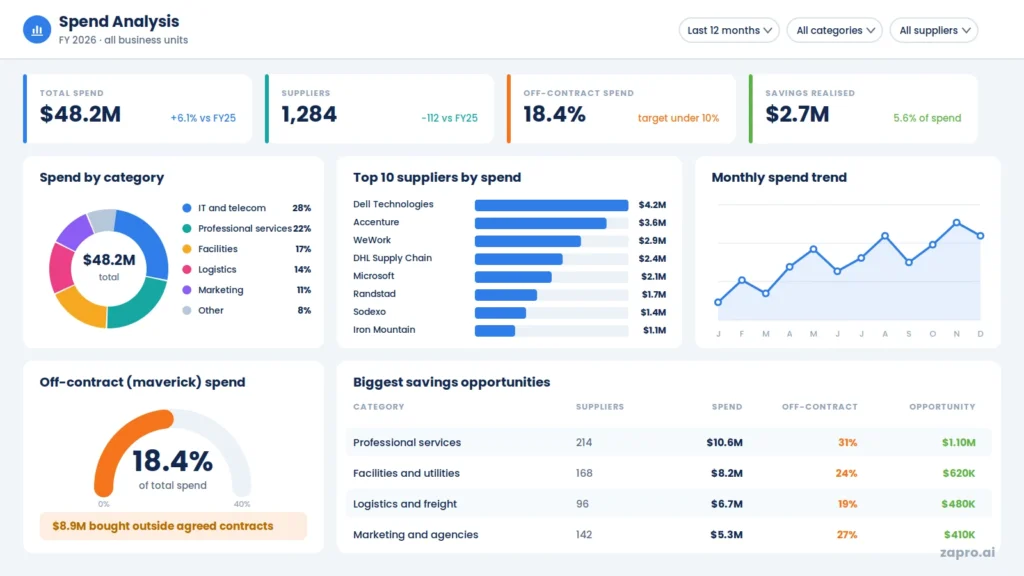
Reporting and Visualization
The system converts processed data into dashboards and reports which procurement leaders can use to obtain valuable decision-making information.
Spend Data Management Challenges
Organizations face their greatest challenge when it comes to spend data management because they use outdated or scattered systems.
- Fragmented Data Across Systems: The different systems which store data create problems because they maintain separate data silos for raw materials through legacy ERPs and travel expenses through expense tools and invoices through AP systems. The process of uniting these systems proves to be extremely difficult.
- Duplicate or Incomplete Data: The system contains duplicate entries and missing information which leads to incorrect spend total calculations.
- Inconsistent Supplier Naming: The different systems use different names to identify the same supplier which results in difficulties when trying to combine data from these systems.
- Manual Processing Limitations: The use of spreadsheets for data processing through manual methods leads to slow operations that cannot handle growing data volumes and produces significant errors which compromise the entire analysis.
Spend Analysis Tools for Procurement
Spend analysis tools for procurement refer to advanced digital platforms that are capable of automating the complicated data processing steps. These tools offer extreme speed, scale, and accuracy which cannot be achieved by a manual method.
What the Tools Do: The tools take in highly unorganized and hard to interpret data, and by doing so, they perform all the necessary steps of data cleansing, data classification, and data enrichment automatically.
Common Features:
- Automation: The data is automatically pulled and processed from the source systems which are already connected without the need for a human intervention.
- Classification: Employs AI and machine learning algorithms to determine the most accurate category for each spend item even in cases where vendor descriptions are highly unstructured.
- Dashboards: Offers the user the ability to interact with the visual summaries of the most important metrics such as spend by category, vendor, and business unit.
- AI Insights: This is a feature that shows the company where exactly the greatest opportunities lie. For example, it can say that “20% of tail spend could be consolidated to a single vendor.”
Benefits of Using Digital Tools: By having these tools at their disposal, procurement teams become capable of devoting less time to data management and more time to negotiation and execution which is a direct way of achieving higher savings.
Standalone analysis tools clean and classify data after the fact; end-to-end platforms capture it correctly at the point of purchase. Compare the best procurement software with spend analytics if you would rather fix the data at source than reclassify it every quarter.
Learn more about Vendor Performance Benchmarking.
How Spend Analysis Works (Step by Step Process)
Spend analysis is supported by a clear methodology which is very important to preserve data
1. Collection of the Data
This part determines the method of the systems from
2. Cleaning the Data
Standardizing all non-numeric data fields, correcting errors, and normalizing currencies and dates. This is the basis of data integrity.
3. Data Categorization
For each transaction a standardized category is assigned by using a classification scheme (e.g., all “office paper” and “printers” are grouped under “Office Supplies”).
4. Data Enrichment
Linking the data to internal budgets, contract IDs, and external data such as risk scores to make it more valuable.
5. Spend Evaluation
Examine the cleaned and categorized data, executing queries to address strategic questions such as, “What is our total spend with non-contracted suppliers?”
6. Insight Reporting
Reveal the results visually through dashboards, thereby making them readily accessible for
Spend Analysis Example
A basic spend analysis example demonstrates its ability to deliver valuable results.
The company’s AP system recorded 50 different cleaning supply vendors throughout the previous year. The spend data classification process followed by cleansing revealed that 90% of total spending occurred through five major vendors. The remaining 45 vendors made up only 10% of total spending which is known as tail spend.
The insight gained is clear: The procurement team can use their increased volume with the three preferred vendors to consolidate the 10% tail spend. The procurement team can use this new leverage to achieve price reductions between 5% and 10% for the entire cleaning supply category which will generate substantial yearly cost reductions and reduce vendor complexity.
Choosing the Right Spend Analysis Solution
When you are deciding on the best spend analysis solution you have to first figure out which capabilities will help you grow the most.
- Key Capabilities to Look For: Make sure that the tool is equipped with a robust AI-driven classification and automated data cleansing functionalities and not only that it is capable of simple reporting.
- Integration Requirements: In order to automate data collection, the solution should integrate without any interruption and deep with your existing ERP, accounting, and AP systems.
- Real Time Analytics: Select a tool that is capable of continuously processing data and thus can provide current or near real-time analytics and not only quarterly or monthly reports.
- Vendor Support: Get a provider who is able to help you through the initial as well as the ongoing data processes by providing quality customer support and having expertise in spend data management.
- Pricing: Spend analysis usually surfaces more savings than the platform costs in its first year. Compare procurement software pricing against the maverick spend identified above.
Conclusion
Spend analysis in procurement – Every organization that wants to achieve financial excellence through scaling or maturity needs to implement spend analysis as their core procurement process. The process eliminates all uncertainty from purchasing choices through the use of actual measurement data. Procurement teams can transition from basic cost control to strategic value generation through proper tool implementation and methodological approach which maximizes every dollar spent for business expansion.
Spend analysis is only as good as the data underneath it. See spend analysis running in a demo, with categorisation applied automatically.

Get Started with Procurement the Zapro Way
Simplify purchasing with Zapro — procurement made smarter and effortless.
FAQ
1. How does spend analysis help reduce procurement costs?
Spend analysis reduces costs by identifying non-compliant spending (maverick spend), highlighting opportunities to consolidate purchasing volume to gain leverage with suppliers, and revealing pricing errors or duplicate invoices.
2. What KPIs should be tracked during a spend analysis process?
Key Performance Indicators KPIs typically tracked include: spend under management, percentage of contracted spend, total spend by category, number of active suppliers, and savings achieved through consolidation or negotiation.
3. How often should organizations conduct spend analysis?
Ideally, organizations should use a digital tool to conduct spend analysis continuously, providing real time insights. If using a manual process, analysis should be performed at least quarterly to capture timely trends and prevent issues from escalating.
4. Is spend analysis useful for identifying supplier risks or fraud?
Yes. By linking financial data with compliance records, spend analysis can flag unusual payment patterns, payments to unverified suppliers, or high spend concentrated with vendors that have low risk scores, which helps mitigate fraud and risk.
5. What types of data sources are typically included in a spend analysis?
The analysis typically includes data from Accounts Payable AP files, Purchase Orders POs, general ledger transactions, corporate credit card statements, and employee expense reports.
Don’t miss our weekly updates
We’ll email you 1-3 times per week—and never share your information.
Let’s Streamline Your End-to-End Procurement
We’ll unify your P2P process and empower your team to work smarter.

About the Author

Md. Kafil