

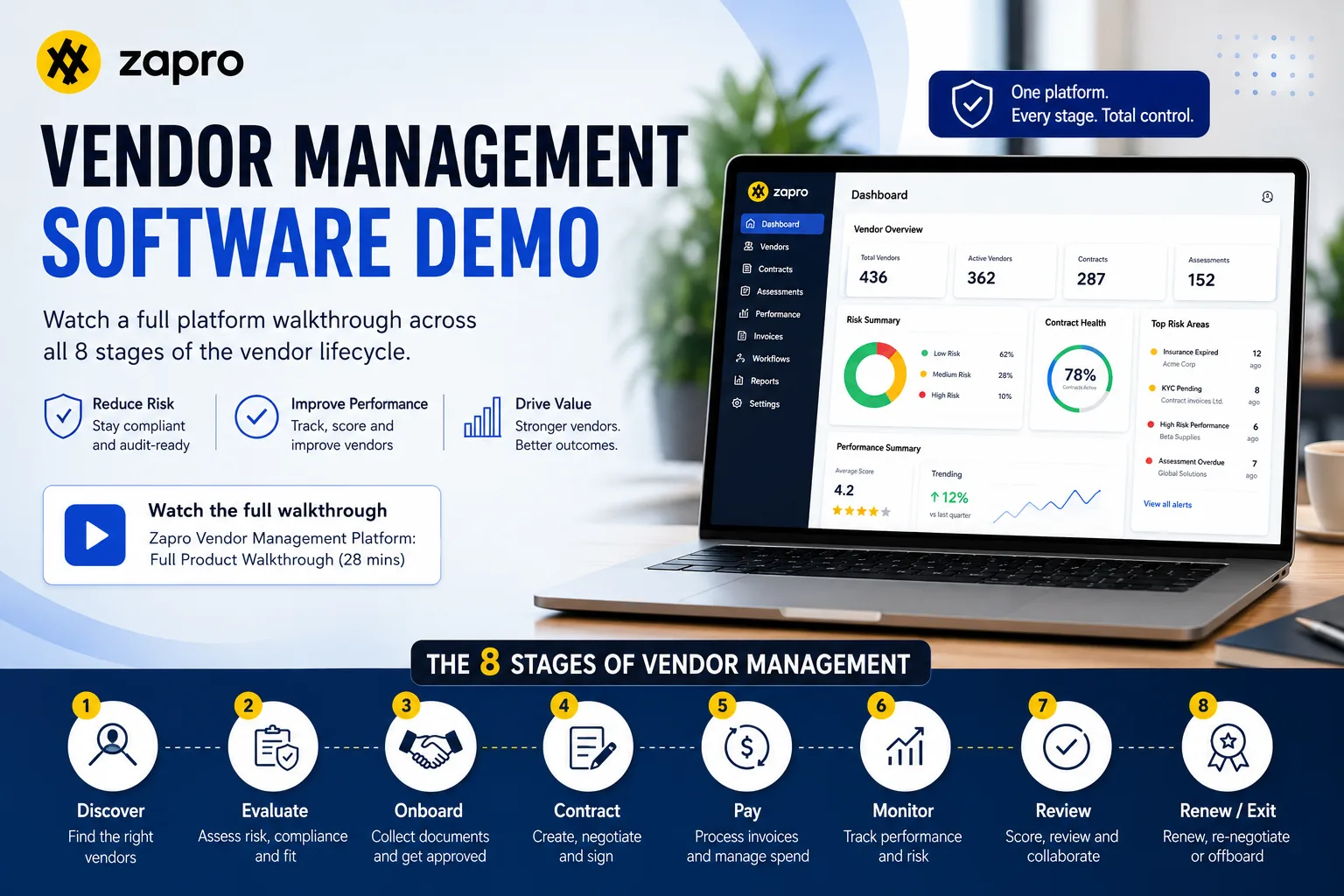
Vendor management is the work of keeping the companies you buy from in order. Finding the right one. Checking they are legitimate before any money moves. Signing them, paying them, and knowing two years later whether they delivered what they promised.
Vendor management software is a platform that handles the full supplier relationship, from the first conversation through to the performance review.
Watch the full Vendor Management Software demo video
A spreadsheet handles this for twenty vendors. It does not handle it for four hundred. Past a certain point, the work outgrows the people doing it, and the failures are quiet ones. A contract that renewed because nobody read the date. An insurance certificate that expired eight months ago. A vendor everyone assumes is fine because nobody has checked.
This page covers a complete vendor management software demo and platform walkthrough covering the eight stages of vendor management and showing how each stage works in Zapro.
This walkthrough runs entirely inside Zapro AI, so every stage shown below reflects what is live in the product today rather than a roadmap slide.
Vendor or supplier: which one are you managing?
The two words get swapped around constantly, so it helps to separate them early.
Anything that ends up inside your finished product came from a supplier. A battery maker shipping cells to a car plant is the clearest case, since their component leaves the factory inside the car. Everything else you buy comes from vendors, who support how the business runs rather than what it sells. Agencies, resellers, software providers, the company that books your flights.
Getting this right shapes your shortlist. If most of your buying is operational, tools built for supply chains will solve problems you don’t have and skip the ones you do, which are tracking contracts, catching renewals and keeping the relationship coherent.
Learn More: Vendor Management Guide
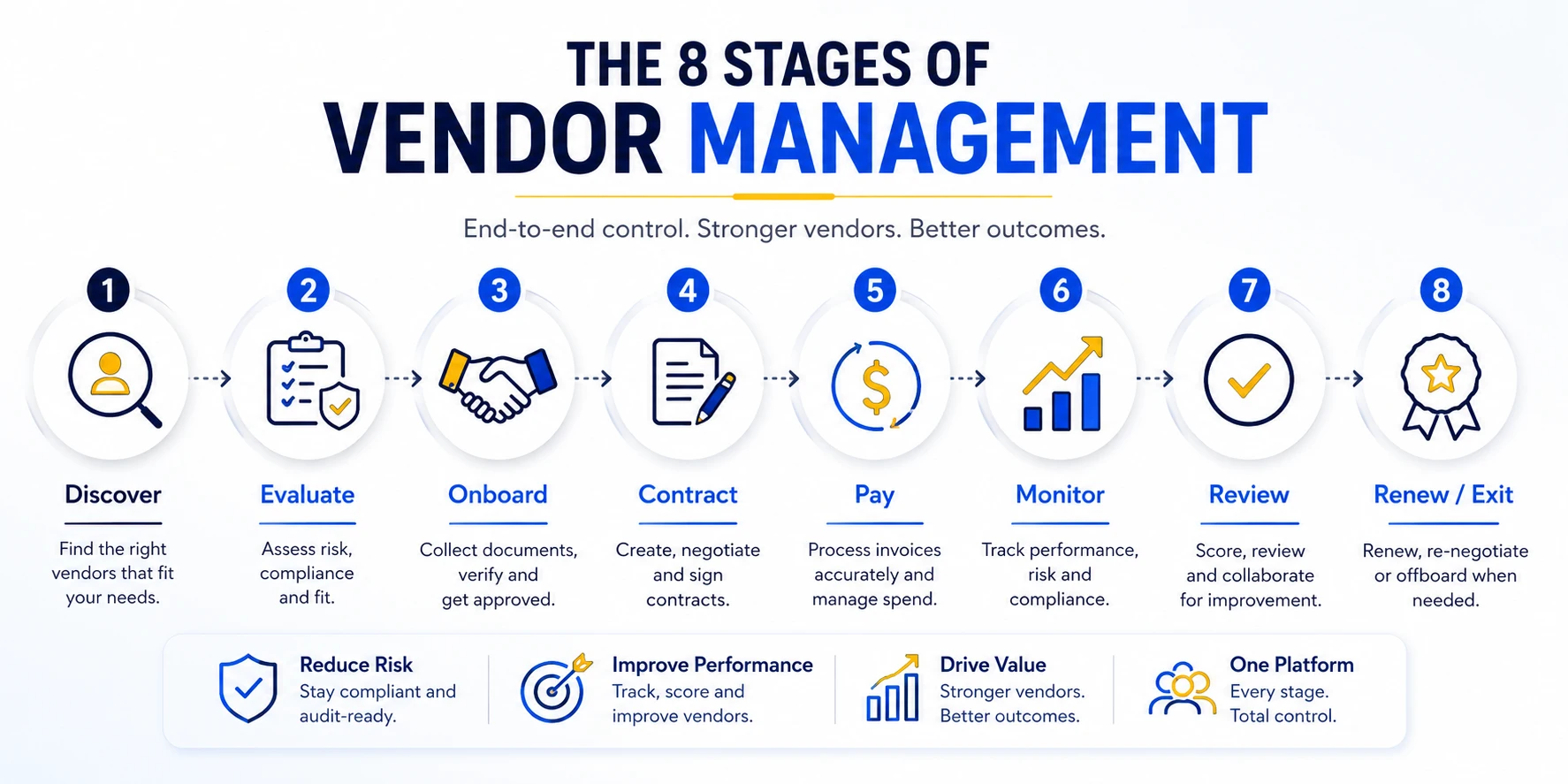
The eight stages, and what to look for in each
Vendor management breaks into eight stages. Below, each one gets three things: what it covers, what ought to appear on screen when someone demonstrates it, and a question worth putting to whoever is running the demo.
It’s worth knowing why the later stages exist at all. Most teams can stay properly on top of twenty or so vendors in a month, perhaps a hundred if things are quiet. Everyone else drifts, and the drifting is invisible until something has already lapsed.
Stage 1: Discovery
Discovery is the stage before any commitment. You identify candidates, compare what they offer, check what the market rate looks like and put a sourcing request together. Handled properly, that comparison takes place inside the platform, with the alternatives and their pricing recorded against the decision rather than scattered across email.
Zapro does not cover this yet. Discovery remains a manual process today, and our native Discovery module is in active development for release in the coming months. Until it ships, this is the one stage of the eight where the platform offers you nothing.
Stage 2: Onboarding
Onboarding brings a vendor into your systems and establishes that they are legitimate, solvent, appropriately certified and safe to pay. The work sits closer to legal review than administration, and it is where eligibility gets decided. A vendor can be entirely competent and still fail this stage because a certificate is absent or a registration does not verify.
In Zapro, the request passes through internal approval before it reaches the vendor’s own portal, and the chain stays visible throughout: who raised it, who reviewed it, and where it currently sits. Registration documents and certificates uploaded by the vendor are read by the platform and used to complete their onboarding form. The same applies from your side, so a certificate that arrives by email can be uploaded and the form populated from it.
The part of this stage worth examining most closely in any demo is a vendor changing their bank account details. Ask to see it performed: who is permitted to initiate the change, what verification runs before it takes effect, who has to approve it, and what the audit record retains afterwards.
Read: 7 Simple Steps for Vendor Onboarding Process
Stage 3: Contracting
Contracting turns an understanding into a signed agreement, and then keeps track of that agreement for however long it runs.
Some of this belongs outside any platform, and it’s worth being honest about which parts. Your legal team drafts in Word, as they always have. Zapro connects to DocuSign and Adobe Sign for signature, and our own authoring and in-app signing are in development for the coming months.
What the platform contributes now is a policy check that runs before anyone signs anything. Say your standard terms are sixty days and an agreement turns up at fifteen. Those forty-five days come straight out of working capital on every invoice the contract produces, and in practice nobody chose that outcome. Someone simply agreed terms without knowing the policy existed.
Signed contracts land in the contract library, which handles three things.
- Expiry and renewal alerts tell you what’s ending and when you need to make a decision about it.
- Obligation tracking is the one people misread. If you promised ten lakh of business and have spent six, the four lakh outstanding isn’t money in your pocket. That promise is why you were quoted the price you were quoted, so it’s a commitment with a deadline behind it.
- Invoice structures come in two shapes. Some contracts bill the same amount on the same day every month with nothing to check, which is a release. Others bill as work completes and need evidence before anyone pays, which is a milestone.
Book a free demo: Contract Management Software for the Full Contract Lifecycle
Stage 4: Transacting
Transacting covers requisitions, purchase orders and invoice matching. This is the procurement engine, and it is the stage most software presents as the entire discipline. For the invoice-matching piece specifically, Zapro’s AP Automation Software captures each vendor invoice, runs the three-way match against the PO and receipt, and routes the approval, which is the depth this walkthrough’s Stage 4 only summarizes.
What changes when the same platform already holds your onboarding and contracting history is the quality of what it can tell you mid-transaction. Raise a purchase order with a delivery date seven days out, and Zapro will point out that this vendor has historically taken twenty. It will also surface the 2.3 score your own users gave the vendor in the last performance round and ask whether the work should go elsewhere. Neither observation is available to a system that holds nothing but the order itself.
Watch Our Procurement Software Demo
Stage 5: Relationships
This stage exists because vendor history tends to accumulate inside individual mailboxes. Finance holds part of the record, the commercial team holds another, and there is usually correspondence nobody else has read. When the person at the centre of it leaves, their successor inherits an account number and very little context.
Zapro consolidates that history against the vendor: correspondence from across the business rather than only your own, call recordings and transcripts, summarised threads, open tasks, shared files and scheduled meetings. The test to apply in any demo is straightforward. If whoever owns this relationship resigned tomorrow, how much of it could their replacement reconstruct simply by reading?
Stage 6: Risk Management
Risk management is about your vendors, and whether they meet the standards you’ve committed to meeting yourself.
Most of the industry lumps risk in with compliance under the heading GRC, which obscures the fact that the two look in opposite directions. Splitting them makes both easier to evaluate.
Hold ISO, SOC 2 or GDPR obligations and your vendors take on a share of them. Your security team drafts a questionnaire, sends it out, and scores the answers. Is access to the premises controlled? Are the accounts filed and current? The stakes are practical rather than procedural, because an important vendor collapsing mid-contract lands squarely on you.
Zapro lets you build those questionnaires today, and a library of ready-made industry templates is due in the coming months.
As for our own posture: Zapro holds SOC 2 certification, operates in line with GDPR, and encrypts vendor, contract and financial data with AES-256 both in transit and at rest.
Stage 7: Compliance
Compliance faces inward, at your own organisation. Are the committees you are required to maintain actually meeting? Is your own team following the purchasing policy it approved? Are you meeting the standards you are auditing everyone else against? A substantial share of what gets recorded as vendor risk turns out, on inspection, to concern your own house rather than anyone else’s.
Compliance management is in active development for release in the coming months. Risk management, covered above, is available today. Worth asking any platform whether compliance is a genuinely separate module or the risk module relabelled, because the two are frequently sold as one.
Stage 8: Performance
Performance answers whether the vendor is doing the job: delivering on time, delivering in full, and billing you correctly for it.
It gets muddled with the relationship stage, though the two track different things. One is about how much contact you’re having. The other is about what arrives at the end of it.
Zapro tracks this at KPA level and builds it around you. During implementation, you tell us which indicators your business actually cares about, and we build those dashboards accordingly, on the reasonable assumption that a logistics business and a software business are watching for different things.
Why the order bends
Eight stages implies a sequence, and reality is looser than that. Two things are worth knowing before you evaluate any platform on how neatly it enforces process.
The first is that onboarding and contracting swap places regularly. Sometimes a vendor is onboarded and then signed. Sometimes a director signs an agency over lunch and the team onboards them afterwards so an invoice can be paid. Which way round depends on how urgent it is and who you’re dealing with, so any platform that insists on one order will get in your way.
The second is more fundamental. Where a vendor has the upper hand commercially, none of this applies. An airline will not renegotiate its payment terms for you, whatever your process says, because the volume you represent doesn’t warrant the conversation. You’ll pay in advance, on their paperwork, and adapt to them.
So the lifecycle describes the vendors you have leverage over. For the rest, you’re following someone else’s process, and no software changes that.
What to ask in any vendor management demo
Seventeen questions that hold up whether you’re evaluating Zapro or someone else entirely. Worth printing before the call.
Lifecycle coverage
- Which of the eight stages are live modules today, and which are still on the roadmap?
- Can you show me a vendor changing their bank account details, click by click?
- What happens when a vendor’s compliance certificate expires part-way through a contract?
- How does the system catch the same vendor being added twice?
- Does the contract module track outstanding obligation, or only remaining budget?
Integrations
- Which ERPs have ready-made connectors, which need building against an API, and which need middleware?
- Does data move one way or both ways, and does it update live or on a schedule?
- For each connector you’ve just named, is it available now or planned?
Access and permissions
- Can staff sign in with their existing work accounts, and does access end automatically when they leave?
- How precise do permissions get? Can a single field be hidden from a particular role?
Security
- Which security certifications do you hold, and how recent is the report?
- Can we choose the country our data is stored in?
- How long do you keep the audit log, and can anyone alter it?
Configuration and migration
- What can our own administrator change without opening a ticket with you?
- How do we get our existing vendor list in, and what happens to duplicates during import?
- What does moving off our current system involve in practice?
- What happens in the first ninety days after signing, and which parts are ours to do?
How the demo changes by company size
Fewer changes on screen than you’d expect. What changes is who’s sitting in the meeting.
Smaller and growing businesses. There’s rarely a procurement manager. The CFO tends to absorb the role, largely because the finance team is already handling supplier invoices through accounts payable, and sometimes it lands with whoever runs admin or facilities. These conversations concentrate on onboarding, contracting and the contract library, because the vendor list has outgrown whatever process was holding it together.
For SMBs walking into this conversation cold, it helps to see the landscape before the call. Our best vendor management software roundup scores twelve platforms specifically on onboarding speed, pricing transparency and time-to-value — the criteria that matter most before headcount catches up with vendor count.
Mature and manufacturing businesses. A procurement function exists in its own right, and the discussion turns to transaction volume, approval routing and ERP integration. More often than not, this is a procurement software conversation rather than a vendor management one.
Technology-led businesses. The CTO frequently owns it, since software suppliers are vendors too. Attention goes to renewals, visibility across a sprawling software estate, and risk questionnaires for anyone processing data on your behalf.
Zapro’s plans are tiered by vendor count, at ten, one hundred and one thousand.
Vendor management demo or procurement demo: which do you need?
If the pressing question is about approvals and transaction volume, book the procurement demo. If it’s about anything else on this page, book the vendor management one.
Procurement software arrived first and was designed around routing. A five hundred rupee purchase takes one path, a five thousand rupee purchase takes another, software requests go to one approver and hardware to a different one. That work is real, and it occupies stage four of eight.
If approvals and transaction volume are the more pressing concern, it is worth spending time with Zapro’s AI procurement platform directly, since it covers requisitions, purchase orders and invoice matching in far more depth than stage four of this walkthrough alone.
The trouble is that most of what surrounds it wasn’t on anyone’s mind when procurement software was designed. GDPR is recent. Measuring vendor performance systematically is recent. Recording a call and summarising a mail thread wasn’t technically possible. Those capabilities settled on top of procurement platforms until the original label stopped describing them.
Which is why the two demos answer different questions. A procurement demo shows you how an order gets approved. A vendor management demo shows you what happens to that vendor over the following five years.
Check out here: [Procurement software demo] · [Vendor Management vs Procurement]
FAQs
What is a vendor management software demo?
A vendor management software demo is a guided walkthrough of a platform covering the full supplier lifecycle. A complete one runs through discovery, onboarding, contracting, transacting, relationships, risk, compliance and performance, rather than stopping at purchase orders and invoices.
How long does a vendor management demo take?
Live demos usually run 30 to 45 minutes and cover the three or four stages closest to your situation. Walking through all eight takes nearer an hour, which is why the recorded version on this page is chaptered so you can skip.
What is the difference between a vendor and a supplier?
A supplier’s goods end up inside your finished product, which places them in your manufacturing chain. A vendor supports operations instead, so agencies, resellers, software providers and service firms all qualify. Finance teams tend to say vendor; supply chain teams tend to say supplier.
The practical test cuts through the labels: if a relationship failing stops your delivery, manage it as a supplier no matter what your system calls it. For the fuller breakdown of how that reshapes contracts and ERP fields, see our guide to vendor or supplier classification.
Is vendor management software the same as procurement software?
No. Procurement software covers requisitions, purchase orders and invoice matching, which is a single stage of the lifecycle. Vendor management software includes that stage alongside onboarding, contracting, relationship history, risk assessment, compliance and performance measurement.
What should I ask during a vendor management software demo?
Ask which modules are live rather than planned, how a bank account change gets verified, which ERP connectors already exist, how precise permissions can be, and what your own administrator can change without opening a support ticket.
Do I need vendor management software if I only have 50 vendors?
Possibly not. Fifty vendors is workable with disciplined spreadsheets and a shared drive. The calculation changes once renewals, certificate expiries and performance reviews start slipping because nobody has the hours to keep track of them all.
Does vendor management software replace our ERP?
No. It runs alongside the ERP and passes transactional data across. Your ERP stays the financial system of record, while the vendor management platform holds the lifecycle, documents, correspondence and compliance evidence for each vendor.
How does AI change vendor management?
AI absorbs the work that doesn’t scale with headcount: issuing performance surveys, chasing questionnaires, following up purchase orders and flagging expiring certificates across the whole vendor base, while people keep hold of the decisions that need judgement.
Don’t miss our weekly updates
We’ll email you 1-3 times per week—and never share your information.
About the Author

Md. Kafil


About the Reviewer

Zapro is dedicated to helping businesses of all sizes make informed decisions. We adhere to strict editorial guidelines to ensure that our content meets and maintains our high standards.
Our editorial standards help keep every article accurate, useful, and trustworthy.
Related Blogs