A procurement audit helps organizations check how purchasing activities are managed and controlled. It reviews whether procurement follows internal policies and external regulations consistently. Many global organizations rely on procurement audits to reduce risk and improve accountability. These audits bring visibility into spending, supplier relationships, and approval practices. A strong procurement audit supports better governance across departments and regions. It also helps leadership trust procurement decisions with confidence.
TL;DR / Key Takeaways:
- A procurement audit checks three things: policy compliance, control effectiveness, and where money is leaking.
- The audit trail is only auditable if every purchase has a requisition, an approval, a PO, a goods received note, and a matched invoice. Auditors work backwards from the ledger to the source document, which is why understanding T-accounts helps you anticipate what they will ask for.
- Segregation of duties is a primary focus — the person who raises a PO should not also approve and pay it.
- Vendor master integrity is a common finding: duplicate, dormant, and unverified vendor records are fraud and error risks.
- Off-contract (maverick) spend and split purchases to dodge approval thresholds are the classic leakage patterns audits surface.
- A clean audit is a byproduct of good systems, not heroic preparation — enforced workflows produce the evidence automatically.
- Every finding needs an owner, a corrective action, and a deadline, or the same issues recur at the next audit.
What Is a Procurement Audit?
| Definition: Procurement Audit refers to a comprehensive examination of procurement policies, procedures, and transactions. Its purpose is to test the extent to which purchasing activities are in compliance with approved rules and documented procedures. |
The procurement audit also ensures that expenditure is consistent with budgets and contractual terms. Procurement auditing emphasizes openness, control, and compliance throughout the purchasing lifecycle. It enables companies to pinpoint procurement weaknesses that result from inefficient management and that expose them to risks. Generally speaking, procurement standards issued by audit bodies are used as guidance bankers for such procurement reviews.

Key Objectives of a Procurement Audit
A procurement audit is conducted to protect the organization from financial and operational risks. It ensures procurement activities follow approved policies and regulatory requirements. Audits also help detect fraud and prevent unauthorized or maverick spending. Another objective is validating contracts, approvals, and pricing accuracy. Procurement audits improve cost efficiency by identifying waste and inefficiencies. They also strengthen supplier accountability through performance and compliance checks.
- Ensure policy compliance
- Prevent fraud and maverick spend
- Validate contracts and approvals
- Improve cost efficiency
- Strengthen supplier accountability
Learn about procurement software.

By 2027, 85% of procurement organizations will still be improving data quality to exploit efficiencies from advanced technologies such as GenAI.
– Lynne Phelan, VP Analyst, Gartner
Key Areas Reviewed in a Procurement Audit
Procurement audits cover multiple areas to give a complete picture of purchasing health. Compliance and governance review policies, approval flows, and regulatory adherence. Financial controls focus on invoices, spending accuracy, and three way matching processes. Risk management examines fraud exposure, supplier dependency, and supply continuity. Performance evaluation reviews supplier KPIs and internal process bottlenecks. Together, these areas ensure procurement operations remain controlled and reliable.
- Compliance & Governance: Policies, approvals, regulations
- Financial Controls: Invoices, spend, 3-way matching
- Risk Management: Fraud, supply risk, vendor dependency
- Performance Evaluation: Supplier KPIs, process bottlenecks
Procurement Audit Process Step by Step
A procurement audit helps organizations evaluate how purchasing activities are managed, controlled, and aligned with internal policies and external regulations. Through structured procurement auditing, businesses gain visibility into spending, supplier performance, and compliance practices. Using a standardized procurement audit checklist or procurement checklist template also helps organizations maintain consistency across departments and regions, especially for international audit procurement requirements.
Here is a step-by-step guide to conducting effective procurement audits.
1. Define Audit Scope
Start by clearly outlining what the audit procurement process will cover. This may include specific departments, vendor categories, procurement transactions, or defined time periods. A well-defined scope ensures the procurement audit remains focused and aligned with business goals.
2. Assemble Audit Team
Form a cross-functional team with members from procurement, finance, compliance, and internal audit. A diverse audit team improves accuracy and ensures the procurement auditing process evaluates financial, operational, and regulatory aspects effectively.
3. Collect Procurement Data
Gather all relevant documents, including purchase orders, invoices, supplier agreements, approval records, and transaction histories. Comprehensive data collection is essential for accurate procurement audit results and supports global procurement international audit standards.
4. Review Contracts and Compliance
Evaluate supplier contracts, pricing terms, service-level agreements, and compliance requirements. This step ensures procurement activities follow internal policies, legal obligations, and regulatory frameworks.
5. Perform Three-Way Matching Checks
Validate transactions by comparing purchase orders, goods receipts, and invoices. Three-way matching helps detect discrepancies, prevent fraud, and ensure payment accuracy during procurement audits.
6. Analyze Spend Patterns
Review procurement spending across departments, categories, and vendors. Spend analysis identifies cost-saving opportunities, highlights unusual transactions, and ensures budget compliance, especially when paired with procurement benchmarking against industry peers.
7. Evaluate Supplier Performance
Assess suppliers based on delivery timelines, product quality, pricing consistency, and service reliability. Supplier performance evaluation strengthens vendor accountability and improves procurement outcomes.
8. Document Findings and Corrective Actions
Record audit findings, identify risks or inefficiencies, and recommend corrective actions. Proper documentation supports continuous improvement, enhances governance, and strengthens future procurement auditing practices.
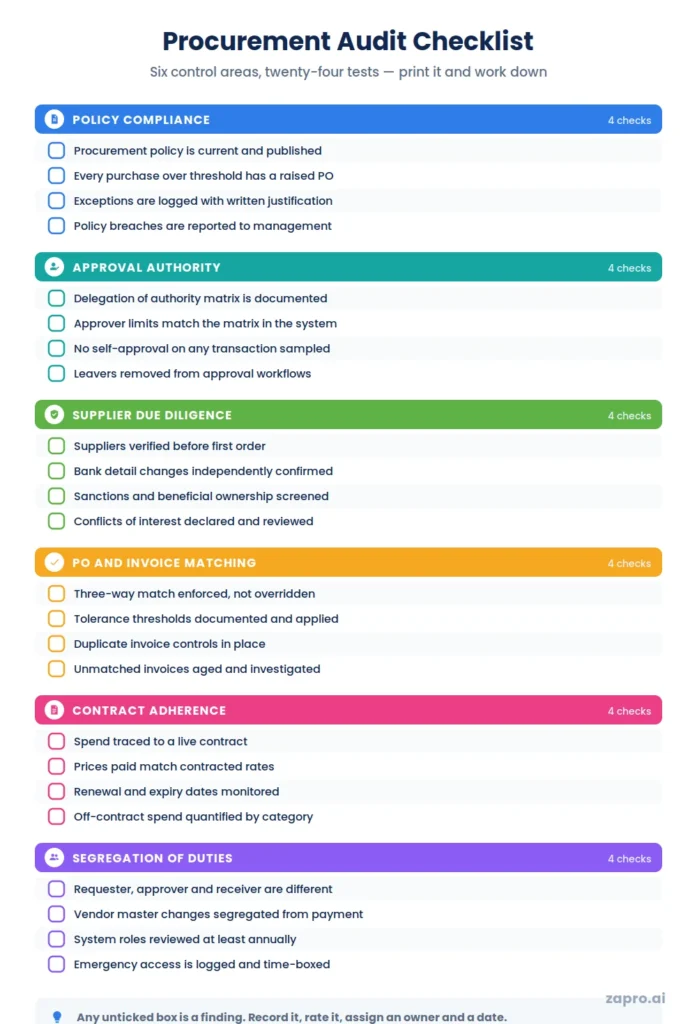
Procurement Audit Checklist
A procurement audit checklist helps teams review key areas consistently and thoroughly. It ensures no critical control or document is missed during the audit. Many organizations use a procurement checklist template for repeat audits. This checklist also supports international procurement audits across regions. Below is a commonly used procurement audit checklist.
| Area | What to Check |
| Purchase approvals | Authorized and documented |
| Contracts | Terms followed |
| Invoices | Price and quantity match |
| Suppliers | Performance and risk |
| Spend | Off contract purchases |
| Audit trails | Full traceability |
Types of Procurement Audits
1. Compliance Audit
A compliance audit evaluates whether procurement activities follow established laws, regulations, policies, and internal procedures. It ensures that purchasing processes adhere to organizational guidelines, contractual obligations, and ethical standards. The audit typically reviews procurement documentation, approval processes, and regulatory compliance to identify deviations and prevent legal or operational risks.
2. Financial Audit
A financial audit focuses on the accuracy and reliability of financial records related to procurement transactions. It verifies that purchases, payments, and contracts are properly recorded, authorized, and reported in financial statements. This audit helps detect errors, fraud, overpayments, or financial mismanagement while ensuring transparency and accountability in procurement spending.
3. Performance Audit
A performance audit assesses the efficiency, effectiveness, and value for money of procurement activities. It evaluates whether procurement processes achieve intended objectives, optimize costs, and deliver quality outcomes. The audit examines supplier performance, procurement timelines, cost management practices, and resource utilization to identify opportunities for improvement and operational excellence.
4. Vendor Risk Audit
A vendor risk audit evaluates potential risks associated with third-party suppliers and service providers. It examines factors such as vendor reliability, financial stability, security practices, regulatory compliance, and contract adherence. This audit helps organizations manage supplier-related risks, ensure business continuity, and maintain strong, secure vendor relationships.
Common Risks Identified in Procurement Audits
1. Maverick Spend
Maverick spend refers to purchases made outside established procurement policies or approved supplier agreements. It often occurs when employees bypass standard procedures, leading to higher costs, reduced negotiating power, and lack of spending visibility. This risk can result in budget overruns and compliance issues.
2. Overpayment
Overpayment occurs when an organization pays more than the agreed price for goods or services due to pricing errors, duplicate payments, incorrect invoices, or weak verification processes. This risk can lead to financial losses and indicates gaps in invoice validation and payment controls.
3. Weak Approval Controls
Weak approval controls arise when procurement processes lack proper authorization procedures or oversight. This can result in unauthorized purchases, fraud, or misuse of funds. Strong approval mechanisms help ensure accountability and prevent inappropriate spending.
4. Supplier Dependency
Supplier dependency occurs when an organization relies heavily on a single vendor or a limited number of suppliers. This increases risks related to supply disruptions, price increases, or reduced bargaining power, potentially affecting operational continuity and cost efficiency.
5. Data Security Gaps
Data security gaps involve vulnerabilities in systems that handle procurement data, such as supplier information, contracts, and financial records. Weak security measures can lead to data breaches, unauthorized access, and loss of sensitive information, posing operational and reputational risks.
How Often Should Procurement Be Audited?
Annual / Quarterly / Trigger-based
The time frame for auditing procurement is dependent on how big the organization is and how exposed it is to risks. The majority of companies consider procurement audits done annually to be a norm. There are some firms that are inclined towards quarterly audits on account of them having high spending categories. Trigger based audits are also an option after such events as fraud cases or breaches of policies. When it comes to international procurement, quite often the audit frequency is increased as requirements need to be met more strictly. As a matter of fact, if you keep on auditing regularly, control and compliance are never lost.
Benefits of a Procurement Audit
1. Cost Savings
Identifies inefficiencies, overpayments, and unnecessary spending in procurement processes. Helps optimize purchasing decisions and improve overall cost management.
2. Stronger Compliance
Ensures procurement activities follow organizational policies and regulatory requirements. Reduces legal risks and promotes transparency in purchasing practices.
3. Fraud Prevention
Detects irregularities, unauthorized transactions, and potential fraudulent activities. Strengthens internal controls and enhances accountability.
4. Better Vendor Performance
Evaluates supplier efficiency, reliability, and contract adherence. Encourages improved service quality and stronger supplier relationships.
5. Budget Control
Monitors procurement spending against planned budgets. Supports better financial planning and prevents overspending.
How Procurement Software Makes Audits Easier
Procurement Software aids in the facilitation of audits by integrating all the procurement data in one place. Additionally, it allows for automated approval workflows, thereby making documentation clearer.
The real-time nature of audit trails along with the provision of three-way matching help reduce invoice errors and cut the risk of overpayment. Auditors can swiftly get an overview of the patterns with the aid of a spend visibility dashboard. Zapro enables enterprises to be ‘audit-ready’ at all times since they record every purchase, approval, and contract in just one system. With Zapro you have access to:
- Centralized procurement data
- Automated approval workflows
- Real-time audit trails
- 3-way matching automation
- Spend visibility dashboards
Conclusion
A procurement audit is one of the most effective ways to oversee risk, compliance, and operational effectiveness. Organizations can rely on it as a tool to build confidence in their procurement activities. Financial control, supplier accountability and decision-making within procurement teams are all brought to a higher level by regular audits. The introduction of digital procurement systems has resulted in audits becoming quicker and more dependable. Consequently, solid auditing practices are indispensable assets required by procurement operations aspiring for robustness and transparency. Audit trails and compliance logging are standard on some plans and add-ons on others. See ai-powered procurement platform pricing and plans to confirm what each tier covers.
Audits go faster when the trail already exists. See an audit-ready trail in a demo – every approval, change and exception timestamped.

See procurement transformation in action.
Schedule a personalized demo with our experts today.
FAQs
1. What are the main types of procurement audits, and how do they differ?
Procurement audits include compliance, financial, performance, and vendor risk audits. Each one of these audits focuses on different controls and outcomes of procurement.
2. How can a procurement audit help identify maverick spend?
One of the ways in which audits assist in the discovery of maverick expenses is by scrutinizing the unauthorized purchases that have been carried out outside of the approved processes and contracts. It is evident that any off-policy or unauthorized spending patterns will be uncovered by such a method.
3. How often should a procurement audit be conducted?
Typically, companies perform procurement audits once or twice a year. Depending on the level of risk, some organizations are not opposed to triggering audits.
4. How do procurement audits support strategic sourcing and long term savings?
With the information gained courtesy of audits about inefficiencies, supplier-related problems, and spend leakages, procurement teams are in a better position to make sourcing decisions which, in turn, result in cost savings in the long term.
5. What is the main purpose of a procurement audit?
Ideally, a procurement audit systematically reviews an organization’s procurement processes and related activities. An ideal procurement audit evaluates a procurement function’s compliance, effectiveness, efficiency, risk management, transparency, and accountability.
6.How does PO automation improve audit readiness?
Auditors love PO Software because it keeps a perfect, unchangeable record of every purchase, who approved it, and when it was paid. It makes audits much faster and less stressful.
7. How do I get employees to stop buying outside the procurement process?
Maverick spend is usually a symptom of friction rather than defiance. People go around the process when it is slower than the alternative. The durable fixes are making intake genuinely easy, publishing preferred suppliers with pre-negotiated pricing so the compliant route is also the convenient one, and setting approval thresholds that do not send small routine purchases through a five-step chain. Then measure the share of spend arriving without a PO by department and give those numbers to budget owners, who tend to correct behaviour faster than policy memos do.
8. How do I run a procurement audit and what should the checklist cover?
A procurement audit tests whether spend followed policy and whether the controls behind it work. Auditors typically sample purchases to confirm an approved requisition preceded the order, that the approver was authorised at that value, that goods receipt and invoice match the PO, and that the supplier was properly onboarded and is not duplicated in the master. They also review contract coverage for major suppliers and segregation of duties. Systems that produce a timestamped audit trail automatically make this a reporting exercise rather than a document hunt. Many teams now enforce this specific check with AP Automation Software, which automatically blocks any invoice that doesn’t match its PO and goods receipt from moving to payment.
Don’t miss our weekly updates
We’ll email you 1-3 times per week—and never share your information.
Manual procurement holding you back?
Book a demo to discover how automation improves audit readiness and control.

About the Author

Md. Kafil