

Building a company is a bit like building a city; if the roads (your processes) aren’t designed correctly, you end up with constant traffic jams. In the world of business, procurement organizational structure is that road map.
It’s easy to think of procurement as just “the people who buy things,” but in 2026, that view is outdated. Today, your procurement structure determines how fast you can ship products, how well you protect customer data, and how effectively you manage vendor risk.
In this post, we break down how to structure your team for speed, safety, and scale.
What Is a Procurement Organizational Structure?
At its core, a procurement organizational structure is the framework that defines how a company identifies, vets, and pays its vendors. It isn’t just an org chart; it’s a map of decision rights. It determines who has the power to say “yes” to a new software tool and who is responsible for ensuring that tool doesn’t leak company data.
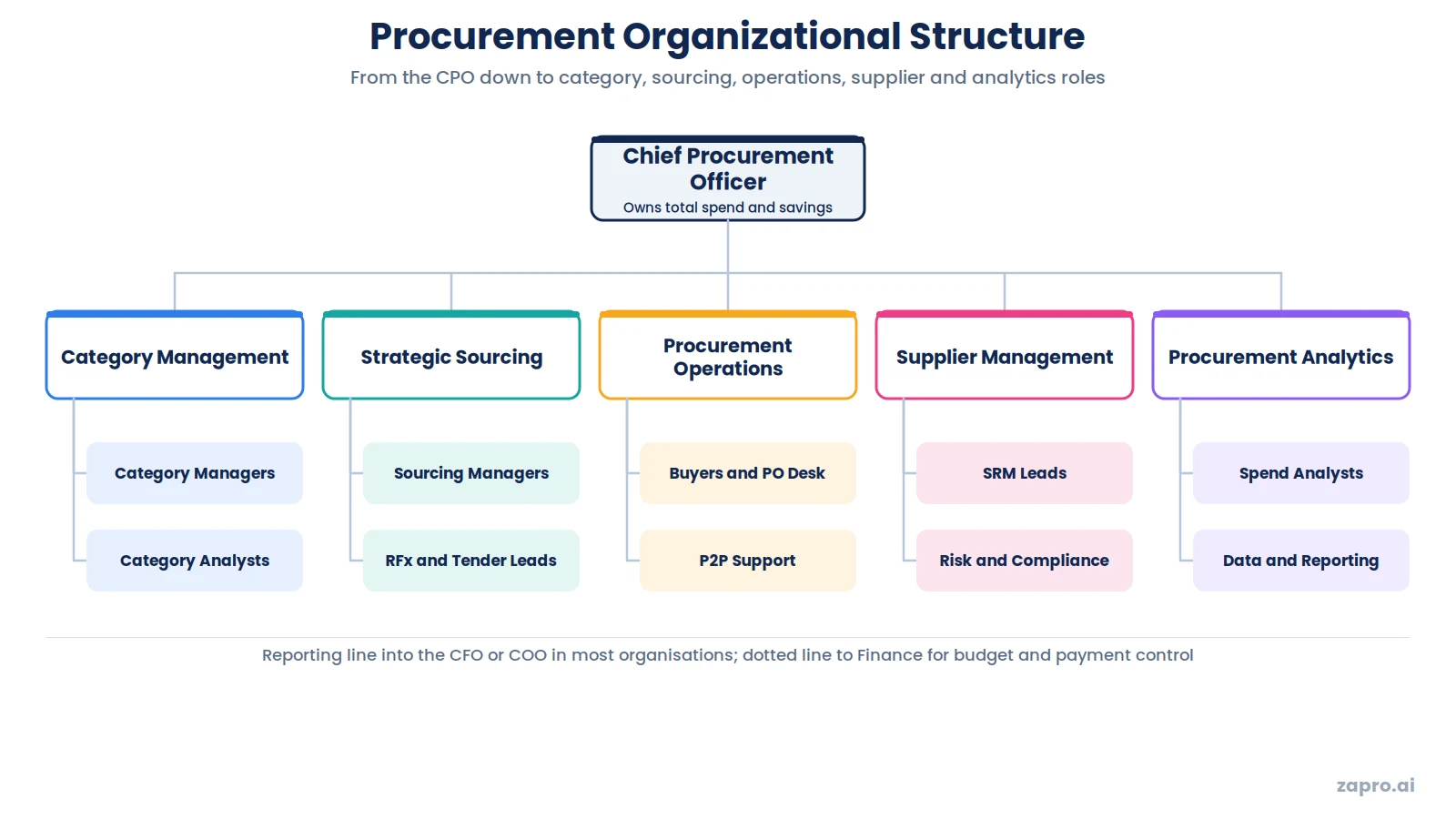
At Zapro, we believe procurement shouldn’t be a silo. A procurement organization structure must sit at the intersection of Finance, Legal, IT, and Security. When structured correctly, it acts as a control tower, ensuring that every dollar spent is a dollar protected.

Only about one-third of CEOs have an operating and business model fit for an AI-driven world.
– David Furlonger, Gartner Research, from the 2025 Gartner CEO
Why Procurement Organizational Structure Matters Today
The days of buying 500 desks once a year are over. We are living in the era of “Vendor Sprawl.”
A modern procurement organization has to deal with:
- SaaS Explosion: Departments now buy their own software, often leading to “Shadow IT.”
- Security Pressures: One unvetted vendor can lead to a massive data breach.
- Audit Readiness: Whether it’s SOC 2 or GDPR, your procurement structure needs to provide an instant paper trail.
If your structure is too rigid, teams will bypass it. If it’s too loose, you’ll end up with a compliance nightmare.
Types of Procurement Organizational Structures
There is no “perfect” model, but there is usually a “best” model for your specific stage of growth.
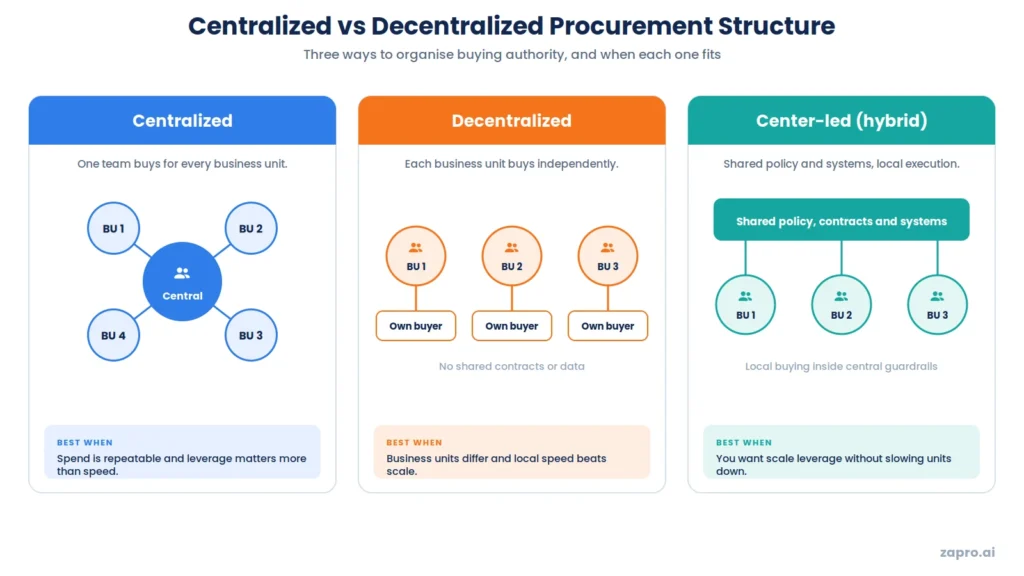
1. Centralized Procurement Structure
Everything goes through one headquarters team.
- Pros: Maximum cost control and rock-solid compliance.
- Cons: Can be slow and feel like a “bottleneck” to fast-moving teams.
- Best for: Large, highly regulated industries.
2. Decentralized Procurement Structure
Each department buys what they need, when they need it.
- Pros: Extremely fast and flexible.
- Cons: Zero visibility, duplicate vendors, and high security risk.
- Best for: Very early-stage startups (though it quickly becomes a liability).
3. Hybrid / Center-Led Procurement Model
This is the “sweet spot” for scaling SaaS companies. Strategic decisions (like security standards and contract templates) are centralized, but departments have the flexibility to choose the tools that help them work.
Zapro POV: For fast-growing companies, a center-led + tech-enabled model is the only way to scale. It provides the governance Finance needs without killing the speed of Engineering and Marketing demand.
Learn more about procurement tools.
Transform P2P with the Power of AI and Zapro.

Key Roles and Responsibilities in a Procurement Organization
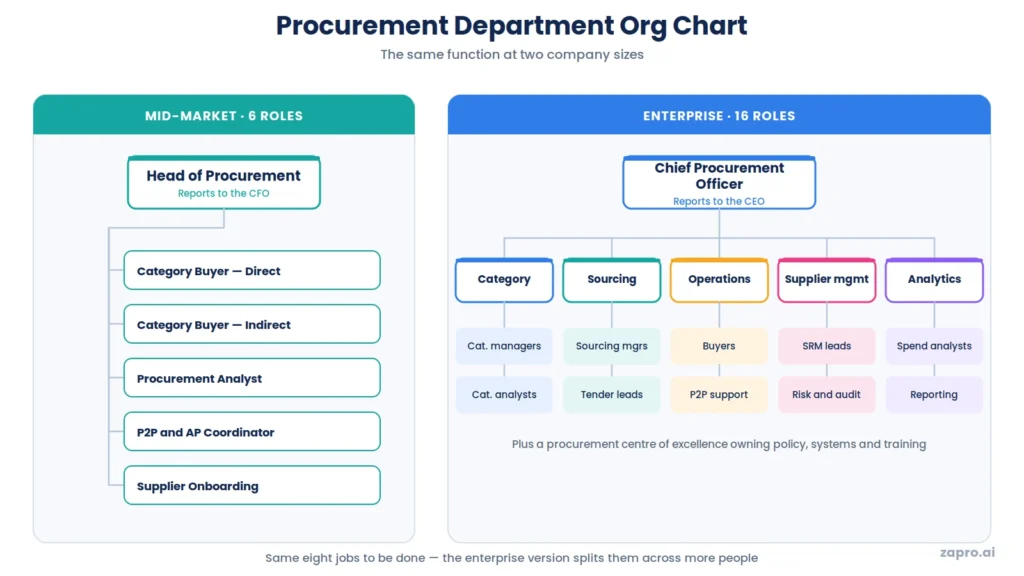
A healthy procurement team structure usually involves these key players:
- Chief Procurement Officer (CPO) / Head of Procurement: The strategist. They align spending with the company’s long-term goals.
- Procurement Manager: The executor. They manage the daily flow of requests and approvals.
- Category Managers: The specialists. They know the market for specific needs (e.g., a “SaaS Category Manager”).
- Procurement Operations: The “engine room.” They manage the tools and data that make the team run.
- Risk & Compliance Stakeholders: Often sitting in Legal or IT, these folks own the “security green light.”
Procurement Organizational Structure for SaaS & Software Companies
If you are a software company, your procurement structure for SaaS companies needs to be different. You aren’t buying raw materials; you’re buying subscriptions.
Your structure must account for:
- Auto-Renewals: A structure that doesn’t track expiration dates is a structure that wastes money.
- Security Reviews: Procurement must work hand-in-hand with InfoSec to review SOC 2 reports before a contract is signed.
- Cross-Functional Collaboration: A single SaaS purchase usually involves Finance (budget), IT (integration), Security (data), and Legal (contract).
Governance and Operating Model in Procurement
A procurement governance structure is basically the “Rule Book.” It defines:
- Spend Thresholds: Who can approve a $5,000 purchase vs. a $50,000 one?
- Decision Rights: Does IT have the final say on software, or does the department head?
- Vendor Approval Workflows: What steps must a vendor take before they are “onboarded”?
Governance ≠ Bureaucracy. When done right, governance actually increases speed because everyone knows the rules of the game.
Best Practices for Designing Your Structure
- Lifecycle First: Design your team around the vendor lifecycle (Onboarding → Management → Renewal → Exit).
- Separate Strategy from Ops: Let your Ops team handle the paperwork so your Managers can focus on negotiating better deals.
- Embed Compliance Early: Don’t wait until the end of a deal to ask for a security review. Make it part of the first step.
- Ditch the Spreadsheets: You cannot run a modern procurement organization on Excel. Enable your structure with a platform that automates the “busy work.”
Common Challenges (and How to Fix Them)
| Challenge | The Fix |
| Over-centralization | Move to a hybrid model; give departments more “self-service” power for low-cost items. |
| Shadow Procurement | Make the official process so easy and fast that people want to use it. |
| No Visibility | Centralize your vendor data. If you can’t see it, you can’t manage it. |
| Scaling Globally | Use a procurement operating model that supports multiple currencies and local tax laws. |
Conclusion
Your procurement organizational structure is the foundation of your company’s financial health. There is no one-size-fits-all, but the goal is always the same: speed with safety. For SaaS-heavy companies, this means building a vendor-centric, compliance-aware team that uses technology to stay agile.
Modern platforms are the “glue” that holds these structures together, allowing you to scale without adding endless layers of human bureaucracy. Centralised and decentralised structures need different user and vendor limits. See Zapro procurement pricing and plans to match your structure to a tier.
Roles and approval limits eventually have to live in software. See how the structure maps to a demo of configurable approval hierarchies. Team design and the procurement skills gap have their own track in 2026: Attracting & Retaining Talent at Gartner Procurement Conference 2026 covers closing that gap and managing generational shifts inside procurement organisations.

Step into the Future of Procurement with Zapro.
AI automation makes your P2P faster, smarter, and error-free.
FAQ
1. What is a procurement organizational structure?
It is the framework that determines how a company manages its purchasing, vendor relationships, and spending approvals. It defines roles, responsibilities, and decision-making power.
2, What are the different types of procurement structures?
The three main types are Centralized (one team holds all power), Decentralized (each department buys its own), and Hybrid/Center-Led (a mix of local flexibility and central control).
3. What is the best procurement structure for SaaS companies?
Usually, a Center-Led model is best. It allows the central team to set security and legal standards while letting individual departments choose the specific software tools they need to be productive.
4. What is the role of governance in procurement organizations?
Governance sets the rules for spending thresholds, vendor risk assessments, and approval workflows. It ensures the company stays compliant and within budget.
5. How does procurement structure impact compliance and risk?
A strong structure ensures that every vendor goes through a security and legal review before money is spent, significantly reducing the risk of data breaches or regulatory fines.
Don’t miss our weekly updates
We’ll email you 1-3 times per week—and never share your information.
Redefine Procurement Efficiency with Zapro.
Unlock AI-powered P2P automation to cut costs, save time, and scale with confidence.

About the Author

Md. Kafil