


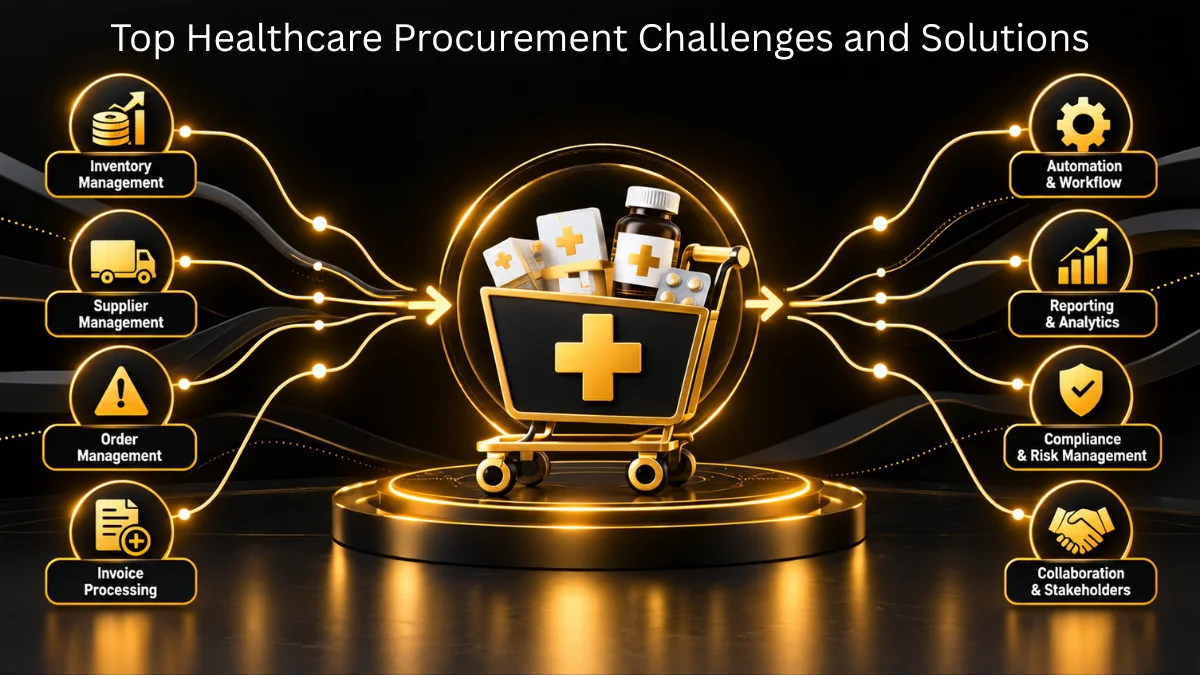
Majority of people immediately picture doctors and nurses when thinking about hospitals. Yet behind every triumphant surgery and every fully-stocked pharmacy, there is a complex logistics system operating quietly.
This article will explore the common procurement challenges faced by healthcare and how practical healthcare procurement solutions can address them.
What Is Procurement in Healthcare?
Essentially, procurement in healthcare is the process through which a facility identifies, negotiates for, and buys the medical supplies and equipment it requires.
Procurement in healthcare is different from the procurement in the typical retail business in that it covers a larger scale of items. It involves everything from sophisticated surgical robots through to everyday essentials like gloves, bandages, and saline bags.

In 2026, healthcare organizations (HCOs) will better align tech investments to add value to business processes. Using newfound efficiency gains, health insurers will expand advocacy programs to improve customer experiences.
– Forrester Predictions 2026: Healthcare
Importance of Procurement in the Healthcare Industry
The supply chain is what keeps the whole patient care system functioning. When there is a failure in the supply of materials, the whole hospital is affected, which is why disciplined hospital procurement is treated as a patient-safety priority, not just a back-office function.
Patient Safety: Nothing can be more dangerous than the risk that a medical part being unavailable or the medicine being expired poses to the patients.
Cost Management: As the hospital finances are being squeezed more and more, one of the most effective ways of cutting down the expenses is through clever sourcing.
Following Regulations: Hospitals are required to adhere to very strict rules imposed by such organizations as the FDA. It is imperative that every item purchased be tracked and verified.
Supplier Reliability: During a crisis, it is of the utmost importance to have trusted partners. Superior procurement will mean that your suppliers are able to come through even in situations of global shipping being at a standstill.
Common Healthcare Procurement Challenges
The challenges in procurement process within a hospital are unique. They are often slowed down by old computer systems and too much paperwork.
1. Lack of Spend Visibility
If you cannot see what you are spending, you cannot save money. Many hospitals deal with “maverick spending.” This happens when different departments buy their own supplies separately. It leads to missed discounts and overspending.
2. Regulatory and Compliance Complexity
The procurement in healthcare industry is governed by many rules. Trying to manually track certifications and safety standards for hundreds of different vendors is almost impossible and leads to mistakes.
3. Supplier Fragmentation and Data Silos
When the pharmacy uses one software and the surgical department uses another, information gets trapped. This makes it hard to see the total inventory or know if a vendor is doing a good job.
4. Inefficient Vendor Onboarding
Checking a new supplier takes time. You have to verify their licenses and history. Without a fast process, this can take weeks and delay the arrival of important equipment.
Fragmented supplier records are often at the root of onboarding delays; an AI Vendor Management tool can centralize vendor documentation so new suppliers are verified and ready to transact faster.
5. Inventory Shortages and Overstocking
It is a hard balance to strike. Having too little stock can cause doctors to cancel surgeries. Having too much stock leads to waste because medical supplies often have expiration dates.
6. Manual Procurement Processes
Even in 2026, many facilities still use spreadsheets and phone calls to order supplies. Manual work is slow and leads to human error.
Ready to Transform Your Healthcare Procurement?

Impact of Poor Procurement in Healthcare
If these healthcare procurement challenges are not fixed, the results can be serious:
- Higher Costs: Last-minute orders and emergency shipping fees are expensive.
- Delays in Treatment: Surgeons cannot work without their tools, which leads to longer wait times for patients.
- Fines and Penalties: If a hospital cannot show the paperwork for a medical device, they may face heavy fines during an audit.
- Lower Quality of Care: When nurses have to spend time looking for supplies, they have less time to spend with patients.
Solutions to Healthcare Procurement Challenges
The good news is that new tools, including the best procurement software available today, are making healthcare sourcing much easier.
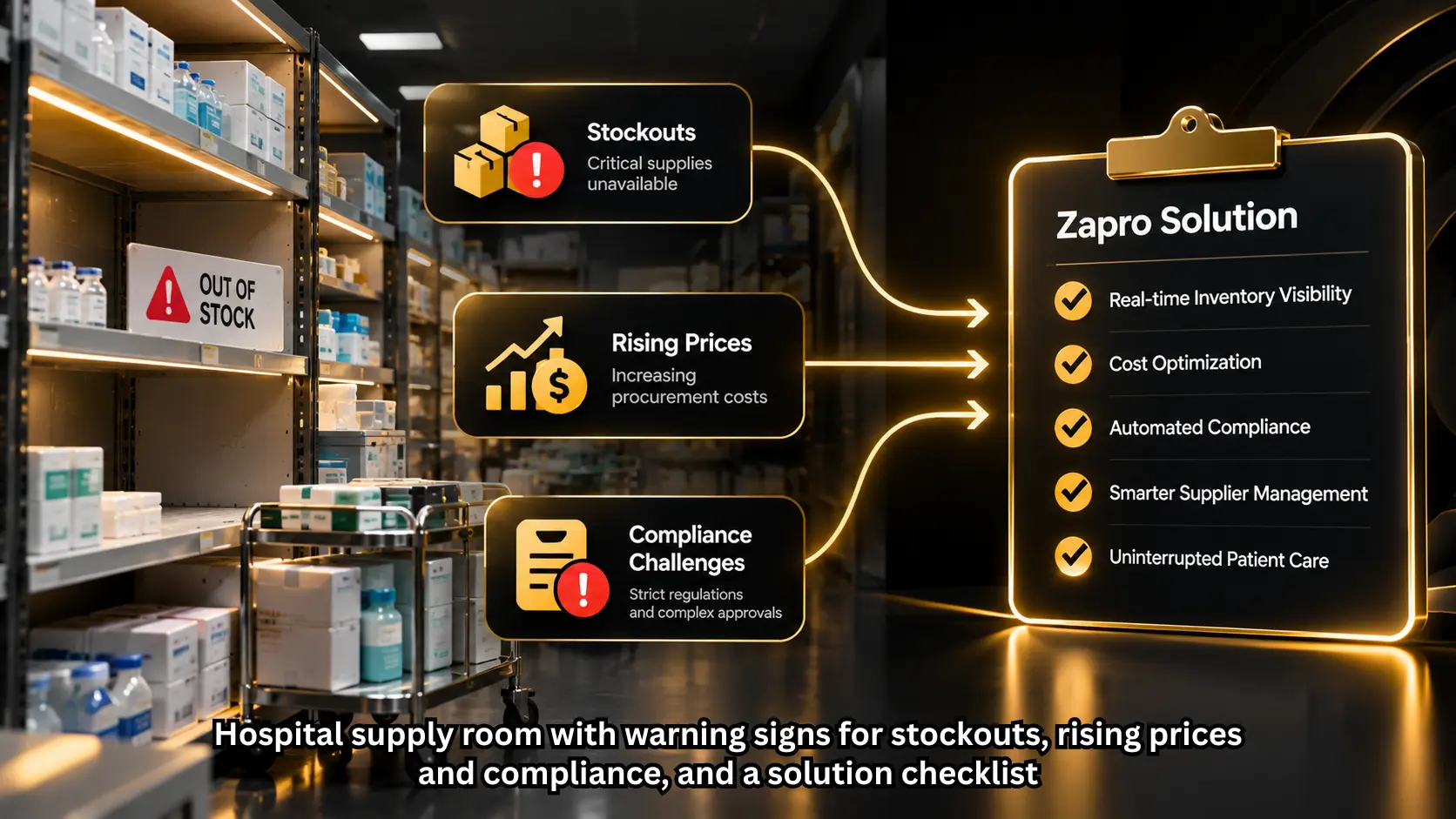
Some health systems are addressing this by adopting platforms like Zapro AI to bring purchasing, approvals, and supplier data into a single connected system.
- Centralized Platforms: Putting all buying into one digital system stops rogue spending and gives leaders a clear view of the budget.
- Automated Approvals: Digital systems send purchase orders to managers for a signature instantly. This stops orders from sitting on a desk for days.
- Vendor Data Management: Keeping one updated record for every supplier ensures you only work with partners who meet safety rules.
- Smart Analytics: Software can now look at thousands of invoices to find ways to save money or predict when a supply might run out.
- Connected Systems: When procurement software links with patient records, the hospital can track exactly which supplies were used for which patient.
Best Practices for Improving Procurement in Healthcare
To keep things running smoothly, healthcare groups should follow these steps as part of a broader healthcare procurement strategy:
Standardize the Process
Every department should use the same steps to ask for and buy supplies.
Focus on Long-Term Partners
Instead of just looking for the lowest price, work with suppliers who understand your specific needs.
Use Data to Decide
Look at your history to see which vendors are the most reliable.
Do Regular Audits
Check your paperwork every few months to make sure everything is still following the law.
How Digital Procurement Tools Transform Healthcare
Moving to digital tools does more than just get rid of paper. It makes procurement in healthcare faster and more open.
- One Place for Talking: All messages and contracts with a vendor are saved in one spot.
- Easy Audits: The computer records every step. This makes it easy to show auditors exactly what happened and when.
- Faster Setup: New vendors can upload their own papers into a portal, which the system checks automatically.
Like healthcare, the telecom industry faces its own set of procurement hurdles, from managing hundreds of vendors for network equipment to preventing contract value leakage. Explore how digital procurement transformation in telecom addresses these challenges through end-to-end process digitisation.
Conclusion
The procurement approach in healthcare is undergoing a transformation. Instead of being merely problem-responsive, it is gradually evolving into a more intelligent, data-driven strategy. By addressing the problems of lack of transparency and excessive paperwork, healthcare organizations will be able to refocus their attention on the main thing: the patients. Healthcare procurement carries compliance overhead that manual processes cannot absorb. See procurement platform pricing and plans for built-in audit and approval controls.

Experience Smarter Healthcare Procurement
Reduce manual work, eliminate procurement bottlenecks, and gain complete spending control with Zapro’s AI technology.
FAQ
1. What are the biggest healthcare procurement challenges?
The biggest healthcare procurement challenges are regulatory and clinical compliance, fragmented purchasing across departments, physician preference items that resist standardisation, expiry and lot tracking for consumables, supply continuity risk, and capital equipment approval cycles that span multiple budget years.
2. Why is standardisation difficult in healthcare procurement?
Standardisation is difficult because clinical outcomes and clinician preference legitimately influence product choice, and switching suppliers can require retraining or revalidation. Successful programmes involve clinicians in evaluation rather than imposing sourcing decisions from finance.
3. How do hospitals manage supply chain disruption risk?
Hospitals manage disruption risk through dual sourcing on critical lines, minimum stock thresholds with automated reorder points, supplier risk monitoring, group purchasing organisation contracts as fallback, and visibility of substitute products approved by clinical governance.
4. How does procurement software help with healthcare compliance?
Procurement software supports healthcare compliance by enforcing approved-supplier and contracted-item purchasing, capturing lot and expiry data at receipt, maintaining complete audit trails for regulatory inspection, and documenting approval chains for capital and clinical purchases.
5. What metrics should healthcare procurement teams track?
Track contract compliance rate, price variance for identical items across facilities, stockout and expiry write-off value, supplier lead-time reliability, requisition-to-delivery cycle time for clinical consumables, and savings realised against benchmark or group purchasing pricing.
Don’t miss our weekly updates
We’ll email you 1-3 times per week—and never share your information.
Your Complete Procurement Solution Awaits
Zapro combines vendor management, spend analytics, and compliance tracking for seamless healthcare procurement.

About the Author

Md. Kafil


About the Reviewer

Zapro is dedicated to helping businesses of all sizes make informed decisions. We adhere to strict editorial guidelines to ensure that our content meets and maintains our high standards.
Our editorial standards help keep every article accurate, useful, and trustworthy.