

Contract compliance analytics is the use of data analysis and reporting tools to track whether signed contracts are being fulfilled as written, surfacing missed obligations, deadline risk, and financial leakage across a contract portfolio. It turns contract terms into measurable data points that can be monitored after signature rather than filed away.Contract compliance analytics is the use of data analysis and reporting tools to track whether signed contracts are being fulfilled as written, surfacing missed obligations, deadline risk, and financial leakage across a contract portfolio. It turns contract terms into measurable data points that can be monitored after signature rather than filed away.
Executing a corporate contract is empty without verification. For enterprises managing thousands of active agreements, the true challenge begins post-signature. Without visibility into operational delivery, financial transactions, and legal parameters, businesses routinely suffer from uncaptured savings, missed deadlines, and unmitigated exposure.
Contract compliance analytics bridges this critical gap. By applying data science, natural language processing (NLP), and transaction matching to your contract portfolio, it converts static legal language into measurable business performance.
Learn about Contract Compliance
What Is Contract Compliance Analytics?
Contract Compliance Analytics Definition
Contract compliance analytics is the systematic practice of extracting, aggregating, and analyzing post-signature data from legal agreements and enterprise systems to monitor performance, minimize risks, and verify absolute adherence to commercial, financial, and regulatory commitments.
How Contract Analytics Supports Compliance
Rather than relying on human review or periodic spot-checks, contract analytics tools dynamically evaluate transactional execution. The software integrates directly with enterprise resource planning (ERP) platforms, accounts payable (AP) ledgers, and supply chain tracking modules to cross-check everyday business actions against original contracted terms.
Contract Compliance Analytics vs. Traditional Reporting
Traditional reporting is retrospective, manual, and isolated. It relies on human teams updating spreadsheets with historical data, often revealing failures long after they happen. Contract compliance analytics provides automated, continuous, and multi-dimensional analysis, linking legal clauses directly to operational metrics.
Why Businesses Need Compliance Analytics
Enterprise ecosystems move too fast for manual audits. When procurement, finance, and legal teams lack unified data views, organizations suffer from silent margin erosion, supplier underperformance, and sudden regulatory penalties. Organizations deploy compliance analytics to establish a single, mathematical source of truth for every active commercial relationship.
Learn about contract compliance services
See Your Compliance Metrics Come to Life

Why Contract Compliance Analytics Matters
Improve Compliance Visibility
Contracts typically sit dormant inside isolated department silos. Compliance analytics breaks down these walls by scanning the entire corporate database and compiling visual health indicators across all business units onto a single corporate glass pane.
Detect Contract Risks Early
By monitoring parameters such as late-delivery frequencies, missing certifications, and clause variances, the analytics engine surfaces contract risks before they cause operational disruptions or legal entanglements.
Prevent Revenue Leakage
Research indicates that organizations can lose up to 16% of negotiated savings due to a lack of proper contract tracking. Analytics flags pricing mismatches, missed volume discounts, or forgotten rebates automatically to halt leakage.
Improve Vendor Accountability
When suppliers know their performance is continuously tracked against service level agreements (SLAs), operational discipline increases. Analytics gives sourcing teams the precise, data-backed performance scorecards required for strategic renegotiations.
Support Audit Readiness
Instead of forcing teams into panicked, weeks-long document scrambles ahead of corporate or regulatory reviews, compliance analytics maintains an ongoing, pristine digital record of data lineage, approval histories, and performance evidence.
Enable Data-Driven Decisions
Analytics removes emotional bias from vendor evaluations. Leaders can confidently decide whether to expand, freeze, or terminate relationships based on empirical compliance trends.
Improve Operational Efficiency
Automating data aggregation and variance checks eliminates repetitive paperwork for legal and finance staff. Teams shift from chasing down missing documents to resolving high-value strategic anomalies.
Learn about Contract Compliance Tools
How Contract Compliance Analytics Works
The journey from a flat document to real-time predictive insights follows a structured, machine-driven data lifecycle:
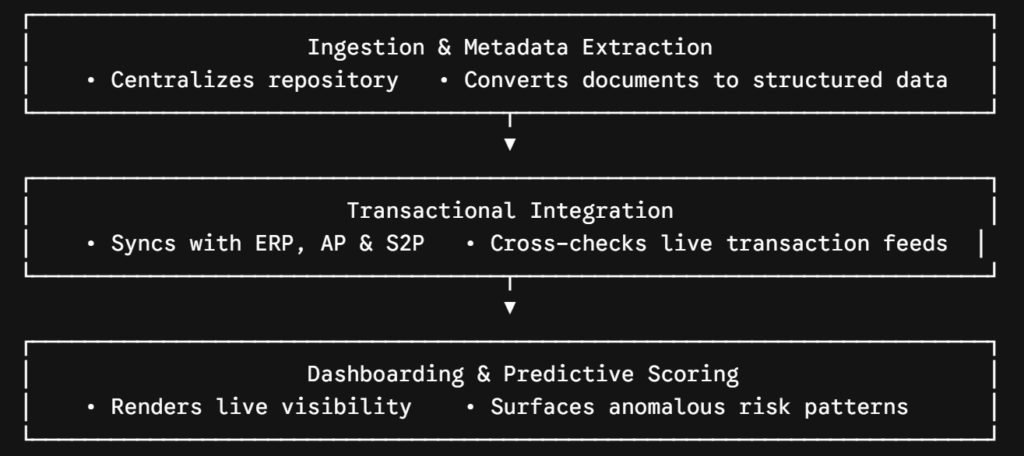
Centralizing Contract Data
All corporate documents, master services agreements (MSAs), statements of work (SOWs), and amendments are aggregated into a single secure repository where optical character recognition (OCR) systems map them into searchable text data.
Extracting Clauses and Obligations
AI-powered data extraction engines read the unstructured prose, automatically identifying and isolating core metadata fields—including effective dates, pricing models, indemnity caps, and operational milestones.
Monitoring Compliance Metrics
The analytics framework converts narrative sentences into active, mathematical rules, setting clear baselines for acceptable contract performance.
Tracking SLA and Vendor Performance
The tool pulls data feeds from active project management tracking boards, delivery systems, and communication logs to measure if milestones are hit on schedule.
Identifying Non-Compliance Patterns
By tracking systemic deviations—such as a specific vendor constantly pushing their delivery window by 48 hours—the engine uncovers root causes that standard accounting reviews miss.
Generating Real-Time Dashboards
The system packages raw transactional data into accessible corporate compliance dashboards, grouping information by department, vendor tier, or risk priority. Zapro AI brings contract records, purchase orders, and invoices into the same spend analytics view, so these dashboards can draw on transaction data directly.
Predictive Risk and Compliance Analysis
Machine learning engines use historical trends to evaluate your portfolio, proactively warning you about potential contract defaults, supply chain bottlenecks, or financial exposures weeks before they manifest.
Learn about Contract Compliance Reporting
Key Components of Contract Compliance Analytics
- Contract Metadata Extraction: Automates the recording of foundational contract data, including counterparty names, monetary values, and termination dates.
- Clause Analytics: Compares negotiated language choices against standard corporate legal playbooks to identify unusual liability thresholds.
- Obligation Tracking: Tracks post-signature actions and deliverable targets dynamically over time.
- Spend and Procurement Analytics: Links outbound accounts payable transactions directly back to contracted price sheets to detect rogue spend or billing errors.
- SLA Compliance Monitoring: Evaluates technical and operational delivery metrics, such as software system uptime or manufacturing fill rates.
- Audit Trail Analytics: Captures an unalterable history of edits, user views, and electronic signatures for regulatory validation.
- Vendor Performance Analytics: Compiles varied operational data points into unified supplier scorecard metrics.
- Compliance Reporting Dashboards: Tailor-made visual environments designed to show relevant KPIs to executive leaders.
Learn about Contract Compliance Audit
Top Contract Compliance Metrics and KPIs
To construct a robust compliance program, organizations must measure these 12 critical performance metrics:
1. Obligation Compliance Rate
Calculates the exact percentage of contractual commitments successfully fulfilled by the organization and its counterparties.
Obligation Compliance Rate = Obligations Fulfilled divided by Total Obligations Tracked
2. SLA Compliance Percentage
Measures how consistently a service provider meets explicitly agreed technical benchmarks, such as IT system uptimes or machine repair windows.
3. Revenue Leakage Metrics
The precise calculation of lost currency resulting from unapplied volume discounts, missed pricing adjustments, or uncollected service penalties.
4. Contract Renewal Rate
Tracks the percentage of valuable agreements successfully extended before expiration, highlighting customer or vendor retention trends.
5. Vendor Compliance Score
A unified performance metric combining delivery speed, billing accuracy, and quality scores into a single grading value (e.g., 0 to 100).
6. Clause Deviation Rate
Measures how often standard corporate legal language templates are edited or replaced during contract negotiations, pinpointing friction areas.
7. Risky Clause Frequency
Monitors how often unvetted terms, such as uncapped liabilities or unilateral cancellation options, slip into final agreements.
8. Auto-Renewal Risk
Identifies active contracts containing automatic renewal provisions that lack designated human warning milestones.
9. Contract Value vs. Realized Value
Compares the projected financial value established during negotiations with the actual dollars collected or saved over the contract lifecycle.
10. Audit Finding Resolution Time
Tracks how many business days your compliance team takes to correct an operational error or missing clause once flagged by an internal review.
11. Purchase Order Compliance
Measures the percentage of purchase orders matched correctly against an active, fully executed corporate contract.
12. Maverick Spend Metrics
Calculates the percentage of company funds leaking outside of contracted, preferred-supplier relationships.
Maverick Spend Rate = Total Spend Outside Approved Contracts divided by Total Organizational Spend
Learn about Contract Compliance Process
Types of Contract Compliance Analytics
Descriptive Analytics
Examines historical datasets to outline past performance. It answers: “What happened over the past 12 months? How many vendor deadlines were missed?”
Diagnostic Analytics
Drills deeper into historical anomalies to reveal the underlying drivers behind failures. It answers: “Why did this specific department frequently suffer from pricing discrepancies and billing overcharges?”
Predictive Analytics
Applies statistical modeling and historical patterns to project future likelihoods. It answers: “Which key suppliers are showing operational indicators that suggest a high risk of failing their upcoming Q3 delivery milestones?”
Prescriptive Analytics
Suggests specific tactical steps based on operational data insights. It answers: “Given the high clause deviation rate in our current software deals, what specific fallback terms should we introduce to accelerate legal reviews?”
Real-Time Compliance Analytics
Constantly evaluates your live enterprise transaction data stream. It answers: “Does the invoice received by Accounts Payable five minutes ago match the specific tiered discount matrix signed in our master services agreement?”
Learn about Contract Compliance Management
AI in Contract Compliance Analytics
Artificial intelligence upgrades contract compliance analytics from passive data charting into an active, autonomous tracking architecture:
- AI-Based Clause Extraction: Deep-learning models skip manual reading steps, instantly extracting complicated, custom terms across thousands of legacy PDFs.
- NLP for Contract Understanding: Natural Language Processing uncovers contextual meaning, understanding when different legal words point to identical performance obligations.
- Machine Learning for Risk Detection: Algorithms automatically flag anomalous phrasing or high-risk language choices that stray from standard corporate baselines.
- Predictive Compliance Monitoring: Systems analyze operational patterns to flag third-party delivery issues weeks before a physical breach occurs.
- AI-Powered Dashboards: Dynamic visual hubs that automatically separate high-priority contract exceptions from everyday compliant workflows.
- Automated Compliance Alerts: Intelligently escalates overdue tasks to specific operational teams, triggering backup alerts if deadlines remain unaddressed.
- AI Agents for Continuous Monitoring: Deploys dedicated, background software agents that log into enterprise workflows, collect compliance evidence, and update scorecards hands-free.
Learn about contract management
Contract Compliance Analytics Use Cases
Procurement and Spend Compliance
Protects cash flow by ensuring every corporate order routes exclusively to preferred suppliers at the exact pricing tiers negotiated by sourcing professionals.
Supplier and Vendor Monitoring
Keeps global logistics loops transparent by tracking fulfillment metrics, background insurance validation, and delivery timeliness continuously.
Regulatory Compliance Tracking
Protects enterprises in highly audited spaces (e.g., healthcare, finance) by verifying every contract contains up-to-date data protection (GDPR/CCPA) or labor compliance text.
Financial Recovery Audits
Scans historical transactional databases alongside contract terms to identify historic overpayments or missed volume rebates, allowing finance teams to reclaim lost capital.
Contract Renewal Optimization
Highlights upcoming contract expirations far in advance, giving category managers ample time to evaluate partner compliance data before extending deals.
SLA and Service Performance Monitoring
Keeps service partners honest by automatically tracking system uptime, network speeds, or response parameters against contracted minimum levels.
Third-Party Risk Monitoring
Tracks the holistic business health of commercial partners, evaluating external data feeds for financial issues, ethical lapses, or security breaches.
M&A Due Diligence
Accelerates mergers and acquisitions by scanning thousands of target company contracts in minutes to surface hidden liabilities, change-of-control risks, or restrictive non-compete rules.
Learn about Contract Compliance AI
Procurement and Spend Analytics for Contract Compliance
Integrating procurement metrics directly into contract compliance analytics addresses critical operational blind spots:
Identifying Maverick Spend
When employees purchase goods or services outside established corporate contracts, it creates rogue or maverick spend. Analytics flags these transactions instantly by cross-referencing credit card and AP data against approved vendor lists, forcing spending back to negotiated agreements.
Monitoring Purchase Order Compliance
The system verifies a strict “No PO, No Pay” framework. It confirms that every generated purchase order references an active contract, matches approved line-item structures, and routes through authorized approval paths. This check works best when contracts, approvals, and purchase orders live in the same procurement platform rather than in separate systems.
Detecting Pricing Discrepancies
Suppliers may accidentally or intentionally apply standard market rates rather than your negotiated wholesale pricing. Analytics flags these line-item variances on incoming invoices before payouts occur.
Tracking Discounts and Rebates
Complex corporate deals often include tier-based pricing structures—such as a 5% rebate once total spending passes $100,000. Analytics calculates aggregate spend in real time to ensure your finance team claims these rewards.
Spend vs. Contract Analysis
This analysis compares the total contract value with actual budget consumption, ensuring teams do not exceed authorized values without proper approval workflows.
Contract Compliance Dashboards and Reporting
Effective software platforms organize complex backend data into tailored visual dashboards built for specific enterprise audiences:
Real-Time Compliance Dashboards
Designed for daily operational managers, these interfaces highlight current tasks, flag immediate SLA bottlenecks, and show active workflow bottlenecks.
Executive Reporting
High-level summary metrics built for C-suite leaders, focusing on total realized savings, high-level corporate risk ratings, and broad vendor performance scores.
Legal and Procurement Reporting
Deep-dive environments that track clause deviation histories, template adoption rates, negotiation cycle speeds, and supplier scorecard breakdowns.
Audit Reporting
Pre-configured, exportable data bundles that provide internal or external regulators with clear, untampered event histories and compliance documentation.
Compliance Trend Analysis
Long-term data tracking that visualizes whether your vendor ecosystem’s compliance scores are improving or degrading over multi-year business cycles.
Common Challenges in Contract Compliance Analytics
- Poor Contract Data Quality: Scanned, older documents with low resolution hinder text conversion, leading to inaccurate automated metadata collection.
- Decentralized Contract Repositories: Agreements scattered across local computers, email chains, and localized field offices break data cohesion.
- Inconsistent Metadata: Different business teams using varied naming structures for matching data parameters corrupts performance analysis.
- Limited Visibility Across Teams: Siloed tools keep legal data separated from procurement transaction engines, preventing financial matching.
- Manual Reporting Processes: Relying on staff to collect and log data manually slows insights and introduces human errors.
- Integration Challenges: Connecting modern analytics software to older legacy ERP systems can create significant technical friction.
- Data Security and Privacy Concerns: Processing high-value, confidential legal agreements requires absolute cloud security, strict role permissions, and compliance with data privacy regulations.
Learn about contract management software
How to Implement Contract Compliance Analytics
Step 1: Centralize Contract Data
Consolidate all historical and current corporate agreements into a secure, searchable cloud database equipped with reliable text search tools.
Step 2: Define Compliance KPIs
Isolate a concise list of high-priority performance goals tailored to your operation, such as reducing maverick spend or tracking core IT service SLAs. Scoping these goals early also makes it easier to compare costs, and procurement software pricing from Zapro starts at $699 per month with unlimited users.
Step 3: Standardize Metadata and Clauses
Establish uniform corporate definitions for key fields like termination windows, liability frameworks, and payment parameters to ensure clean comparison analytics.
Step 4: Integrate Procurement and CLM Systems
Build clean data pipelines linking your contract repository directly to your accounts payable and ERP execution systems.
Step 5: Deploy AI Analytics Tools
Introduce intelligent software platforms capable of automated contract parsing, semantic analysis, and real-time transaction matching.
Step 6: Build Real-Time Dashboards
Configure targeted visual scorecards tailored to the daily workflow needs of your procurement, legal, and finance leaders.
Step 7: Continuously Optimize Reporting
Regularly audit your analytics rules, update templates based on performance data, and adjust alert thresholds to match shifting business goals.
Learn about our Contract Compliance Checklist
Features to Look for in Contract Compliance Analytics Software
- AI Clause Recognition: An intelligent extraction system that accurately pulls complex conditions out of unstructured legal prose.
- Dashboard and Reporting Tools: A highly flexible visual system that lets users modify and generate custom compliance scorecards easily.
- Real-Time Alerts: Automated multi-stage notification ladders that alert designated owners before contract obligations breach.
- Spend Analytics Integration: Built-in tools that tie outbound cash transactions back to original contract pricing matrices.
- Audit Trail Monitoring: A permanent log tracking all contract views, modifications, and user approvals for regulatory audits.
- Workflow Automation: Straightforward, no-code logic configurations to manage document routing and internal approval paths smoothly.
- ERP and Procurement Integrations: Pre-built software connections designed to sync seamlessly with platforms like SAP, NetSuite, or Salesforce.
- Predictive Analytics Capabilities: Machine learning models that project partner defaults or supply chain backlogs based on performance histories.
Traditional vs. AI-Driven Contract Compliance Analytics
Spreadsheet Reporting vs. Real-Time Dashboards
Spreadsheet tracking is outdated the moment data entry concludes, creating a sluggish environment. AI dashboards process transaction streams continuously, reflecting real-time updates to your risk posture.
Manual Audits vs. Continuous Monitoring
Manual checks are slow, resource-heavy spot reviews that miss systemic pricing or delivery leaks. AI analytics runs 24/7 background audits across your entire contract portfolio simultaneously.
Reactive Compliance vs. Predictive Compliance
Traditional processes only flag errors after a supplier relationship fractures or an invoice overpayment clears. AI tools analyze trends to warn managers about potential contract failures weeks before they disrupt operations.
Static Reports vs. AI Insights
Traditional data outputs show raw numbers without context. AI-driven systems provide automated narrative insights, detailing why non-compliance occurs and suggesting precise playbook fixes.
Comparison at a Glance
| Feature | Traditional Analytics | AI-Driven Analytics |
| Data Ingestion | Manual data entry by administrators | Automated AI metadata & clause extraction |
| Analysis Frequency | Periodic or retrospective spot reviews | Continuous, 24/7 real-time data monitoring |
| Data Visibility | Siloed inside separate business systems | Consolidated into unified corporate dashboards |
| Financial Tracking | Periodic invoice checking against templates | Automated matching of ERP spend vs. contract sheets |
| Risk Position | Reactive (uncovered after an error occurs) | Predictive (flagged via trend anomaly models) |
| Audit Preparation | Days of manual document tracking | Instant, single-click digital audit histories |
The Future of Contract Compliance Analytics
Agentic AI for Compliance Monitoring
Compliance systems are moving toward fully autonomous AI compliance agents. These tools will not only discover workflow exceptions but will also independently collect data across company systems, create vendor dispute claims, and correct simple billing errors hands-free.
Predictive Risk Intelligence
Future analytics frameworks will merge internal contract histories with external global data streams. By tracking weather trends, economic changes, and geopolitical updates alongside contract terms, systems will forecast supplier disruptions with incredible accuracy.
Autonomous Compliance Audits
Regulatory compliance checks will become fully automated systems. AI agents will run ongoing internal tests, generate compliance documentation, and report directly to auditing portals without manual paperwork.
Continuous Regulatory Monitoring
As global compliance guidelines adapt, AI analytics tools will instantly evaluate your active database, flag outdated legal phrasing, and recommend compliant text fixes automatically.
AI-Powered Negotiation Insights
By connecting post-signature fulfillment patterns directly back to pre-signature negotiation workspaces, AI analytics will guide professionals to use specific clauses that historically maximize revenue and minimize disputes.

Turn Contract Data Into Real Savings
Track obligations, catch revenue leakage, and score vendor performance — all backed by real-time analytics, not spreadsheets.
FAQs
1. What is contract compliance analytics?
It is the use of data science, natural language processing, and transactional matching to automatically track, measure, and enforce the operational, financial, and legal terms within signed corporate contracts.
2. How does contract analytics improve compliance?
It converts static document text into active digital data points, connects agreements directly to everyday business transactions, surfaces pricing errors, and flags portfolio risks before breaches happen.
3. What metrics should businesses track?
Key metrics include the obligation compliance rate, SLA alignment percentages, maverick spend rates, clause deviation frequencies, contract value vs. realized value, and auto-renewal risks.
4. How does AI help contract analytics?
AI speeds up performance by automatically extracting data fields, identifying non-standard language variations, and predicting potential supplier defaults using historical performance patterns.
5. What is revenue leakage in contract compliance?
Revenue leakage is the unrecovered loss of corporate funds caused by overlooked volume discounts, unapplied contract rebates, or failing to collect penalties from underperforming vendors.
6. How do dashboards support compliance reporting?
Dashboards combine messy backend transaction feeds into clean, role-specific visual environments, giving leadership teams an instant look at company savings, liabilities, and audit states.
7. What industries benefit from contract compliance analytics?
Highly audited or logistics-heavy fields gain the most value, including corporate procurement, supply chain tracking, healthcare networks, financial institutions, and enterprise tech providers.
8. What is maverick spend analysis?
It is the systematic identification of corporate purchases made outside of approved company contracts or preferred-supplier channels, a habit that dilutes your negotiation leverage.
9. How can businesses reduce contract risk using analytics?
Analytics minimizes exposure by continuously monitoring expiration windows, scoring clause variations against standard corporate playbooks, and tracking supplier fulfillment health.
10. What features should contract analytics software include?
Look for automated AI clause extraction, live cross-system integrations (ERP/AP), custom alert structures, audit trail histories, and clear dashboard customization tools.
Don’t miss our weekly updates
We’ll email you 1-3 times per week—and never share your information.
Losing Revenue to Untracked Contracts?
Get expert guidance on building real-time compliance dashboards and stopping leakage with Zapro.

About the Author

Md. Kafil


About the Reviewer

Zapro is dedicated to helping businesses of all sizes make informed decisions. We adhere to strict editorial guidelines to ensure that our content meets and maintains our high standards.
Our editorial standards help keep every article accurate, useful, and trustworthy.
Related Blogs
How Machine Learning Is Transforming Contract Management
12 Contract Management Best Practices for 2026