

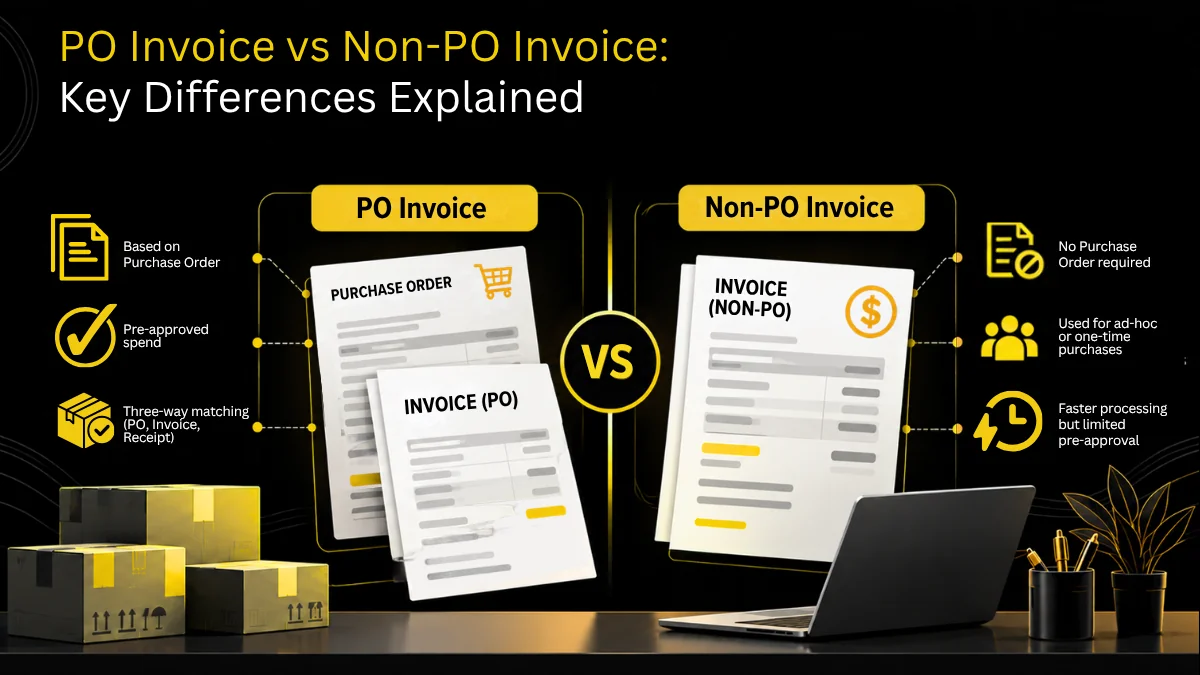
Invoices are the last step before money goes out of your company. However, not all invoices take the same route in accounts payable. Some are always attached to a purchase order invoice, while others find their way to the financial department without any prior approval. These scenarios are called PO invoices and non-PO invoices, often discussed as PO Invoice vs Non-PO Invoice.
Knowing the difference between a PO invoice and a non-PO invoice is not only a matter of accounting. It has a direct influence on cost control, the speed of approval, the readiness for audit, and even supplier relations in the PO invoice process and non PO invoice process. Applying the wrong process leads to delayed payments, mismatches, and extra work.
We will explain the difference between PO invoice and non-PO invoice in this article, commonly referred to as PO vs non PO invoice. You will find out what each one is, how different their approvals are, how the matching concept applies, and at what point each is used in PO invoice vs non PO invoice in accounts payable. We will also show how invoice processing automation can help smooth the process and turn it into a competitive advantage.
Platforms such as Zapro AI are designed to route both PO and non-PO invoices through the correct approval and matching workflow automatically.
Getting this distinction right also affects supplier relationships, since delayed or mismatched invoices are easier to avoid when payment data is visible inside an AI Vendor Management platform alongside the vendor’s contract terms.
2. What Is a PO Invoice?
A PO invoice is an invoice that cites a purchase order that has been approved. The purchase order is made before the supplier delivers the goods or services, and it specifies the quantities, pricing, and terms as part of the purchase order invoice workflow. When the supplier sends in an invoice, it is checked against the purchase order.
Because PO invoices are tied directly to an approved purchase order, they’re usually processed inside the same AI procurement software that generated the original PO.
Simple Example
The procurement team issues a purchase order for 50 laptops at an agreed price. The supplier delivers the laptops and sends an invoice with the PO number referred to, making it a PO invoice. Accounts payable check that the invoice matches the purchase order and the delivery record as part of the PO invoice process. After the verification, the invoice is approved for payment.
Key Characteristics of a PO Invoice
- Connected to an authorized purchase order
- Enables procurement based on a predetermined process
- Less complicated to validate and audit
- Strong control over spend
PO invoices are frequently seen in cases of inventory, equipment, raw materials, as well as major or recurring purchases where controlling costs is paramount.

By automating the processing of invoices based on purchase orders (POs)… AP clerks were enabled to process about 50% more invoices.
3. What Is a Non-PO Invoice?
A non PO invoice, also referred to as a non PO based invoice, is an invoice without a purchase order reference. Most of the time, such invoices come from one-off or service-based expenses where a formal purchase order was not issued in advance.
Simple Example
Without a purchase order, a legal consultant bills for a month of advisory services after the engagement. Finance must seek approval of the invoice after they receive it, following the non PO invoice process.
Key Characteristics of a Non-PO Invoice
- There is no existing purchase order
- Approval is post-invoice processing
- Manual intervention is heavily relied upon
- Delays and errors are more likely
Non-PO invoices are typical of expenses like utilities, professional services, subscriptions, travel costs, and emergency purchases.
4. Key Differences Between PO Invoice vs Non-PO Invoice
The primary difference between PO invoice vs non-PO invoice is when and how much control the spending is exercised. A PO invoice is basically a plan and the approval happens before the expenditure is made. A non-PO invoice is basically a cost with approval afterward.
Comparison Table: PO Invoice vs Non-PO Invoice
| Aspect | PO Invoice | Non-PO Invoice |
| Purchase order | Required | Not required |
| Approval timing | Before purchase | After invoice receipt |
| Control level | High | Moderate to low |
| Risk of mismatch | Low | Higher |
| Processing speed | Faster with automation | Slower if manual |
| Audit readiness | Strong | Depends on documentation |
5. Approval Workflow: PO Invoice vs Non-PO Invoice
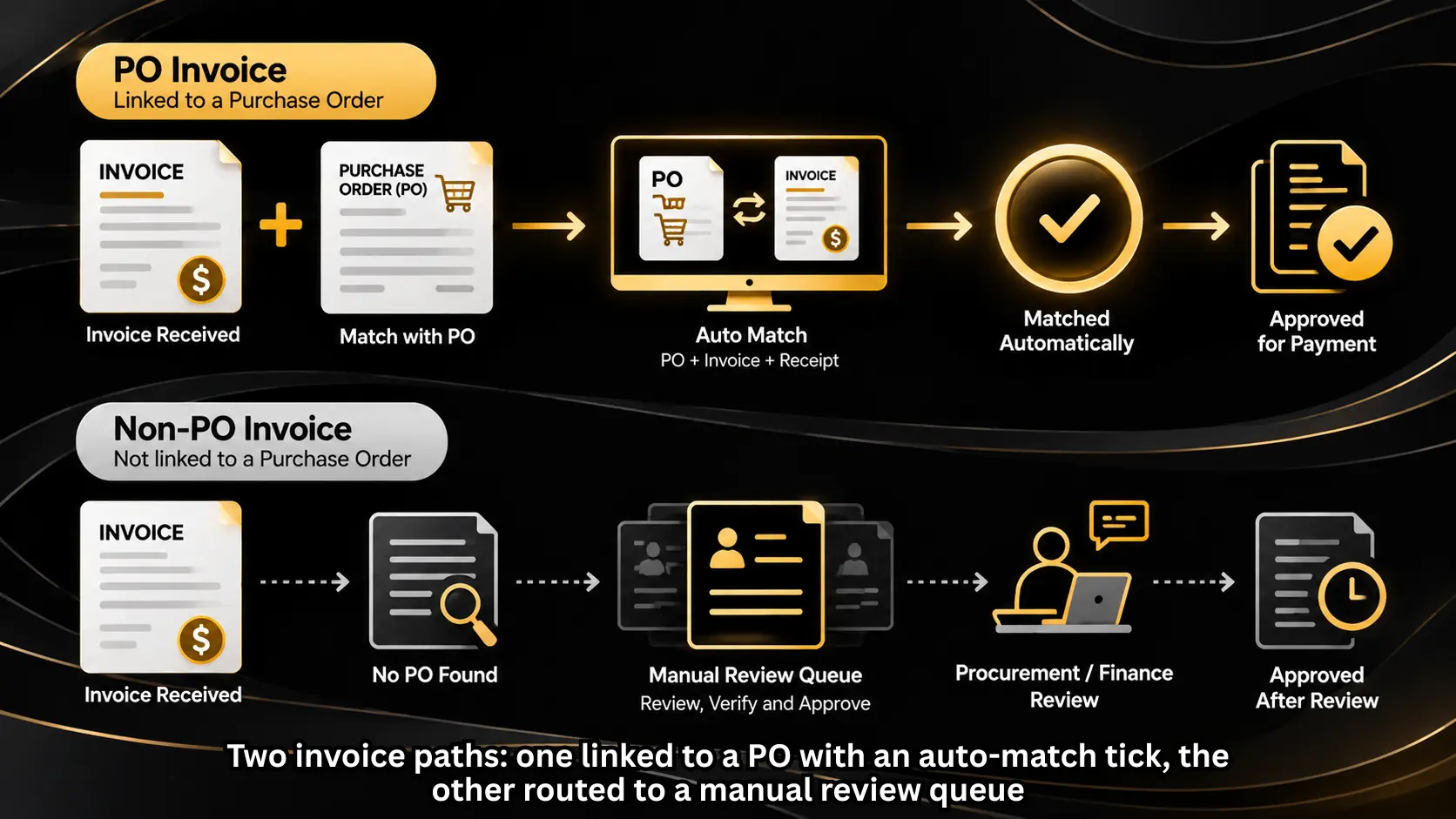
PO Invoice Approval Workflow
A lot of the time the approval of a PO invoice will be completed before the invoice is sent. When the purchase order is issued, the vendor is checked both in terms of budget and prices as part of the PO invoice process.
Once the invoice is received:
- Invoice is matched to the purchase order
- Goods receipt is verified if applicable
- Invoice is auto-approved if it matches
Therefore, PO invoice approval is often very predictable and quick.
Non-PO Invoice Approval Workflow
Non PO invoices require approval after receipt, which introduces more steps:
- Invoice is submitted to finance
- Invoice is routed to the requester or manager
- Budget and justification are reviewed
- Invoice is approved or rejected
And because approvals occur after the fact, any delay to the non PO invoice process is more likely, especially if the approvers are unavailable.
Know the Difference. Streamline Both.

6. Matching Process: 2-Way vs 3-Way Matching
Invoice matching refers to the invoice matching process of confirming the legitimacy and accuracy of what has been billed.
PO Invoice Matching
PO invoices generally do:
- 2-way matching for services
- 3-way matching for goods
2-way matching refers to the invoice being matched with the purchase order. 3-way matching occurs when the invoice is matched to both the purchase order and the goods receipt as part of the PO invoice process.
Non-PO Invoice Matching
Non PO invoices usually rely on:
- Invoice to approval confirmation
Because there is no purchase order, it is impossible for a formal invoice matching process to take place. Validation relies on manager approval and supporting documentation, which increases risk, effort, and the possibility of maverick spend.
7. When to Use a PO Invoice
PO invoices are best used when:
- The spend is planned or recurring
- The costs are substantial
- Inventory or assets are involved
- Compliance and audits are important
- Supplier terms are agreed upon before
Manufacturing materials, office equipment, IT hardware, and long-term vendor contracts are just some of the examples of such items.
PO invoices help companies restrict maverick expenditure and ensure procurement policies are uniformly met.
8. When to Use a Non-PO Invoice
Non PO invoices are appropriate when:
- Purchases are unplanned or emergency
- Service scope varies
- It is not practical to make a PO at the beginning
- Transaction amounts are small
Examples include utilities, legal services, freelance marketing, and emergency repairs.
As a matter of fact, while non-PO invoices give last-minute freedom, they must still be controlled tightly to prevent rogue spending.
9. How Automation Helps
If you want to make the processing of PO invoice and non PO invoice faster and reduce errors, the solution lies in invoice automation.
By automation:
- PO invoices are matched automatically
- Non-PO invoices are routed through a guided approval workflow
- Instant flags are raised for exceptions
- Approvals occur quicker with less chasing
Not only that, today’s automated AP platforms give finance teams full visibility into spending patterns, helping identify where non PO based invoices can be converted into planned PO spending.
This transition works especially well for growing companies. Besides saving time, automation lowers non-compliance risks and improves cash flow forecasting. To shortlist tools that handle both invoice types well, compare the best procurement software options.
For finance teams, this often becomes the first step toward scalable procurement maturity, making automation an effective entry point for marketing-qualified leads. Non-PO invoice volume is one of the clearest signals that a platform is overdue. See pricing and plans to price the fix.

Power Your Procurement with Zapro
Take control. Cut costs. Scale smarter.
FAQs
1. What is the main difference between PO and non-PO invoices?
The main difference between a PO invoice and a non-PO invoice is that a PO invoice is associated with a purchase order and approved before the purchase, while a non PO invoice is processed without a prior purchase order.
2. Are non-PO invoices bad practice?
Non-PO invoices are not bad practice. They are necessary for certain expenses but require stronger approval controls to avoid overspending and delays.
3. Can non-PO invoices be converted into PO invoices?
Yes, they can. By analyzing frequently occurring non PO invoices, management can decide which purchases should move to a PO-based process, allowing suppliers to operate under a structured PO invoice process.
Don’t miss our weekly updates
We’ll email you 1-3 times per week—and never share your information.
Ready to streamline your procurement?
Connect with our experts to see how Zapro can simplify your procurement.

About the Author

Md. Kafil


About the Reviewer

Zapro is dedicated to helping businesses of all sizes make informed decisions. We adhere to strict editorial guidelines to ensure that our content meets and maintains our high standards.
Our editorial standards help keep every article accurate, useful, and trustworthy.