

Procurement in healthcare is the process hospitals and medical centers use to source, purchase, and manage the medical supplies, equipment, and services they need to operate. Cost savings come from standardizing supplier contracts, group purchasing, and better visibility into what is being bought and by whom across departments.
It definitely doesn’t come cheap to operate a hospital in 2026. Hospital top management leaders find themselves constantly hunting for savings as they battle the dual challenge of increased labor costs and the inflating prices of new medical technology.
Aside from the obviously good reasons, one of the most fruitful places to discover savings is supply chain expenditures. Hospital procurement is by far the most neglected area but if well-directed, it has the potential to be a huge life-saver budget-wise.
This article focuses on how a wise healthcare procurement strategy helps in cutting down the hospital expenditure and at the same time making it a more efficient operation.
What Is Hospital Procurement?
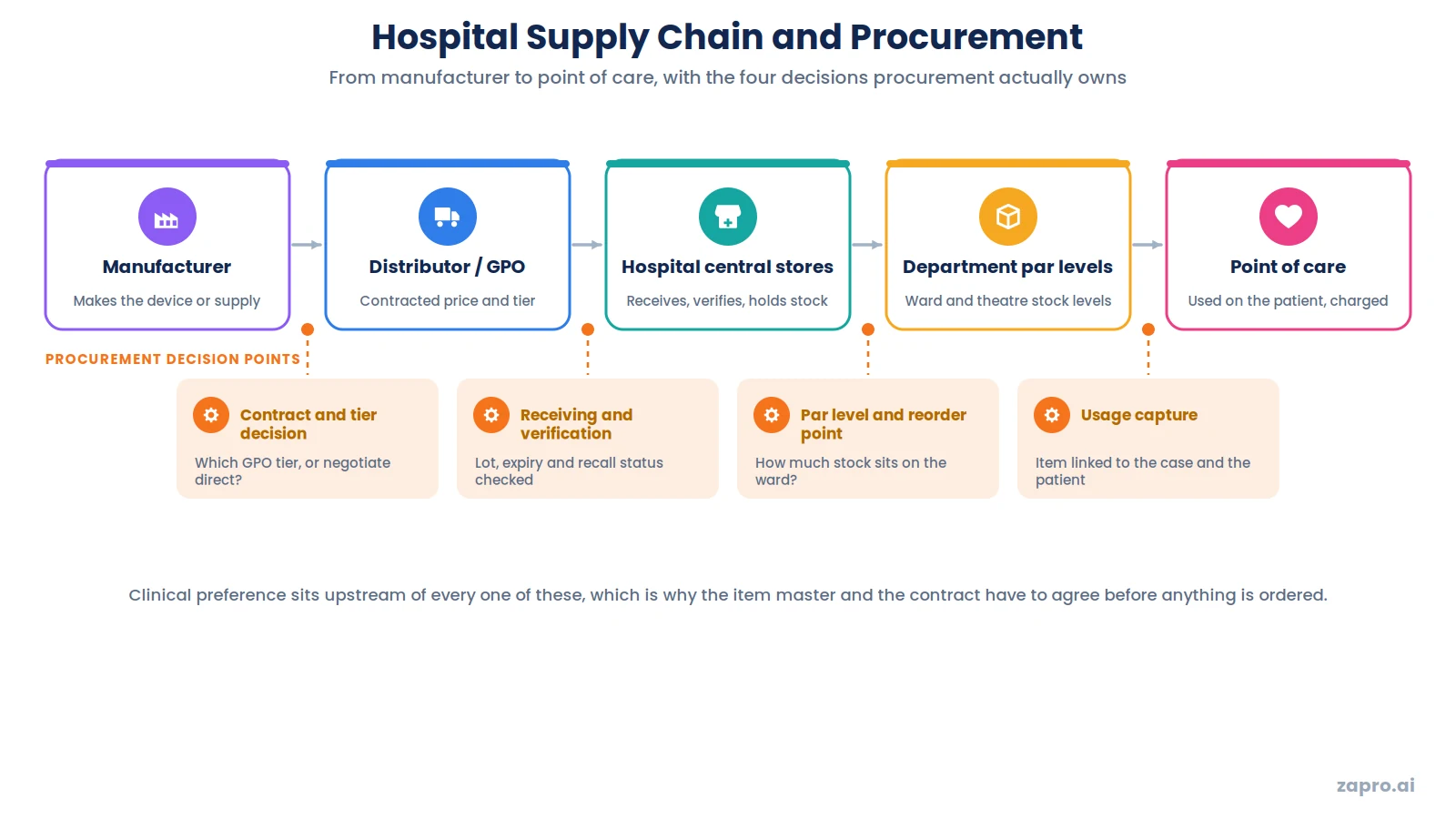
The uniqueness of hospital procurement lies in the fact that a hospital is a multifaceted institution needing an enormous variety of things for its continuous operation ranging from high-technology equipment to toilet paper.
It goes beyond merely pressing a “purchase” button. It entails sourcing vendors, price bargaining, safety compliance verification, and ensuring timely deliveries among other things.

In 2026, healthcare organizations (HCOs) will better align tech investments to add value to business processes. Using newfound efficiency gains, health insurers will expand advocacy programs to improve customer experiences.
– Forrester Predictions 2026: Healthcare
Why Hospital Procurement Costs Are Rising
It’s a common feeling that your budget gets depleted at a faster rate now than before. The truth is that there are many reasons pointing to a rising cost trend:
- Price Volatility: The price of the basic raw materials used to make healthcare items can change suddenly and drastically.
- Emergency Purchasing: Basically, it is the situation where a hospital runs out of a vital item. Then, no matter how expensive the rush delivery and the order will be, the hospital still has to buy it.
- Lack of Standardization: If you have two surgeons wanting to use different brands for the same operation, then the hospital loses its leverage for negotiating a bulk discount.
- Fragmented Vendor Ecosystems: It is much more difficult and hence expensive to manage a large number of small contracts than just a few big and well-structured ones.
Medical Procurement Challenges in Hospitals
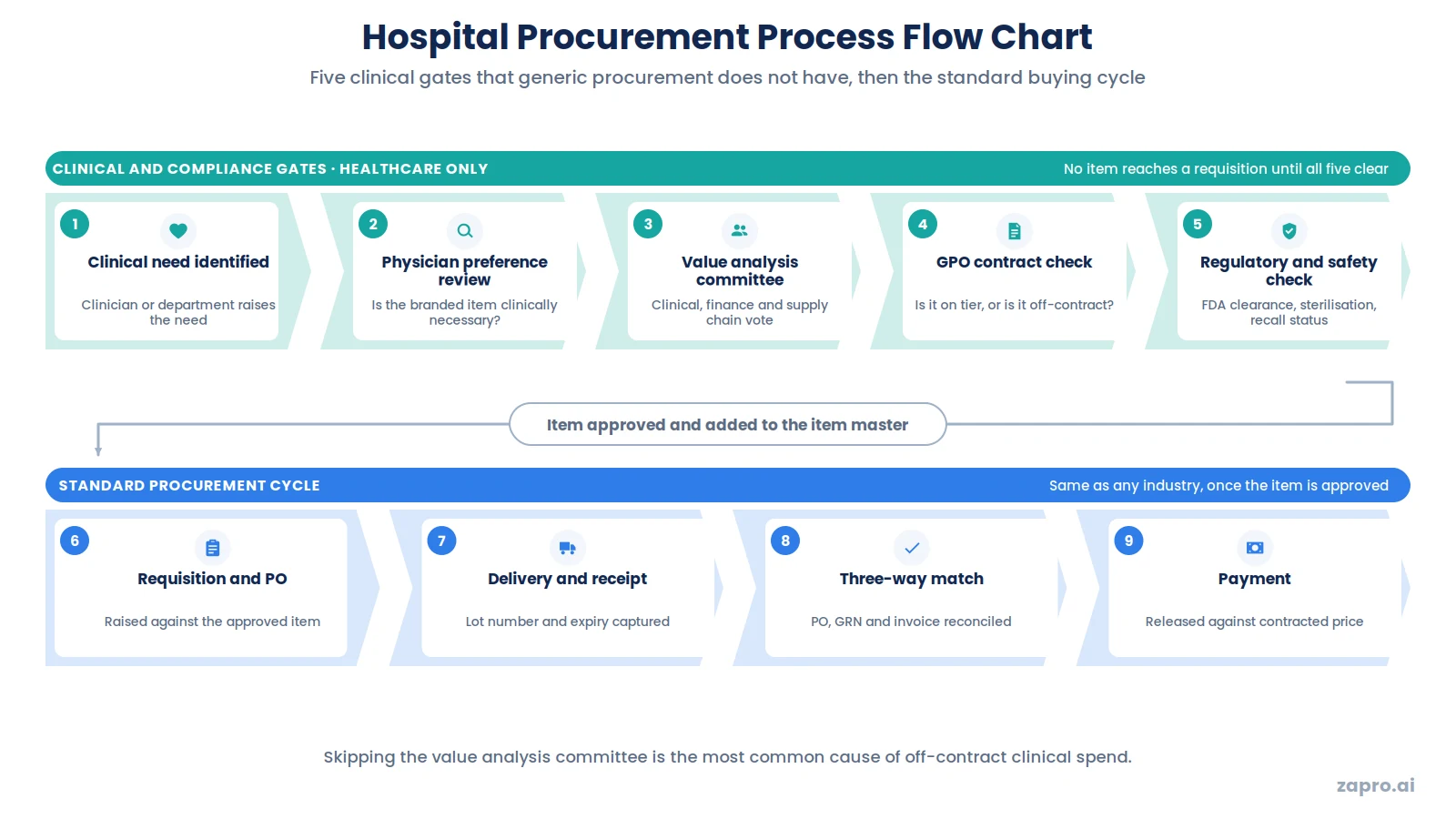
Nowadays, medical procurement is extremely complex. Supply chain managers are plagued by:
- Fluctuating Demand: Surgical needs vary tremendously and therefore the forecast of the next month’s number of surgeries and their types is nearly impossible.
- Manual Request Process: It takes extra time to place an order, and the chances of getting it wrong are higher when the supply request process is still done on paper or via e-mails.
- Supplier Blindness: Most hospitals don’t have a reliable mechanism for tracking supplier performance in terms of on-time delivery or at-the-agreed price.
- Regulatory Compliance: Ensuring each product adheres to stringent health and safety standards is not only complex but also takes a lot of effort and paperwork.
Ready to Transform Your Healthcare Procurement?

Healthcare Procurement Strategy for Cost Savings
Have you ever wondered how the situation could be turned around? It begins with a well-defined strategy.
Centralized Procurement Models
Rather than allowing each department to purchase its own supplies, procurement in hospital contexts ought to be centralized. This gives the hospital the chance to leverage its buying power that is otherwise scattered. The whole hospital’s requirement can be negotiated for a much better price when consolidated.
Data-Driven Spend Analysis
It is not human nature to think that it is necessary to have the whole picture before making a change. When all spending is viewed through data to the last cent, it is possible to identify “cost leakages”
Supplier Rationalization
If forcibly interpreted, this phrase would mean “stick with fewer vendors.” Becoming a more valued customer to a handful of suppliers by establishing stronger partnerships instead of running after numerous suppliers is the essence of this practice. As a result, you will enjoy better pricing and services.
Role of Health eProcurement in Hospitals
One of the most significant developments currently underway in the medical sector is the shift to health eprocurement. It is essentially an online shopping and administration tool specifically designed for healthcare. If you are shortlisting tools, our guide to the best procurement software compares the leading options.
- Paperless Requests: You’ll never have a lost document again because everything is registered in the system.
- Orders get approved instantly by the right people without any workstore interruptions: The system will automatically notify the manager whose digital signature is required. That way, the order will not be stalled just because the manager is out of office, for example.
- You can see every dollar that is spent and every penny left in your budget down to the last cent at any given moment alongside the entire order history and delivery schedule.
- Orders move through the procurement pipeline much faster—measured in hours, not days.
Healthcare Procurement Transformation in Practice
Healthcare procurement transformation is the shift from manual, siloed hospital purchasing to a data-driven digital operating model. It standardises clinical and non-clinical supplies, centralises contracts and GPO pricing, automates requisition-to-pay, and gives finance and clinicians shared spend visibility to cut supply costs while protecting patient care and compliance.
In practice, investing in healthcare procurement transformation is mainly a cultural shift rather than just an implementation of a new software solution. It entails the transition from traditional, manual processes to a digital-first workflow approach.
Besides, the procurement team needs to be brought into conversation with the clinical team as well. When patients, buyers, and doctors collaborate, they succeed in choosing the products that offer both quality and value.
Healthcare Procurement Services vs. In-House Teams
Hospitals, for some reason, employ or contract services separately. It also happens that they take the benefit of using healthcare professional procurement services.
- Outsourcing: These are small-sized clinics that do not have staff capable of dealing with complex contracts. But that is not the only benefit of outsourcing.
- Hybrid Models: The core team remains intact, but the hospital can still bring in experts, e.g. for strategic sourcing or handling specialized medical equipment.
- Tech-Enabled Services: This option allows an organization to utilize an external platform, such as Zapro’s AI procurement platform, to manage its internal operations more efficiently.
Measuring Cost Savings in Hospital Procurement
Assess a few key performance indicators (KPIs) to know whether your approach is bearing any fruits:
- Cycle Time: What is the time interval between the moment the nurse requests a product and the delivery to the ward?
- Savings Rate: To what extent have you transformed your spending pattern in a more frugal way relative to the previous year?
- Compliance Rate: Although the majority of the purchases are made from approved vendors, there are still some who are on their own.
Future of Procurement in Hospitals
The very essence of the future is all about proactively embarking on the journey. Some of the possibilities we’re looking at:-
- AI-Driven Demand: Patient data can help anticipate the supplies needed even before the hospital staff recognizes them.
- Predictive Sourcing: This approach aims to provide alternates even before a shipping problem is detected with the existing supplier.
- Autonomous Workflows: The systems can automatically reorder basic supplies (like gloves or cotton) whenever the stock runs low.
Conclusion
There are ways to reduce expenditure in the hospital which do not necessarily involve laying off workers or compromising the standard of care. In fact, focusing on hospital procurement is a way to realize a lot of “hidden” money that simply goes down the drain in the form of vendor prices and inefficient systems. A clever digital play is undoubtedly the strongest weapon in a hospital’s arsenal to survive the economic crunch in 2026. Hospital supplier counts sit at the upper end of most vendor limits. See procurement software pricing and plans to check the active vendor caps per tier.

Experience Smarter Healthcare Procurement
Reduce manual work, eliminate procurement bottlenecks, and gain complete spending control with Zapro’s AI technology.
FAQ
1. What is hospital procurement?
Hospital procurement is the sourcing and purchasing of medical supplies, pharmaceuticals, capital equipment and support services required to deliver patient care. It combines clinical evaluation with commercial negotiation and must guarantee continuity of supply under regulatory and accreditation requirements.
2. How does hospital procurement differ from corporate procurement?
Hospital procurement carries clinical risk: a stockout affects patient care, not just operations. It also involves clinician-influenced product selection, lot and expiry traceability, regulatory documentation, group purchasing organisation contracts and capital equipment cycles that corporate indirect procurement does not encounter.
3. What is a group purchasing organisation in hospital procurement?
A group purchasing organisation aggregates demand across member hospitals to negotiate contracted pricing with manufacturers and distributors. Members access pre-negotiated rates without running their own tenders, though contract compliance monitoring is still required to ensure the negotiated price is actually invoiced.
4. How do hospitals control medical supply costs?
Hospitals control supply costs through contracted-catalog ordering, clinician-led product standardisation, par-level inventory management to reduce expiry waste, price-variance monitoring across departments, supplier consolidation, and matching invoices to contracted rates before payment.
5. What technology do hospital procurement teams need?
Hospital procurement teams need catalog and contract management, requisition workflow with clinical approval, mobile goods receipt with lot and expiry capture, par-level replenishment, capital expenditure approval workflow, and analytics segmented by facility, department and service line.
Don’t miss our weekly updates
We’ll email you 1-3 times per week—and never share your information.
Your Complete Procurement Solution Awaits
Zapro combines vendor management, spend analytics, and compliance tracking for seamless healthcare procurement.

About the Author

Md. Kafil


About the Reviewer

Zapro is dedicated to helping businesses of all sizes make informed decisions. We adhere to strict editorial guidelines to ensure that our content meets and maintains our high standards.
Our editorial standards help keep every article accurate, useful, and trustworthy.