Vendor Management
 End-to-End-Procurement
 Strategic Sourcing
 Spend Analytics
 AP-Automation
 Inventory Management
 ERP-Integration
 Blogs
Blogs Procurement Guide
 Ebooks
 News and Media
 Healthcare
 Financial Services
 Technology
 Venture Capitalist
 About Us
 Vendor Management Guide
Running a small business or a startup often feels like trying to build a plane while it’s already in the air. As a founder or a lead in a small team, your “procurement department” is usually just you, a cluttered browser with twenty open tabs, and a growing sense of anxiety about your overhead. Unlike the “Goliaths” of industry, you don’t have a floor full of sourcing specialists or a multi-million dollar software budget. You have a lean bank account and a calendar that is already overbooked.
However, here is the truth that many big corporations won’t tell you: agility is your secret weapon. While a massive enterprise takes six months to approve a new vendor, you can do it in six days. But to do that without losing your shirt, you need a smart approach to vendor discovery for small business.
Finding the right partners isn’t just about saving a few dollars on office supplies or raw materials; it’s about building a supply chain that grows as fast as you do. This guide is a practical, “no-fluff” roadmap for small teams looking to master the art of the find.
Why Vendor Discovery Matters for Small Businesses
For a small business, the “cost of a mistake” is much higher than it is for a large corporation. If a Fortune 500 company picks a bad vendor, they lose a fraction of a percent of their quarterly profit. If you pick a bad vendor one that misses a critical delivery or provides a faulty product—you might lose your biggest client, your reputation, or even your business.
Small business supplier sourcing is about de-risking your future. A robust discovery process ensures you aren’t just “buying stuff”; you are “securing partners.” By diversifying your options early on, you avoid “Vendor Lock-in,” where you become so dependent on one supplier that you have to accept their price hikes and poor service because you don’t know who else is out there.

Vendor management is no longer about cost-cutting. It’s about value creation and supply resilience.
Vendor Discovery on a Budget: The “Time vs. Money” Trade-off
In a startup environment, your primary currency is time. You likely can’t afford a $50,000 enterprise sourcing suite, but you also can’t afford to spend forty hours a month manually vetting suppliers.
The key to affordable vendor discovery is focusing on high-impact, low-effort activities. Instead of trying to find the “perfect” vendor, focus on finding three “vetted and viable” ones. This gives you enough leverage to negotiate without the “paralysis by analysis” that kills small business momentum.
Free and Low-Cost Discovery Methods
You don’t need a massive budget to find world-class vendors. You just need to know where the “Digital Watering Holes” are.
1. Leverage “Niche” LinkedIn Communities
Don’t just post a status update. Join specific industry groups and look at who the thought leaders are mentioning. Use the LinkedIn “People also viewed” feature on a competitor’s page to see who their potential suppliers might be.
2. The Power of Local Chambers and Small Business Development Centers (SBDCs)
It sounds “old school,” but local networks are goldmines for SMB procurement tips. Local vendors are often more willing to grow with you and may offer better terms for a “neighbor” business than a massive national conglomerate would.
3. Industry-Specific Forums and Subreddits
Whether it’s a Slack community for SaaS founders or a subreddit for artisanal coffee roasters, your peers are your best discovery tool. Ask the question: “Who is everyone using for [X] that doesn’t require a $10k minimum spend?” The honesty you get in these forums is often more valuable than any marketing brochure.
A Simplified Vendor Evaluation Process
Small businesses often fail at discovery because they make the evaluation too complicated. You don’t need a 50-point scorecard. You need the “Three C’s”:
- Capability: Can they actually do what they say? Ask for a “Micro-Pilot.” If you need a thousand units, ask for a paid sample of ten.
- Cost (TCO): Don’t just look at the price tag. For a small business, shipping costs and “minimum order quantities” (MOQs) are the real killers. Use this simple formula:
TCO = Unit\ Price + Shipping + (Administrative\ Time \times Hourly\ Rate) - Chemistry: Does the vendor treat you like a partner or a nuisance? If a vendor takes three days to reply to your sales inquiry when you are trying to give them money, imagine how long they will take when you have a support issue.
Improve your supplier relationship in just a click!

Negotiating as a Small Buyer: How to Get Big-Player Treatment
The biggest pain point for small businesses is feeling like you have no leverage. You think, “Why would this vendor give me a deal when I only spend $500 a month?”
Here is how you win at startup vendor selection negotiations:
- The Growth Story: Sell them on your trajectory. Vendors want to be on the ground floor of the next big thing. Show them your growth charts.
- Prompt Payment: Big companies are notorious for “Net-90” payment terms (meaning they pay three months late). If you offer “Net-15” or even “Net-0,” you are a dream client for a vendor’s cash flow. They will often give you a discount just for being a fast payer.
- The “Referral” Carrot: Offer to be a case study or provide referrals to other small businesses in your network. For a mid-sized vendor, one “vocal” small business fan can be worth more than one “silent” corporate giant.
When to Invest in Discovery Tools
There comes a point where “doing it yourself” becomes a net loss. This is the Tipping Point. You should consider investing in affordable vendor discovery software or services when:
- You are onboarding more than two new vendors a month.
- Your “Maverick Spend” (unplanned, retail-price purchases) exceeds 10% of your total budget.
- You’ve experienced a supply chain delay that cost you more than $1,000 in lost revenue.
Modern platforms like Zapro.ai are increasingly building “entry-tier” solutions designed specifically for growing teams. They provide the same AI-powered discovery and 3-way matching that the big guys have, but at a scale and price point that won’t break your seed round.
As you outgrow local sourcing, the same platforms extend into global vendor discovery, so scaling internationally doesn’t mean starting your vendor search from scratch.
Building Long-Term Vendor Relationships
Discovery doesn’t end when the first invoice is paid. For a small business, your vendors are an extension of your team.
- Transparency is Key: If you’re having a slow month, tell them. Don’t just go silent.
- Annual Reviews: Once a year, sit down with your top three vendors. Ask them, “How can we be a better client for you?” You’d be surprised how often this lead to a proactive price reduction or a “first-look” at a new product.
Conclusion: Small is Strategic
Vendor discovery for small business isn’t about having the most resources; it’s about having the most resourcefulness. By staying lean, using your community, and leveraging “smart” tools when you hit your limits, you can build a vendor network that is faster, more loyal, and more innovative than any of your larger competitors.
Stop thinking like an “order taker” and start thinking like a “strategic sourcer.” The world is full of amazing partners who are looking for a business exactly like yours.

Say Goodbye to Spreadsheet Vendor Management
Centralize, automate, and optimize your entire vendor lifecycle with Zapro’s all-in-one platform
Don’t miss our weekly updates
We’ll email you 1-3 times per week—and never share your information.
Let’s Strengthen Your Vendor Relationships
We’ll unify vendor data and help your team build smarter partnerships.

About the Author

Md. Kafil


Related Blogs

Supplier Performance Management (SPM) Explained
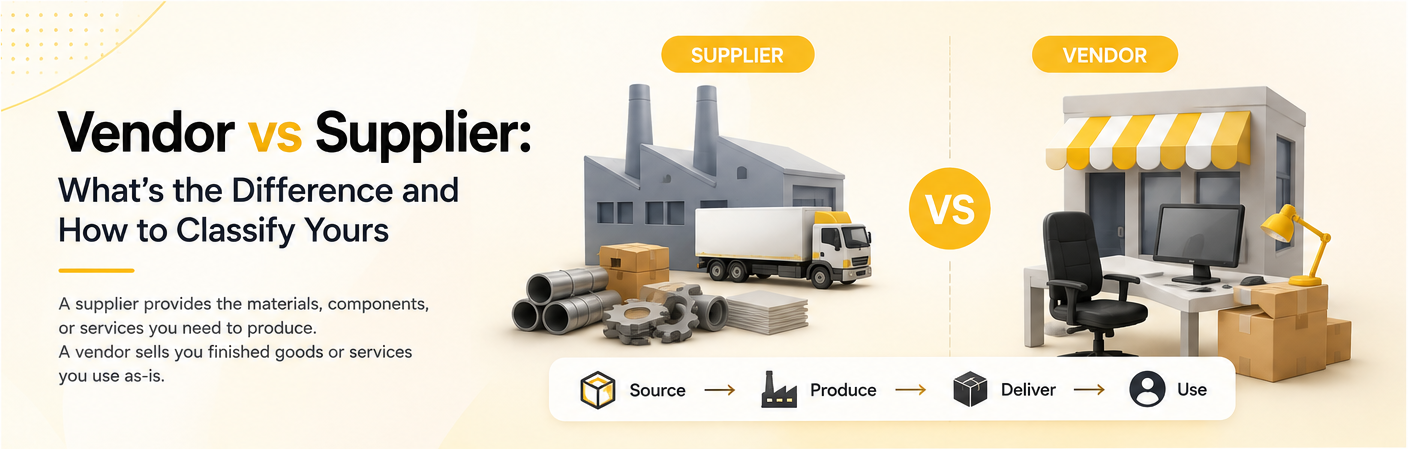
Vendor vs Supplier: What’s the Difference and How to Classify Yours