

eSourcing tools move RFQ, RFP, and vendor bidding online, centralizing supplier communication and comparing bids objectively on price, quality, delivery, and compliance. The top picks for 2026 are Zapro, SAP Ariba, Coupa, Ivalua, Jaggaer, Oracle Procurement Cloud, GEP SMART, Zycus, Basware, and Proactis.
eSourcing tools are digital platforms that move vendor selection online, centralizing RFQs, RFPs, and bid solicitation, and using automated scoring to compare supplier bids objectively on price, quality, delivery time, and compliance.
The strategic sourcing process that has been going for decades in a way in which procurement professionals had to manually write Request for Quotes (RFQs), send them to a long list of vendors, wait for responses, and then try to compare the prices across different spreadsheets has been changed radically. This manual and opaque process slows decision making, limits price comparison, and leads to huge audit gaps.
This old traditional method of 2026 is not acceptable anymore. The answer is to adopt e sourcing tools – a set of digital solutions aimed at turning sourcing from a disintegrated manual task into a smooth, data-driven process.
This tutorial will explain the worth of e sourcing platforms and also will review the top contenders to help you choose the ideal system for your procurement needs. If you’re weighing full procurement suites rather than sourcing-only tools, our roundup of the Best Procurement Software options for 2026 is worth a look.
Key Takeaways
– eSourcing tools centralize RFQ, RFP, and RFI management, replacing email-based vendor communication with one auditable record.
– Reverse auctions let suppliers competitively lower price in real time, useful for cost savings on commodity goods.
– Top picks for 2026: Zapro, SAP Ariba, Coupa, Ivalua, Jaggaer, Oracle Procurement Cloud, GEP SMART, Zycus, Basware, and Proactis.
– Choosing a tool by template category (IT, facilities, professional services) speeds RFI setup versus a generic starting template.
– Full audit trails of bids, communications, and approvals are what make eSourcing platforms compliance- and audit-ready.
What Are E Sourcing Tools in Procurement?
E sourcing tools in procurement imply digital platforms that shift the whole vendor selection process to the Internet.
Such devices are meant to improve the production, centralization, and automation of the communication between companies and suppliers, solicitation of bids, and evaluation of the proposals. They build a single place where:
- Digital Platforms Manage RFQs, RFPs, and Vendor Bidding: The platform handles all requests for proposals (RFPs), requests for information (RFIs), and quotes (RFQs), thus it is free from the email overload.
- Centralized Vendor Communication: All communication and Q&A sessions with vendors take place in the one safe spot thus ensuring everyone is given the same information.
- Data Driven Sourcing Decisions: The platform looks at the bids automatically comparing them side by side based on already set criteria such as price, quality, delivery time, and compliance thus making evaluation objective.
Key Challenges E Sourcing Platforms Solve
By converting and centralizing the process, e sourcing platforms conquer the most significant procurement obstacles:
- Vendor Discovery and Comparison: Tools provide easy and quick access to a reliable supplier database and use automated comparison matrices for sourcing managers to evaluate bids holistically.
- Pricing Transparency: Online bidding processes (usually through reverse auctions) make it possible for all vendors to follow the same rules thus ensuring fairness and transparency and producing unambiguous documentation of the best price offered.
- Sourcing Cycle Delays: The time saved by using automation in the stages of drafting, distributing, collecting, and comparing bids is very significant which in turn leads to both contract award and time to market getting accelerated.
- Compliance and Documentation: The digitized records of each step-from the first invitation through the last bid selection-are stored automatically, thus leaving behind an audit trail without any gaps.

Successful companies have realized that defining such a strategy and its business benefits not only supports effective operations but also minimizes downstream vendor management risks.
Types of E Sourcing Tools Used by Procurement Teams
The phrase e sourcing tools stands for several different features which might be present in a single integrated suite or as separate modules.
RFQ Tools
Basic apps for requesting standard price and quantity quotes, which are perfect for simple, transactional purchases of low complexity.
RFP & Tender Management Tools
Comprehensive systems intended for intricate, expensive purchases where qualitative factors (e.g., technical features, implementation plan) matter more than just the price.
Reverse Auction Platforms
Extremely competitive settings where vendors “fight” with each other by lowering their price in real-time during a set period. Good for achieving cost savings on commodity goods.
Supplier Evaluation Instruments
After the completion of the bidding process, these tools help in assessing vendor risk, compliance, financial health, and overall performance before signing a contract.
Once a supplier clears that evaluation and a contract is signed, ongoing oversight typically shifts to a dedicated AI Vendor Management platform that tracks performance, risk, and compliance for the life of the relationship.
Top 10 eSourcing Tools in Procurement
E-sourcing providers offer software to run RFIs, RFPs, RFQs and reverse auctions online. They let you compare supplier bids side by side and award contracts. Well-known e-sourcing providers include SAP Ariba, Coupa, Ivalua, JAGGAER, GEP SMART, Zycus, Oracle and Zapro. These providers differ in auction depth, supplier network size, ease of use and pricing.
The market of top strategic sourcing software is quite vibrant and filled with products that appeal to companies of different sizes and levels of complexity.
1. Zapro
A contemporary and combined platform that targets medium-market and growing businesses which require close integration between sourcing, vendor onboarding, and procure-to-pay (P2P). It features extremely configurable RFX and vendor management.
Teams that want to see this sourcing-to-P2P integration firsthand can explore Zapro AI directly to review current features, pricing, and demo options.
2. SAP Ariba
One of the market leaders widely known for its immense supplier network and full-cycle S2P (Source-to-Pay) suite, which is a perfect fit for big, global enterprises.
3. Coupa
A solution designed for the cloud and very much focused on user-friendliness and customer engagement, it offers a full Business Spend Management suite such as sourcing and expense management.
4. Ivalua
A flexible, modular platform very strong in spend analysis and customized sourcing workflows for business with complicated procurement requirements.
5. Jaggaer
Concentrates mainly on handling difficult spend categories, mostly in direct procurement and the higher education sector.
6. Oracle Procurement Cloud
The sourcing integration within Oracle Cloud ERP is perfect for current Oracle users who want a combined finance and procurement solution.
7. GEP SMART
A combined sourcing and procurement suite that is famous for its extensive analytics capabilities and managed services offering.
8. Zycus
Along with its eSourcing module, it offers robust AI-driven tools for spend analysis and contract lifecycle management.
9. Basware
Although it is primarily an AP automation and e-invoicing product, it provides purchasing and sourcing tools that are integrated for managing spend across the P2P cycle.
10. Proactis
Provides solutions that can be scaled for middle-market organizations and that concentrate on spend control and contract compliance, which is also integrated with their eSourcing feature.
Master the strategic sourcing process with ease.

Why Businesses Are Moving Toward Integrated Sourcing Software
The previous method made procurement staff move from one tool to another to perform a single task, which led to inefficiencies caused by changes at every transition point.
Disconnected sourcing and procurement work inefficiently because the data from the sourcing event (e.g., the final price from the bid) has to be manually entered into the ERP system to produce the contract and purchase orders.
The advantages of complete sourcing software are pretty obvious:
- Manual Tasks Are Reduced: The contract and vendor master record are automatically created from the approved bid, which removes data transfer errors and accelerates time to contract.
- Single Data Source: All spend data, from sourcing decisions to final payment, is kept in one place, thus offering unparalleled visibility into Total Cost of Ownership (TCO).
Learn more about procurement software.
How Modern Sourcing Software Is Evolving
Contemporary sourcing software solution vendors are not only providing simple bidding platforms but are creating integrated, smart systems that link the entire procurement lifecycle.
Modern solutions such as Zapro put a great emphasis on the integration of sourcing, procurement, and inventory processes thus enabling the teams to go from vendor selection to purchase execution without interruption. This connection is very important in the case of direct materials purchasing because the result of sourcing is the production planning and inventory management that depend on it. The program offers features not only for getting the best price but also for handling the most trustworthy and compliant supply chain partner.
What to Look for in Top Strategic Sourcing Software
Picking the proper sourcing software tools is only possible if you have a clear checklist that is mainly focused on worth and usability:
- Easy Vendor Comparison: The system should provide flexible and easy-to-configure scenario analysis tools that allow comparing bids on Total Cost of Ownership (including shipping, payment terms, and risk) and not just on unit price.
- Pricing Transparency: The software should keep track of all communication and bid changes thus giving a full, auditable history of the vendor chosen and the reasons behind it.
- Collaboration Across Teams: The platform ought to give access to and allow evaluation of the pieces by the stakeholders (e.g., Legal, Engineering, Finance) right within the system, thus getting rid of external email chains.
- Scalability: Is the system capable of dealing not only with your current RFQ volume but also with your future worldwide expansion and more complex categories?
Conclusion: E Sourcing Is Now a Procurement Standard
The period of manual, spreadsheet-based sourcing is a thing of the past. The implementation of e sourcing tools should not be considered as an optional step anymore, rather it is a fundamental prerequisite in order to achieve financial control, risk mitigation, and competitive advantage. By making a modern strategic sourcing tools investment, you empower your procurement team to negotiate better deals, ensure compliance, and secure supply chains that are reliable for the future.

Ready to Transform Your Procurement Process?
Request demos and transform your procurement
FAQ
1. How do eSourcing tools improve supplier comparison and selection?
They set up structured templates (RFI/RFP) for collecting standard data and then use automated scoring matrices. This makes the procurement teams to objectively compare qualitative factors (like compliance and technical fit) and quantitative factors (price, delivery) side by side.
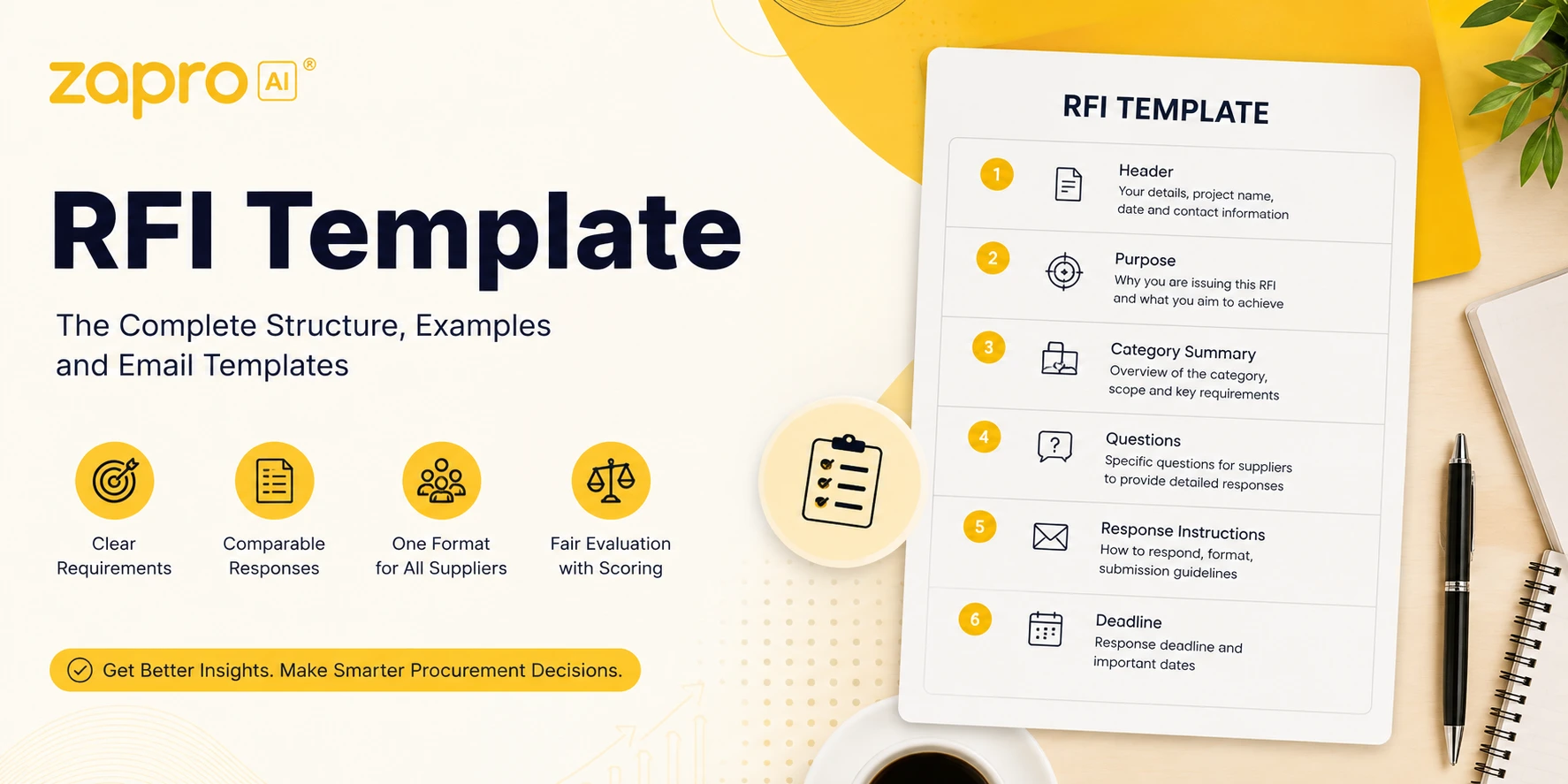
Most platforms ship with a generic starting point rather than a category-specific one, so it’s worth adapting the RFI stage separately. A purpose-built RFI template and examples by category — IT, facilities, professional services — saves the rework of stripping out irrelevant questions before the request goes out.
2. Are eSourcing tools suitable for indirect and service procurement?
Surely. Though e sourcing platforms are mainly thought of as direct materials, they are also the right choice for indirect spending (IT, marketing) and services (consulting, maintenance) as they help to formalize scoping and evaluation through detailed RFP templates.
3. Can eSourcing platforms support multi-vendor bidding and reverse auctions?
Yes, they can. Most advanced platforms are capable of managing both. Reverse auctions – the situation when suppliers competitively lower their price – is one of the most important features of many e sourcing tools in procurement to be used for achieving maximum cost savings on commodity goods.
4. How do eSourcing tools help ensure compliance and audit readiness?
They build a non-modifiable, centrally-located digital record for each and every action — every bid, every communication, and every approval — demonstrating the rationale behind the decision. This frees from the need for manual bookkeeping and meets strict regulatory audit requirements.
5. Which industries get the most benefits from strategic sourcing software?
Industries that are characterized by high spending, complex supply chains, or strict regulatory requirements are the ones that benefit the most from it such as manufacturing, retail, financial services, healthcare, and public sector organizations.
6. What is the best e-sourcing software for running RFx events?
E-sourcing software should let you build an event from a template, invite and manage suppliers, collect structured responses so bids are genuinely comparable, and score them against weighted criteria with an audit trail. Supplier-side usability matters too, because a difficult portal reduces response rates. What separates a good outcome from a good event is what happens afterwards: the awarded price needs to reach the people raising orders. Zapro’s strategic sourcing module is built for RFx, bidding and supplier selection, and sits on the same platform as vendor management, contracts and procurement, so the supplier you qualify, the agreement you sign and the orders placed against it stay connected rather than being re-keyed into separate systems.
Don’t miss our weekly updates
We’ll email you 1-3 times per week—and never share your information.
Ready for Smarter Vendor Management?
Our experts are ready to help you find the right solution for your business needs.

About the Author

Md. Kafil


About the Reviewer

Zapro is dedicated to helping businesses of all sizes make informed decisions. We adhere to strict editorial guidelines to ensure that our content meets and maintains our high standards.
Our editorial standards help keep every article accurate, useful, and trustworthy.